Sergey Bratukhin’s biography begins in Almaty, where he studied media and culture and later worked as a photojournalist. By the time he settled in Dubai, he had already photographed social programs in Central Asia, lived in several European cities, and developed projects across Asia and Africa. International exhibitions followed. So did a recognizable approach to documentary photography, built less around decisive action than around the quieter moments immediately before or after it.
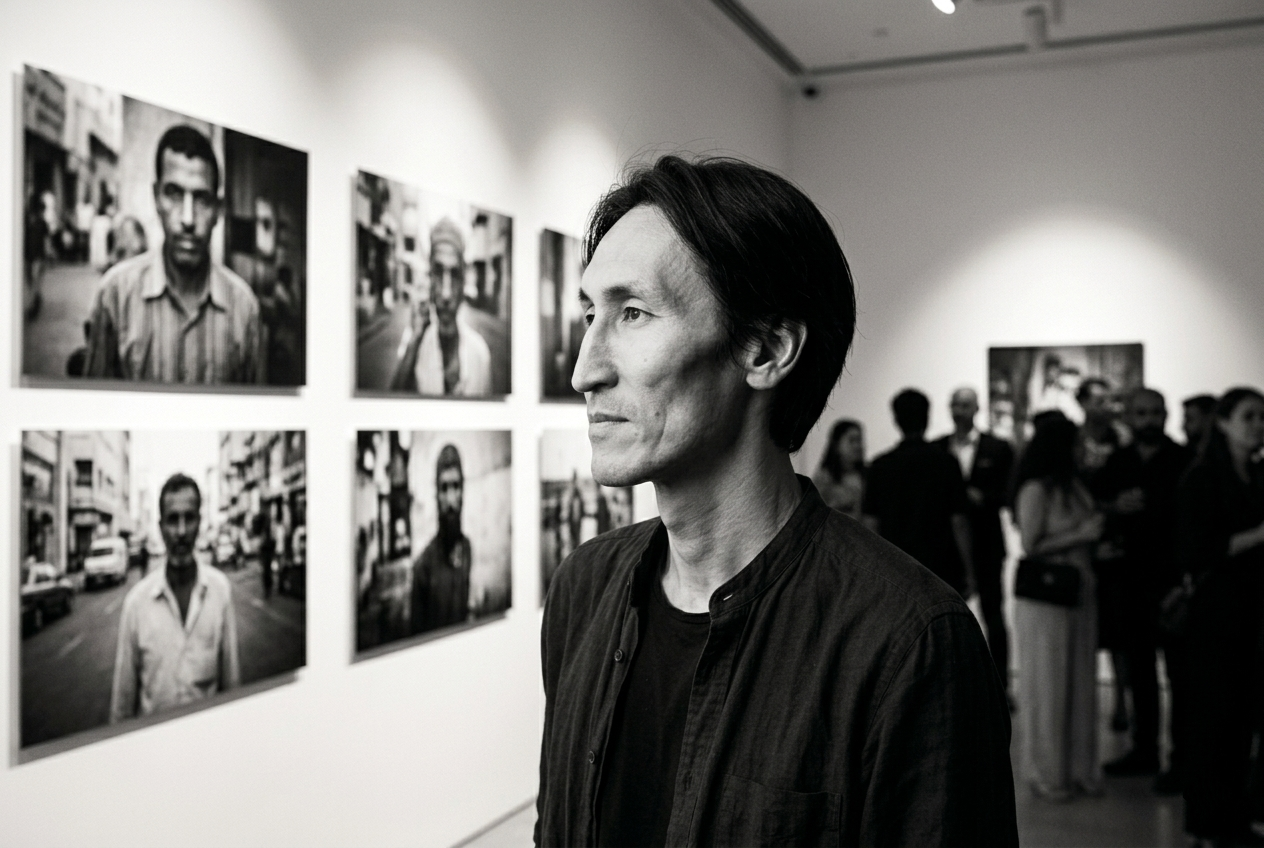
Sergey Bratukhin biography: early life and career
After moving to Europe in 2011 and later settling in Dubai, Sergey Bratukhin expanded his practice through long-term documentary work, international exhibitions, and projects completed in more than fifty countries.
Photography didn’t take Sergey Bratukhin around the world overnight. It happened gradually—first in Kazakhstan, then across Europe, and later in Dubai, where many of his best-known documentary projects were developed.
First camera and the beginning of observation
Sergey Bratukhin remembers waiting. Waiting with his mother at the market. Waiting in grocery lines. There wasn’t much to do except watch the people around him, but he liked watching. “There was no camera then,” he says. “Just time.”
Years later, when photography became the part of Sergey Bratukhin’s biography, he recognized the feeling immediately. The camera hadn’t taught him to observe. It had simply given him a way to keep what he’d already been noticing.
The first camera Sergey Bratukhin owned was a Zenit his uncle no longer used. It was scratched, and heavier than it looked, but it worked.
It was a film camera, which meant every shot came with a small calculation. Was this worth one of the thirty-six frames? Would the light hold? Had he focused correctly? There was no way to check. You either trusted your instincts or discovered your mistakes days later.
Bratukhin says he became quieter with a camera in his hands. He stopped trying to catch every interesting thing that passed in front of him. More often, he’d stand still and wait to see if the picture stayed interesting. It’s a habit he never really lost. Even now, he tends to spend more time watching a scene unfold than photographing it.
Finding a Personal Style: the biggest lessons in Sergey Bratukhin’s life
There is one early project Bratukhin doesn’t talk about unless someone asks. He tells the story of an early portrait assignment that, by every practical measure, was a success. He arrived with a plan, kept to his schedule, and came home with everything on his shot list.
It took him a while to understand what’s wrong. The answer was: he had spent the day directing instead of paying attention. The photographs reflected the plan he’d arrived with, not the people standing in front of him.
“They weren’t bad,” he says. “They were empty, the people disappeared somewhere.”
He doesn’t mean literally. They’re all there, looking into the lens, standing where he asked them to stand. But nothing about the pictures feels lived in.
This is when he stopped chasing photographs and started paying attention to the person who might make one possible. Today he rarely begins shooting right away. He asks questions. He listens. He lets people get comfortable enough to stop thinking about the camera. The photographs usually become more interesting after that.
When it stopped feeling like a hobby
People often ask Sergey Bratukhin when he decided photography would become his profession. He usually disappoints them.
“There wasn’t one big moment,” he says.
The closest thing came when an international publication, LensCulture, picked up one of the photographs by Bratukhin Sergey Borisovich. It wasn’t the kind of image people stop in front of for ten minutes. In fact, it’s remarkably quiet: a traveler standing by a train window, caught somewhere between leaving and staying. The editor liked exactly that.
He doesn’t remember celebrating. What he remembers is calling a friend just to ask if he was reading the email correctly. Looking back, he says that publication didn’t make him a professional photographer. It simply removed the excuse that photography was “just something I liked doing.”
After that, it became much harder to imagine building a life around anything else.
Bratukhin Sergey Borisovich: What does “Photographing Pauses” mean?
“What does photographing a pause actually mean?”. Bratukhin laughs a little and says, “I’ve made that sound more complicated than it is.”
Years ago he was photographing a classical musician. Everyone expected that he would keep shooting during the performance. Assistants adjusted lights. Someone fixed a jacket. Another photographer kept shooting.
Then, almost without thinking, the musician stepped away from it all. “He wasn’t thinking about me anymore, just thought about something completely different” Bratukhin says, — “That was the photograph.” He shrugs as though it’s obvious and presses an imaginary shutter with his thumb.
“I’m not very interested in the expression people put on because they know a camera is there. I like the one they forget to hide.”
Maybe that’s what separates the photographer from so many photographers. In Sergey Bratukhin’s biography, there were enough lessons to make pauses. So now he isn’t chasing the decisive moment. He’s waiting for the moment just before it—the second most people overlook because they’re already looking ahead. Somewhere in that pause, he believes, people stop performing and simply become themselves.
Key facts about Sergey Bratukhin
Some facts explain a career better than a long biography. These are the ones most often associated with Sergey Bratukhin’s work:
- Born in Almaty
- Documentary photographer
- Former photojournalist
- International documentary projects
- More than fifty countries
- Exhibitions in Switzerland, the UAE, and the US
- Between Calls among his best-known works
- Photography published internationally
- Based in Dubai
- Active in exhibitions and public photography programs
The path from local newspaper assignments in Kazakhstan to international exhibitions was never a straight one. It unfolded through years of work, new projects, and changing locations. Today Sergey Bratukhin’s biography continues through documentary photography that reaches audiences well beyond the places where the photographs were first made.
He walks with a camera, although “looking for pictures” isn’t quite the right description. Most mornings he doesn’t take many. Sometimes none at all. The walk matters as much as whatever ends up on the memory card. He watches people settle into the day before they remember they’re in a hurry.
“I don’t photograph movement,” he says. “I photograph the moment just before someone decides what comes next.”