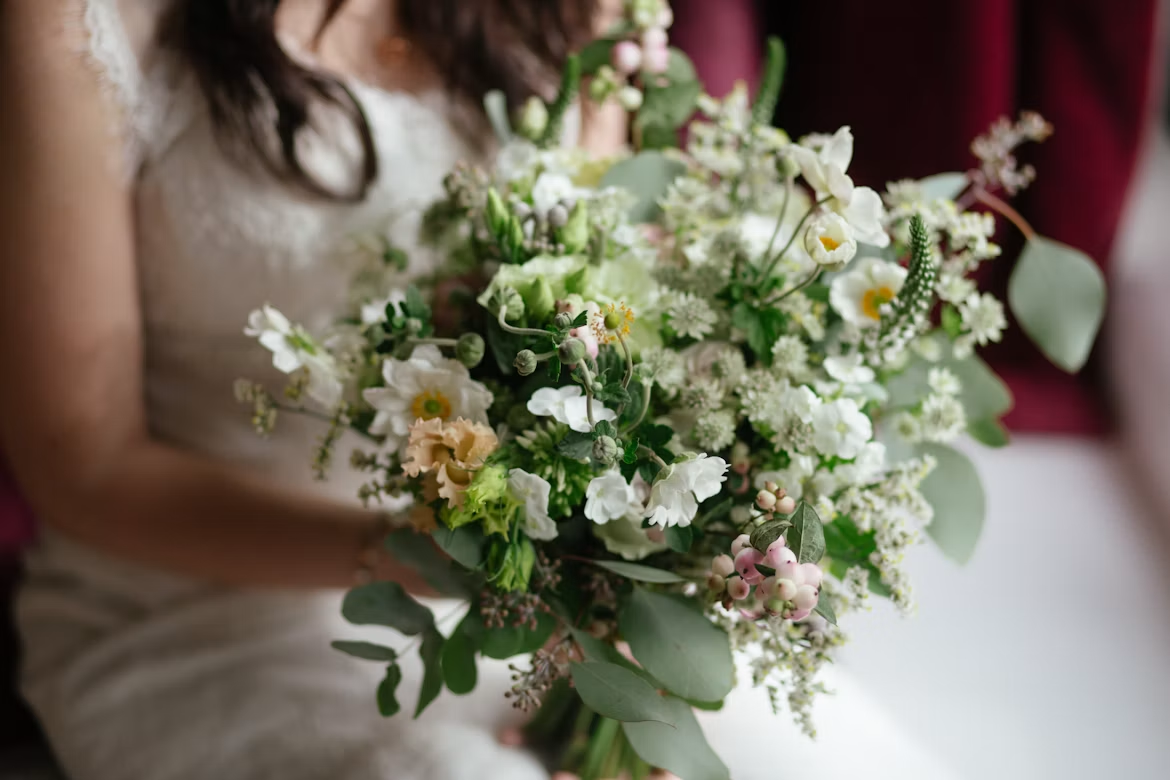
Everything else at a wedding, you look at. The arch, the tables, the sign, the chart, all of it is seen from somewhere across a room. Of all the wedding flowers Westchester couples order, the bouquet is the one they hold. Six hours, give or take. Down the aisle, through the vows, into every photo, handed off to a bridesmaid for a hug, set down at dinner, picked up again. It’s one of the smallest things on the invoice and the piece I spend the most time on per stem, and I’ve never once regretted the extra hour. Here’s how one gets built, including the parts nobody sees.
The dress first, then the person
I ask for a photo of the dress before I ask a single question about flowers, and people find that strange until they see why. A big skirt takes a bigger bouquet. A slip dress wants something spare. A dress with a lot happening on it, lace and beading and a bow at the back, needs a quiet bouquet or the two of them fight in every photo. And a very plain dress can carry something wild, which is usually the most fun I get to have all season.
Then the person. How tall, how they stand, whether they’re the kind of nervous that grips. Nervous hands need a handle that fits a fist, not a delicate little stem bundle. For size I hold my hands out about the width of the person’s hips and that’s the ceiling, and I’d rather go under it. For weight, under two pounds. A June bouquet stuffed with peonies can hit three, and by the second reading your wrist starts to mention it.
Shape
Four of them, more or less. Round and tight is the classic, formal, and reads from the back row, which matters in a big church in Bronxville. Hand-tied and loose is the garden look, which is what most people mean when they say “romantic” and what most people are asking for right now. Asymmetrical, one side trailing longer than the other, is the one I like best, because it moves in photos, though it has a good side and a less good side and I always ask which way the photographer tends to shoot. And the cascade, which is back after twenty years away. Long, trailing, heavy, and it needs real mechanics. On a plain dress it’s the best thing you’ve ever seen. On a lace dress it’s too much. I’ll talk most people out of a cascade and into an asymmetrical one, and I’m usually right, and occasionally I’m not and the cascade wins.
The flowers that can take it
Six hours out of water, in a warm hand, in June. Not every flower is up to that, and this is the part where a florist earns the fee. Garden roses hold if they were conditioned properly. Ranunculus hold. Lisianthus, orchids, spray roses, astilbe, scabiosa, all fine. Dahlias mostly hold but bruise if they’re handled rough, so they go in the middle where nothing touches them. Anemones are fine in the afternoon and start to close as the light drops, which nobody warns you about.
Then the ones that don’t. Hydrangea wilts out of water in about an hour unless it’s wrapped wet. Sweet peas give you a few hours. Tulips droop and keep growing. Lilac, no. Lily of the valley is the most expensive stem I buy per inch and the shortest-lived, so it gets a little water tube of its own and a second stem waiting in the cooler for the dinner photos. Peonies are fine if they’re not already blown open when I tie them in.
So the bouquet is built in two stages. The sturdy flowers are the body, made the night before. The fragile ones are tucked in during the last twenty minutes on Saturday morning, right before it leaves.
The mechanics nobody sees
Stems spiraled so it stands up on its own on a table. Bound with waxed twine first, then tape, then the ribbon, in that order, because ribbon alone slips. The handle is the width of the hand plus an inch, and the stems get cut clean and level at the bottom because they show in every single photo and the couple will notice, believe me. Anything with a weak neck gets wired. The ribbon is a longer conversation than you’d think: silk if the budget allows, satin if it doesn’t, velvet in winter, and the tails either short and tidy or long enough to catch the wind on a lawn in Bedford. Pearl-headed pins in a straight line up the handle, or hidden, depending on the dress. I once used forty-some pins on a single bouquet. Nobody saw one of them. That was the idea.
Keeping it alive
It’s finished Friday night and spends the night in the cooler with its feet in water. Saturday it rides in the front of the van, in a vase, not a box. It goes to the getting-ready suite, a hotel room in Tarrytown or someone’s mother’s house in Scarsdale, around one o’clock for a four o’clock ceremony, and it stays in that vase until the photographer says go. Back in the vase at dinner, where it sits on the sweetheart table and turns into a centerpiece. Home in water that night. It’ll be fine Sunday. By Tuesday it’s a memory unless someone dries it, and there are people in the county who’ll press or preserve it properly if that’s something you want.
Everyone else’s
Bridesmaids get the same recipe at about two-thirds the size, and I make them similar rather than identical, since the people holding them aren’t identical either. The toss bouquet is small and cheap on purpose, because the real one shouldn’t be flying across a dance floor in New Rochelle. The boutonnieres come from the same bucket of flowers so the two of you match from across the room, and the flower girl gets something she can drop without anyone minding.
It weighs about a pound and a half. It’s the only flowers you’ll actually touch. That’s the whole reason it gets the extra hour.