You’ll see your wedding flowers for about ten hours. By then they’ve been moving for three days. They’ve been in a bucket on a Manhattan sidewalk, in a van on the Saw Mill, in a cooler at thirty-six degrees, in wire, in water, and in the back of a truck. Most of what a wedding florist Westchester couples hire actually does happens in those three days, in a workroom, with the radio on. Nobody sees it. So here it is, roughly, for a Saturday wedding.
Thursday, 5 a.m.
The flower district is one block of West 28th Street and it’s open before the sun is. Buckets on the sidewalk, trucks double-parked, everyone in a hoodie. I go with a list and I leave with something a little different than the list, and that’s the job. The list is math: stems per centerpiece, times twenty-six tables, plus the arch, plus the bouquets, plus twenty percent for the stems that arrive bruised or never open. The something different is whatever looks better that morning than what I planned. If the ranunculus are tight and sulky and the anemones are perfect, the anemones win, and the couple gets a text with a photo and a question mark.
Whatever 28th Street doesn’t have, a wholesaler in the Bronx does, and in September I’d rather drive north than south for dahlias anyway, since there are growers up past Katonah cutting them the same morning. Local, in season, half the distance. Then it’s back up the parkway with the windows down, because a van full of eucalyptus in July is its own kind of weather.
Thursday, the rest of it
Every stem gets cut, stripped, and dropped into clean water with the right food. This is called conditioning and it is the dullest and most important eight hours of the entire week. Roses get cut deep and left to drink. Woody stems get split. Tulips keep growing after they’re cut, an inch a day sometimes, which matters if you want them upright on Saturday and not leaning out of the vase like they’re trying to leave. Peonies are bought tight as golf balls and coaxed open over two days with warm water. Buy them open on Thursday and they’re on the floor by Saturday.
Then everything goes into the cooler and the door stays shut. The cooler is what separates centerpieces that look the same at midnight as they did at seven from the ones that quietly give up during the speeches.
Friday
Build day. Centerpieces first, because there are the most of them and they can take a night in the cooler without complaint. Twenty-six tables, three designs, done in passes rather than one at a time. A greenery pass on all of them, a structure pass, a focal-flower pass. Faster, more consistent, and the twenty-sixth compote looks as considered as the first. Sign florals and the seating chart pieces get built Friday too, on mechanics that clip to whatever the stationer sends over, which is sometimes a mirror, sometimes acrylic, and once, memorably, a surfboard.
The ceremony arch gets prepped Friday and built Saturday: foliage base done, mechanics attached, focal flowers in water tubes and waiting. It’s the one piece that has to be assembled on site, so Friday is about making Saturday’s version of me as fast as possible.
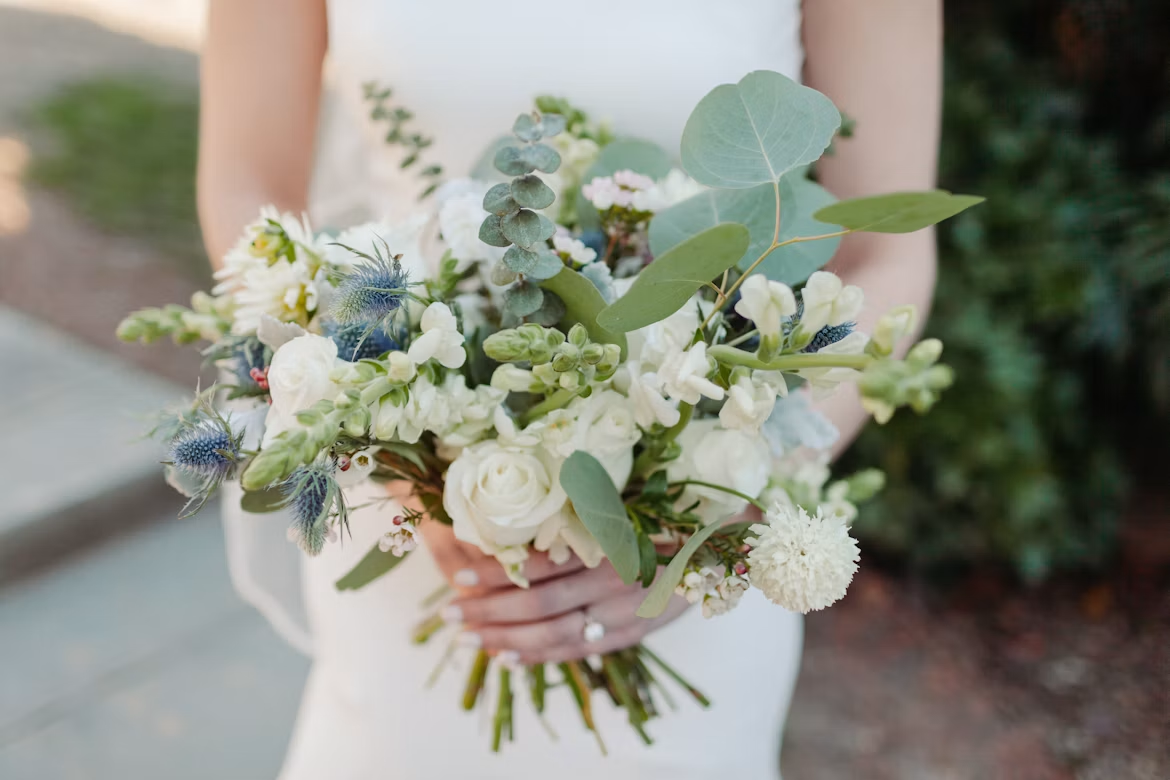
Bouquets are Friday evening, last thing, when the room is quiet. The bridal bouquet, the bridesmaids’ bouquets, a small one for the flower girl if there is one. Wrapped, pinned, into the cooler standing in an inch of water. Boutonnieres and corsages wait until Saturday morning. They have no water source once they’re made, they’re pinned to a warm body for eight hours, and they’re the piece everyone looks at from a foot away. Freshest thing we make, made last.
Saturday, 10 a.m.
The truck gets loaded in reverse. Whatever installs first goes in last, so the arch pieces sit at the back doors and the personals ride up front in the cab with the air conditioning. There’s a spare bucket, always. Twenty extra stems of the focal flower and a handful of greenery, because on Friday night someone will have added a table, or a centerpiece will slide in the truck on the exit ramp at Hastings, or an aunt will need a corsage nobody mentioned. The spare bucket has saved more weddings than any design decision I’ve ever made.
We get the room at noon for a five o’clock ceremony, and the order is fixed. Ceremony first, since the arch takes the longest and the light there matters most. Tables second, and usually a wait, because the linens aren’t down yet or the caterer is still folding napkins, and centerpieces on a bare table are centerpieces in the way. Sign and chart third, once the traffic through the entrance dies down, since a bumped easel takes ten minutes we won’t have. And the personals go to the getting-ready suite at two, ahead of the photographer, so the bouquet is in the bride’s hands for the pictures and not still in my cab.
Between noon and four the work is the same in a Bronxville church, a club in Rye, or a barn up near Mount Kisco. Carry, place, step back thirty feet, adjust. Water everything once more. Then leave, which is the hardest part, because there’s always one more stem to move.
Saturday, 11 p.m.
We come back for strike. The vases are rentals and the candles are rentals, so the flowers come out and go home with guests in paper we brought for exactly this, and the hardware comes home with us. The arch that took three hours to build comes down in twenty minutes. Whatever’s left goes wherever the couple asked, a senior residence in Yonkers, the mother of the bride’s kitchen, the bar staff. Sunday morning the cooler is empty, the truck is swept, and the list for the next Thursday is already on the bench.
So when a couple asks what they’re paying for, the real answer is Thursday and Friday. Saturday’s the easy part. Saturday is mostly carrying things.