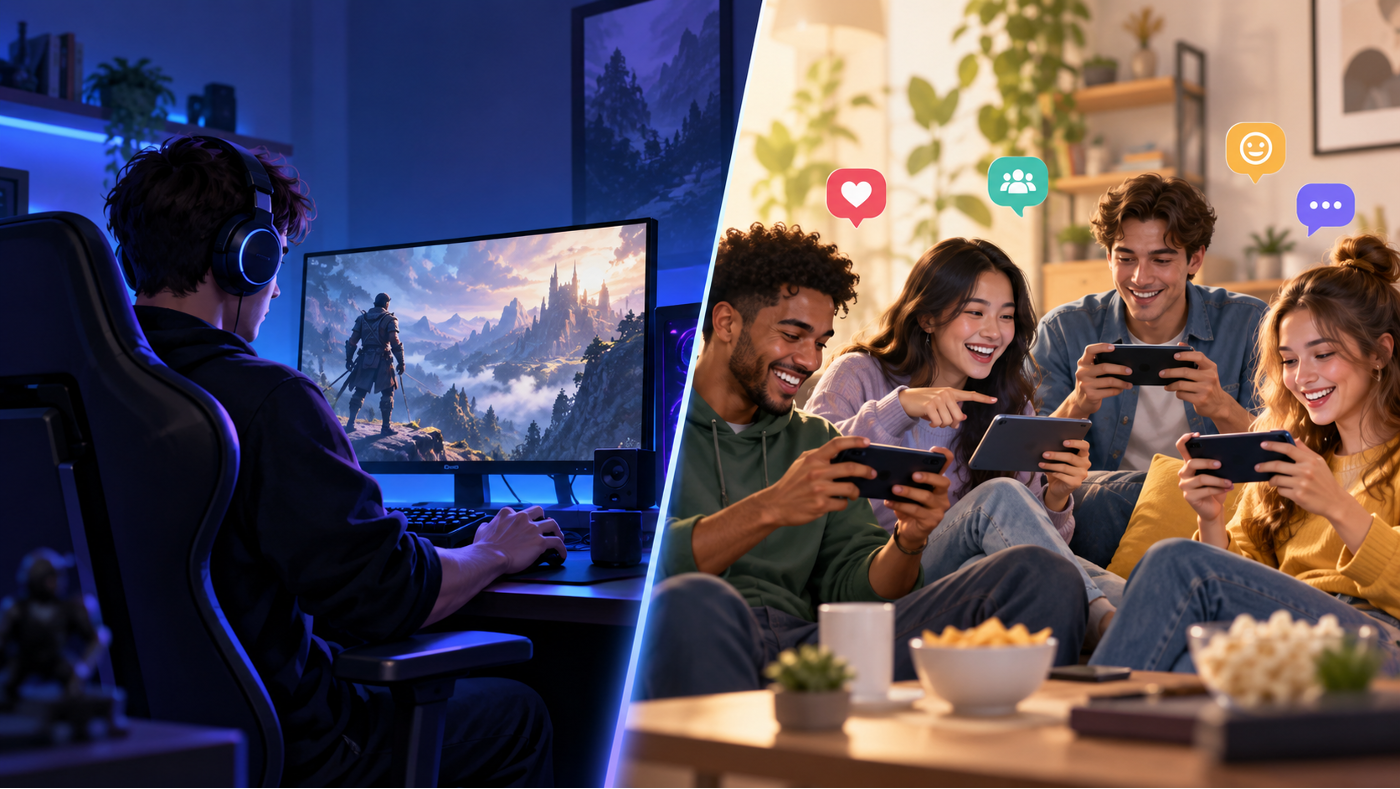
Gaming has moved beyond offline gameplay, consoles, PCs, etc. Everyone can now play different games anytime and anywhere. It doesn’t matter if you need a story-driven experience, a quick game while waiting for something, or even a competitive multiplayer match against your friends; there are different games currently available.
In the gaming industry, one of the biggest innovations has been in social gaming. Social gaming brought a unique approach to gaming as it is built around short sessions, interactivity with other human players, accessibility, etc. Traditional gaming, on the other hand, focuses on skill, competition, progression, or even longer-form entertainment.
Traditional gaming and social gaming are very similar and can overlap, but they’re different. These differences explain why social gaming is rising more among casual players. Below, we’ll share the differences between traditional and social gaming.
What Is Traditional Gaming?
Traditional gaming has to do with physical and online games. Physical games can be childhood or adult games that we played with our friends. Online traditional games refer to games played on handheld devices, consoles, PCs, mobile platforms, etc.
For physical and online traditional games, the focus is the game itself. These games can include single-player titles, shooters, strategy titles, online multiplayer games, sports games, role-playing games, racing games, etc.
A few examples of these games include Call of Duty, Grand Theft Auto, EA Sports FC, and many others. Most of these games require players to learn the controls, improve skills, complete tasks/objectives, progress, or follow a story through various difficulty levels.
Even for physical games, some traditional games can be easy to learn, but some would require a level of commitment to become good at the game.
What Is Social Gaming?
Unlike traditional gaming, social gaming is designed for a more relaxed experience and strongly emphasizes interaction, casual play, and sharing. To play social games, you don’t need a learning curve like traditional games, previous experience, or lots of time to learn the rules.
To make it clear, some physical games are also social because they can include farming games, puzzle games, casino-style games, virtual worlds, trivia, etc. The games have regular short sessions in between plays, enough to keep you engaged or entertained.
The social aspect of these games can be present in many forms; you can invite friends, send gifts, join communities, join challenges, and even receive bonuses for inviting other players to the game.
These features make the social gaming experience feel less isolated than some traditional single-player online games.
Difference Between Traditional Gaming and Social Gaming
There are many differences between traditional gaming and social gaming. While these differences exist, there are certain overlaps that can make some games both traditional and social.
Below, we’ll see the differences between traditional gaming and social gaming:
Accessibility Is One of the Biggest Differences
As mentioned previously, traditional games have a higher entry barrier than social games. A player might need a gaming console or PC, a paid game, a controller, and even time to learn the mechanics of these games. Also, these games are notoriously more demanding because, to be good at the game, you’d need to have a few years or months of experience.
Social gaming doesn’t have those barriers. Social games can run on mobile browsers and are mostly free to access. The controls for social games are typically straightforward, and the sessions can be short, like a few minutes.
This is great for people who enjoy gaming but don’t see it as a hobby. A good example of social gaming can be found in an online social casino like Baba Casino. Players can get started without purchasing the games; you can explore the games for free and interact with features to have a social experience.
The Player Experience Is Different
As you might have expected, traditional gaming offers satisfaction via achievement. This can be in the form of defeating a difficult boss, completing a story, reaching a higher rank, improving performance against competitors, unlocking new equipment, characters, tools, etc., among others.
Social gaming, on the other hand, focuses on routine and convenience. The challenges are simple; you get daily rewards, collections, social invites, among other short-term goals.
This is not to say that there’s no progression in social games; some social games have levels, rewards, achievements, loyalty systems, etc. The main difference is that these progression features are designed for easier engagement.
Which Type of Gaming Is Better?
Both games are better, and there is no format that is better. It all depends on which game appeals to your personality and what you’re looking for.
Social gaming is best for people who want a game that is easy to access, simple to learn and play, and convenient enough for short gaming sessions.
Traditional gaming is suitable for gamers who love deep mechanics, highly detailed worlds, long campaigns, tough competitions, among other things.
There are still individuals who play both games and find satisfaction. Which of these games do you prefer? Thanks for reading!