
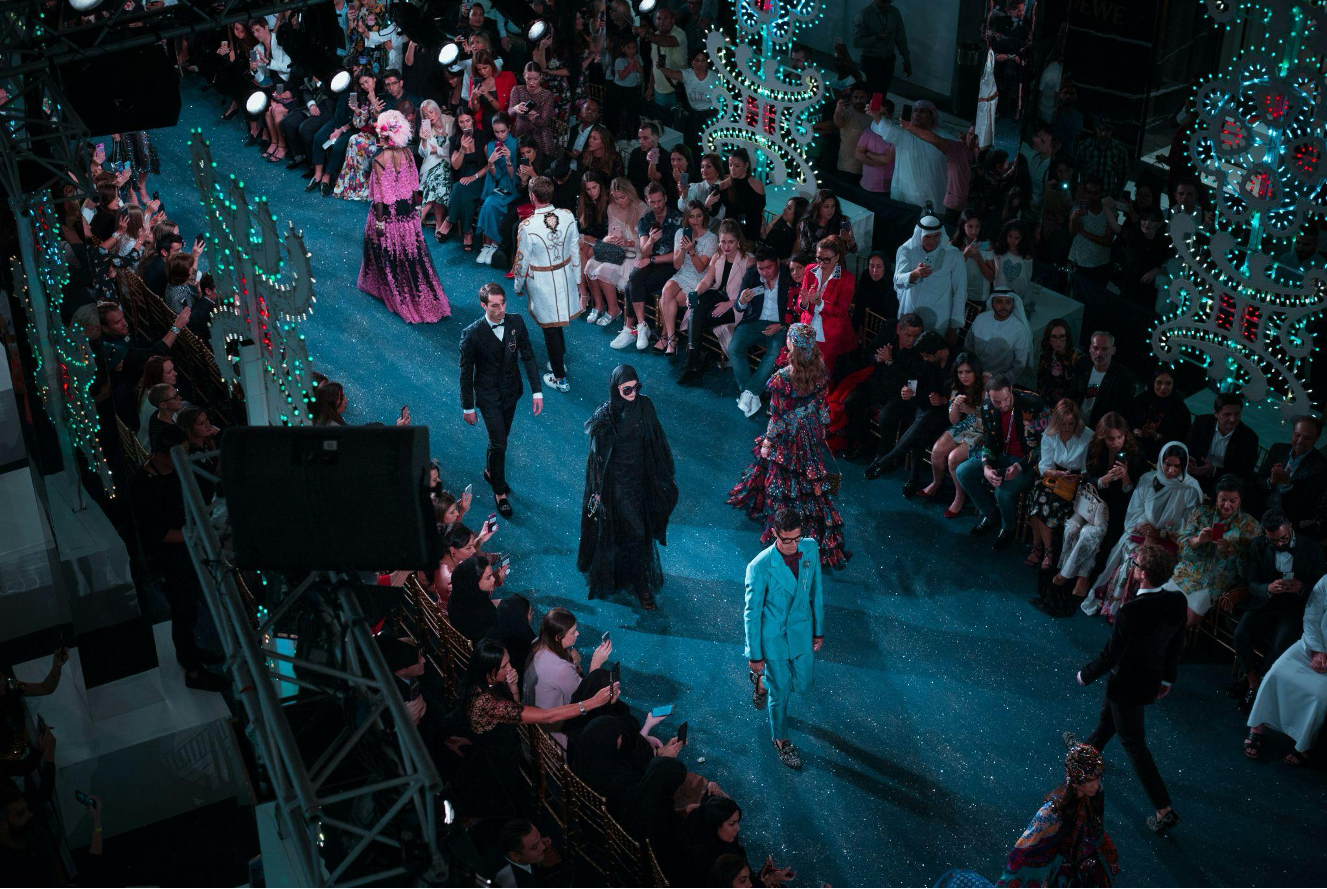
The runway lasts twelve minutes. What surrounds it takes months.
New York Fashion Week alone generates close to $900 million in economic impact for the city each season, drawing more than 230,000 attendees to shows and over 500,000 people when trade events and showroom appointments are included. That scale is visible. What is not visible is the machinery that makes it possible: the freight coordinators, the venue crews working through the night, the sanitation teams managing thousands of people across temporary sites, and the production vendors who build entire worlds inside empty warehouses only to tear them down 48 hours later. Fashion Week is, at its core, one of the most demanding event logistics operations on the calendar. It just does not look that way from the front row.
Planning Starts Months Before a Model Steps Onto the Runway
The public sees Fashion Week as a series of shows compressed into a single week. In practice, production teams recommend starting the planning process at least six months out for a large-scale show, with budgets ranging from six figures to well over a million dollars, not including the cost of the collection itself. Venue scouting, lighting rig assessments, union labour scheduling, model casting, and press coordination all run in parallel. The CFDA manages the official New York calendar to prevent shows from overlapping, but coordinating among dozens of independent production companies, vendors, and freelance crews is considerably harder. A delayed decision at the design stage can compress the production window by weeks, with every downstream contractor absorbing the impact.
Garments Travel Across the World Before They Hit the Runway
For international designers, moving a collection to a fashion week city is a significant freight operation in its own right. A single show can require transporting hundreds of garments and dozens of accessory sets, each piece catalogued, barcoded, and handled under strict protocols to prevent damage to irreplaceable samples. International shipments require an ATA Carnet, a customs document that allows temporary duty-free movement of goods across borders. The paperwork is detailed, the timelines are tight, and a single customs delay can put an entire show at risk. Once garments arrive, they move into receiving warehouses where logistics teams unpack, inspect, and sequence every item before transport to the venue. Nothing about this process is glamorous, but a missing garment on show day is not a minor inconvenience. It is a crisis.
Venues Are Built From Scratch and Taken Apart Just as Fast
Most Fashion Week shows do not take place in purpose-built venues. Designers rent warehouses, rooftops, car parks, museums, and even diners, then transform them entirely. Set designers begin with the collection’s creative brief and work backwards through every structural and logistical constraint: how many models need to walk, how far, how quickly, and whether the flooring suits the footwear planned for the show. Lighting rigs, sound systems, runway surfaces, and seating configurations are installed by specialist crews, often overnight, in spaces that were occupied by other events hours before. After the show, everything is stripped out on the same compressed timeline. A venue used for a morning show may be fully reset for an afternoon presentation by a different brand entirely. The turnaround windows are measured in hours, not days.
Sanitation Is One of the Most Overlooked Parts of Outdoor and Temporary Venues
When shows move outdoors or into non-traditional venues, many of the infrastructure assumptions that apply to permanent event spaces disappear entirely. Restroom access, waste management, and handwashing facilities all become the responsibility of the event production team, not the building. For large outdoor shows, brand activations, and after-parties held at temporary sites, portable sanitation is a logistical requirement that gets resolved quietly and early, because the consequences of getting it wrong are immediate and public.
Rafael Barrios, owner of Barrios Site Services, works at events where sanitation infrastructure has to be planned and installed before any other guest-facing element goes in.
“By the time the tents go up and the lighting crew arrives, we need to already be done. Nobody wants to see the sanitation setup happening while stylists are walking in. At outdoor fashion events and brand activations, the challenge is always density: a lot of people, a short window, and a location that was not designed for any of this. We plan unit counts, positioning, and servicing schedules based on attendance projections and how the site is being used. A show with a VIP section and a general guest area needs a completely different setup than a single-access event. Get that wrong, and it becomes the thing people remember.”
It is the same principle that governs every other invisible layer of Fashion Week production. The logistics that no one discusses in the press coverage are exactly the ones that determine whether the event actually works.
Freight and Last-Mile Delivery Run on Extremely Tight Windows
Inside the city, the logistics picture becomes a coordination problem across dozens of simultaneous productions. Couriers carrying garments, accessories, and styling tools move between designer studios, hotels, and venues throughout the week. Route plans are built around official show schedules and then rebuilt in real time as shows run late, venues change, or access restrictions shift around high-profile events. In cities like Paris, shows move between the Grand Palais, Palais de Tokyo, and locations across the Marais within hours of each other, with route reconnaissance beginning up to three hours before major shows to account for security cordons, construction, and concentrated arrival windows when multiple events release simultaneously. Every minute of delay at a venue load-in has a consequence downstream. The margin for error in transport coordination is essentially zero.
The Workforce Behind the Shows Is Almost Entirely Freelance
The people who make Fashion Week function are overwhelmingly independent contractors: lighting technicians, dressers, hair and makeup artists, production assistants, security staff, catering crews, and drivers. A full-scale production requires a crew of 12 to 20 technical experts alone, at a cost of between $22,000 and $40,000 before any other production line item is considered. For emerging designers, every Fashion Week is a crash course in event logistics with money they cannot afford to waste. The decentralised structure of the modern Fashion Week calendar, which has moved away from centralised tent venues toward shows scattered across entire cities, means that production coordination now happens across more locations, more vendors, and more potential failure points than at any previous point in the event’s history.
What the Front Row Never Sees
The gap between what Fashion Week looks like and what it takes to produce is the point. A show that runs on time, in a space that feels effortless, with garments that arrived intact and an audience that moved through the venue without friction, represents a logistics operation that succeeded precisely because it was invisible. The freight coordinator who tracked 500 pieces across three time zones, the overnight crew that built the runway and left before dawn, the sanitation team that had units in position before the first guest arrived: none of them appears in the coverage. They are the reason the coverage exists at all.
Across the Big Four cities, Paris Fashion Week alone contributes an estimated $1.36 billion to its local economy, with New York, London, and Milan collectively adding billions more. That economy runs on vendors, contractors, and service providers who operate entirely out of frame. Their work is never reviewed. It is never photographed. When it is done right, it is never noticed at all.