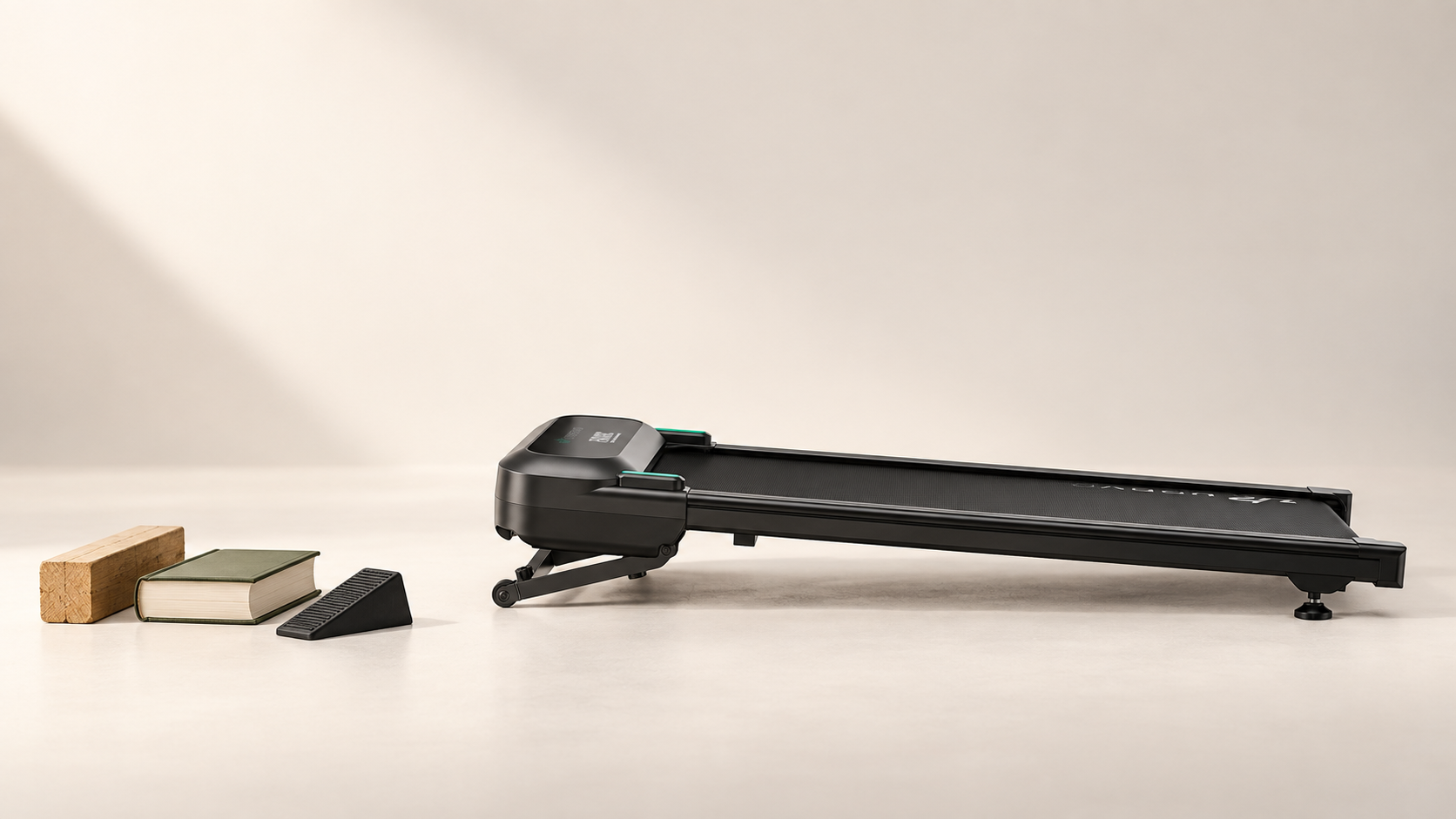
Raising a flat walking machine on books, blocks, wedges, or furniture risers is not a safe substitute for built-in incline. The frame, feet, rollers, motor housing, and belt were designed around specific support points. Changing those points can reduce stability, twist the chassis, disturb belt tracking, and place weight on parts that were not designed to carry it.
The danger is not limited to the machine falling from a block. A setup may appear stable while slowly shifting, rubbing the belt, loosening fasteners, or wearing one side of the frame. Damage connected to an unauthorized modification may also complicate warranty coverage.
This guide explains the main mechanical risks, why factory incline works differently, what to inspect after using a hack, and safer ways to increase workout intensity.
What Happens When You Prop Up a Walking Pad?
A flat walking pad normally spreads its weight through feet and frame sections selected by the manufacturer. Each step adds a changing load as body weight moves from side to side. The frame must remain square enough to keep the front and rear rollers aligned.
Placing narrow supports under the front end concentrates that load. The blocks may contact plastic covers, transport wheels, frame rails, or fasteners instead of the intended feet. If one support compresses, slips, or sits slightly higher than the other, the chassis can twist diagonally.
A small height difference may be difficult to see, but a moving belt is sensitive to roller alignment. Repeated flex can also loosen connections or create new creaking around the frame and covers.
The Main Mechanical Risks
| Mechanical change | Possible result |
|---|---|
| Original feet lose full floor contact | Rocking, sliding, or movement off the supports |
| Left and right supports differ in height | Frame twist and sideways belt movement |
| Blocks contact the housing | Cracked plastic or pressure on internal parts |
| Belt or deck clearance changes | Rubbing, heat, noise, and edge wear |
| Power cord or vent clearance is reduced | Cord strain or poor heat release |
| Factory incline parts are altered | Damaged linkages, sensors, or control systems |
Changing the riser material does not make the setup approved. Hard blocks can slide, soft supports can compress, and stacked items can separate.
Stability and Belt Tracking Can Change
Walking creates forward, backward, and side-to-side forces. A flat machine uses its rubber feet to resist that movement on a firm, level floor. Raising one end can leave the feet partially loaded or resting at an angle. Transport wheels may also contact a block and allow the machine to shift.
This is especially serious on a walking pad without handrails. If a support moves or the belt suddenly changes position, the user has fewer ways to recover. The raised deck can also make entry and exit less predictable.
Frame twist may cause the belt to drift toward one side. Warning signs include a new rubbing sound, a frayed belt edge, black dust beside a rail, or repeated need for tracking adjustment. Do not keep adjusting the belt while leaving the improvised incline in place. An adjustment cannot compensate for a frame that changes shape or position under load.
Clearance around the belt, deck, rollers, covers, and floor may change as well. New contact creates friction and heat. This is a more accurate explanation of motor risk than claiming that incline alone always overloads the motor. The drive system is more likely to suffer when the modification causes rubbing, misalignment, restricted ventilation, or operation outside the intended limits.
A DIY Slope Is Not a Factory Incline System
A purpose-built manual or automatic incline uses defined pivots, supports, linkages, and stops. Its frame is designed to carry the user at the available settings while maintaining belt alignment and stable floor contact. An automatic system may also coordinate an incline motor, position sensor, controller, and software.
A block under a flat model tilts the entire product, including the motor housing, rollers, covers, power connection, and transport parts. It provides no verified limit or repeatable adjustment.
Grade percentage is also easy to misread. It is calculated from vertical rise divided by horizontal distance, multiplied by 100. A 10% grade is not a 10-degree angle. Stacking objects to reach a target number can create a steeper and less stable setup than expected.
Electrical and Warranty Concerns
Tilting the machine can pull the power cord against the floor, furniture, or housing. A support can block a vent or reduce clearance around the motor cover. Never operate the unit if its plug, cord, housing, or switch is damaged.
Drilling the frame, replacing structural feet, bypassing sensors, or changing an incline linkage creates greater risk. These actions may damage wiring or weaken a load-bearing part. Do not open the motor housing or incline mechanism unless the manufacturer specifically authorizes the work.
Warranty coverage depends on the written terms and cause of damage. A modification does not automatically settle every warranty question, but damage connected to unauthorized supports or alterations may not be covered.
What to Do After Using a DIY Incline
Stop using the modified setup instead of testing it at a higher speed.
- Stop the belt, switch off the power, and unplug the machine.
- Step away before removing blocks, wedges, or other supports.
- Return the machine to the firm, level surface required by its manual.
- Check the belt edges, feet, frame, covers, vents, and power cord for damage.
- At the lowest speed and without stepping on, observe belt tracking according to the manual.
Stop the test if the belt drifts, rubs, hesitates, or makes a new sound. A burning smell, cracked frame, damaged cord, repeated error code, or unstable foot requires manufacturer support or qualified service.
Safer Ways to Add Incline or Intensity
Use only the speed and workout modes approved for the machine. A controlled increase in speed, duration, or intervals can raise effort without changing the support geometry. Adjust one factor at a time and remain within the stated speed, user-weight, and operating-time limits.
If incline is important, choose equipment designed with fixed, manual, or automatic incline. Compare the actual grade range, walking area, adjustment method, maximum user weight, intended activity, and whether settings can change while the belt is moving.
When comparing incline models from UREVO, confirm that the machine’s documented incline range and walking-focused speed match your body, room, and workout plans. A factory-designed incline is the safer choice because its frame and support system were engineered for that function.
Final Thoughts
DIY incline hacks change more than the angle of a walking pad. They can bypass the original feet, concentrate frame loads, reduce traction, disturb roller alignment, alter clearances, and place the cord or housing in an unintended position.
Keep a flat model on the level surface specified by its manual. If you already raised it, remove the supports with the power off and inspect the machine before further use. When incline is a priority, use equipment designed and rated for it instead of modifying a moving machine.