Fashion spent a decade shouting. Logos swelled. Colours screamed. Every season arrived with a hashtag attached and a shelf life of about eleven weeks.
Then something shifted.
Walk through any creative district on a Saturday in July — Dalston, Kreuzberg, Bushwick, Vilnius Old Town — and look at the people setting the tone. Gallery assistants. Session musicians. The woman who runs the record shop that doesn’t have a sign. They are wearing, on the face of it, nothing interesting at all. A crumpled shirt. A soft trouser. A dress that looks like it was inherited and improved by twenty summers of laundry.
Linen won. Not because it trended. Because it refused to.
The fabric with no marketing budget
Flax has been spun into cloth for something like thirty thousand years. Egyptians wrapped their dead in it. Medieval Europe ran on it. It was the default fabric of human civilisation right up until cotton got cheap and polyester got cheaper.
That history matters, because linen never had a moment. It never needed a campaign. It simply outlasted everything that did.
Which makes it a strange thing to see on a runway. Linen resists the entire logic of the industry. It doesn’t hold a sharp line. It doesn’t photograph like silk. It creases the second you sit down, and no amount of steaming will make it behave. In an industry built on the illusion of effortless perfection, linen is a fabric that admits, openly, that you have a body and you have been using it.
The wrinkle as a position
Here is the part people get wrong. They treat the creasing as a flaw to be managed — a tax you pay for the breathability.
It isn’t. It’s the entire point.
A crease is evidence. It says you sat on a train. You leaned against a wall at a gig. You picked someone up and held them. Compare that to a wardrobe of synthetics that emerge from a suitcase looking exactly as they went in, having recorded nothing at all.
There is a whole aesthetic philosophy hiding in this, and Japan named it centuries ago: wabi-sabi, the beauty of the imperfect and the impermanent. You can find it in a repaired ceramic bowl. You can also find it in the back of a jacket after a long lunch.
The generation currently rejecting fast fashion didn’t arrive at linen by accident. They arrived at it because it’s one of the only fabrics that gets more interesting the longer you own it. Cotton fades. Synthetics pill. Linen softens, drapes better, and develops a hand-feel that a brand-new garment simply cannot fake.
Why the creative class adopted it first
Artists have always dressed for a specific kind of freedom: clothes that disappear so the work can happen.
Linen does that. It’s up to four times more absorbent than cotton and dries quickly, which is why it stays cool in heat that would turn a synthetic into a sauna. It moves without clinging. It requires no negotiation with your body.
There’s also the economics. A well-made linen piece is expensive once and cheap forever. That maths appeals to people whose income arrives in irregular, terrifying lumps — which is to say, most people making culture.
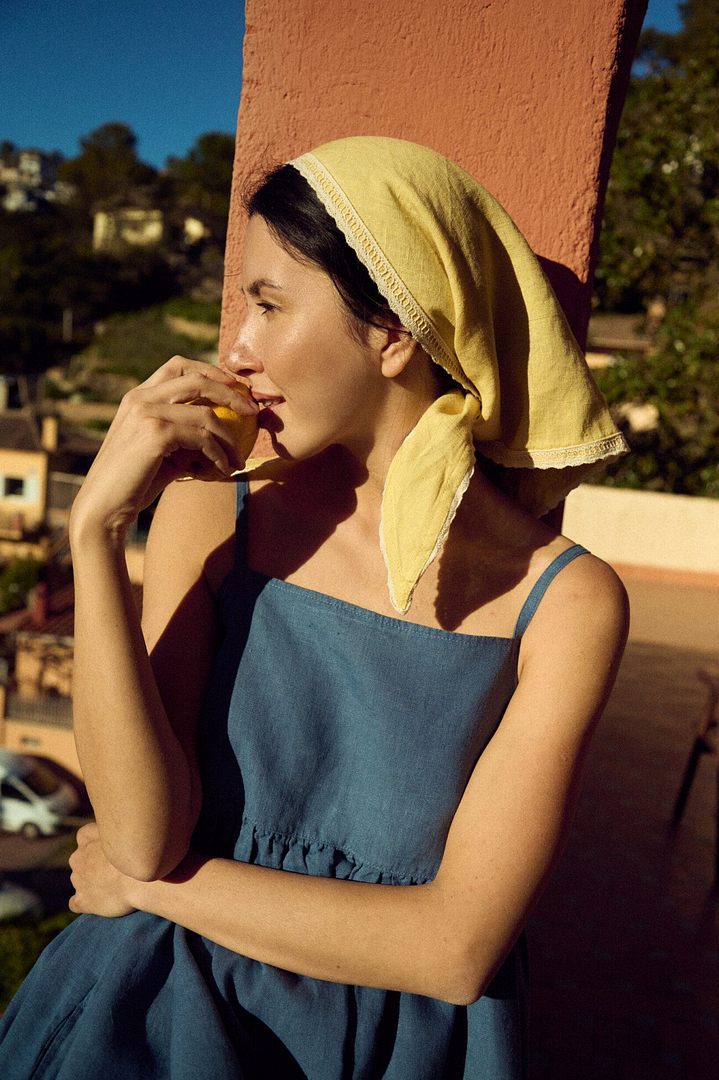
You can see the result in how independent labels have restructured their collections. Rather than chasing twelve micro-drops a year, brands like Linenfox build around a small, repeatable core: linen dresses cut generously enough to work across a decade of bodies and moods, made in weights that suit a heatwave in Athens or a damp Tuesday in Glasgow. It’s the anti-collection. Nothing about it expires.
How to wear it without looking like a holiday advert
The failure mode is obvious. Head-to-toe oatmeal, straw hat, an expression of serene wealth. Everyone knows the image and nobody wants to be it.
The fix is contrast. Linen reads as soft, so put something hard next to it. A midi dress with heavy boots and a leather jacket. Wide trousers with a plain white vest and unglamorous trainers. A dark, saturated colour instead of the usual sand — inky navy, forest, black — which strips out the Mediterranean connotation entirely and leaves you with just the texture.
Fit does more work than anything else. Linen is not a fabric for tailoring; it’s a fabric for volume. Let it hang. The moment you try to make it slim and structured, you’re fighting the material and the material will win.
The point
We are watching a slow collapse of trend cycles. Nobody can keep up, and increasingly nobody is trying. What replaces it isn’t another trend — it’s a set of defaults you can wear for years without thinking about them.
Linen is the clearest example of what that looks like in practice. Not loud. Not new. Just quietly correct.
It’s the same argument we’ve made about denim — that the most sustainable jeans are the ones you don’t replace — applied to a fabric that was built for it from the start. Buy one piece. You’ll notice the rest of your wardrobe starts to look like it’s trying too hard.