
Walk into any serious conservation studio in London or New York. You’ll smell it immediately. Archival paper. Mild solvents. The faint, metallic tang of climate control systems working overtime.
For over a century, that’s where the war against time was waged. Hand by hand. Brush by brush. Millimeter by millimeter.
But here’s the thing nobody talks about at cocktail parties. The most transformative tool in that room right now? It’s not a scalpel. It’s not a specialized solvent. It’s a server rack humming in the basement.
Look, collectors and estate managers know the drill. You’ve lived it. A stunning 19th-century silver gelatin print by Julia Margaret Cameron arrives at the gallery. The provenance is impeccable. The composition is breathtaking. But the emulsion is foxed. The edges are crumbling. The original tonal range? Lost to a milky, unforgiving haze.
Historically, you faced a brutal choice. A binary that made no sense. Accept the degradation as a badge of authenticity or risk irreversible, heavy-handed manual restoration that often did more damage than the original decay.
That binary? It’s dead.
Family offices and major private estates are quietly rewriting their legacy planning protocols. And I mean quietly. Nobody’s issuing press releases about this. Why? Because condition discounts at Christie’s and Sotheby’s are unforgiving. A water-damaged early autochrome by the Lumière brothers doesn’t just look bad. It actively suppresses bidding. It sits on the market. It gathers dust.
Forward-thinking advisors are now commissioning high-fidelity digital surrogates. Not to replace the physical asset. Obviously. Never that. The physical object remains sacred. But to provide prospective buyers with a clear, unobstructed view of the artist’s original intent. To bridge the gap between current decay and historical peak. And frankly? It unlocks latent value that would otherwise remain dormant for decades.
Now, we have to be absolutely clear about what this technology actually is. Because there’s a lot of garbage out there.
It is not a “filter.” Applying a generic, oversaturated algorithm to a historical artifact is, quite simply, digital vandalism. I’ve seen it ruin perfectly good archival scans. Beautiful, textured photographs from the 1920s turned into plastic, soulless messes. It’s heartbreaking.
True professional-grade restoration relies on probabilistic modeling. Not guesswork. Not fantasy.
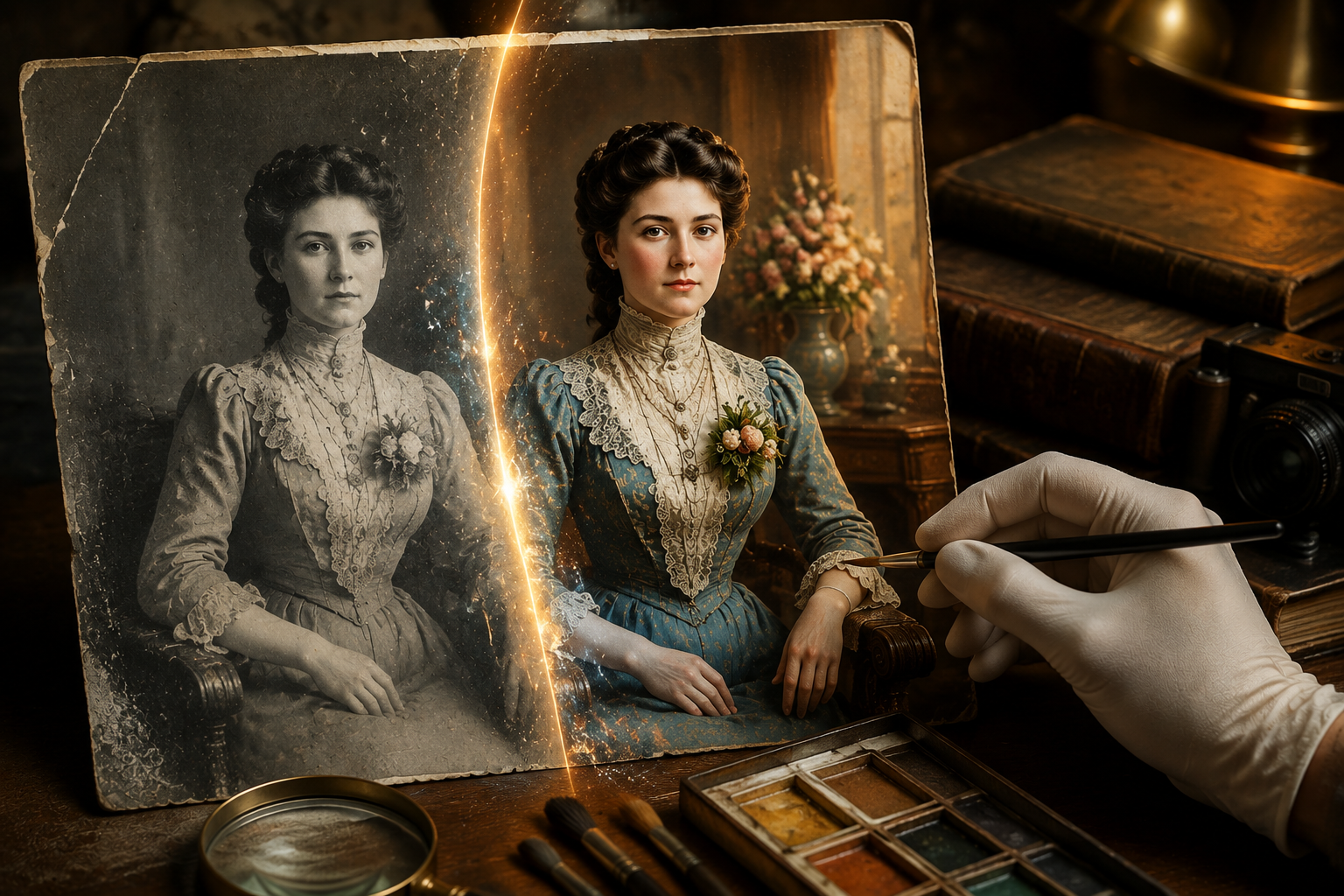
When a conservator deploys advanced ai colorization protocols on a faded portrait, the system isn’t just throwing paint at a canvas. It cross-references the garment’s weave with period-specific textile databases. It calculates the statistical likelihood of a particular dye based on the subject’s known geography and social standing in, say, 1890. It understands that the foliage in an 18th-century landscape study should reflect the specific chlorophyll decay patterns of aged oil paint, not the neon punch of a modern smartphone camera.
Here lies the tension, though. And it’s real.
The democratization of these tools has flooded the market with what I call “plastic history.” You know exactly what I’m talking about. Skin smoothed into unnatural marble. Backgrounds hallucinated into sharp, artificial focus. The original, beautiful film grain completely obliterated.
For the serious collector, restraint is the ultimate luxury. The guiding philosophy must be “digital patina.” A master conservator at the British Museum would never aggressively scrub the natural aging from a Renaissance bronze. Similarly, a digital steward must respect the history embedded in the pixels. The goal is to gently lift the veil of degradation, not to pretend the photograph was taken yesterday with an iPhone 15.
If it looks too clean? You’ve gone too far.
If you’re integrating this into a collection management strategy and more of you should be the rules are non-negotiable.
First, the original master scan is sacred. AI processing happens only on secondary, lossless surrogates. Always. No exceptions.
Second, treat the algorithmic output as an interpretive layer. Not a final truth. Blend it at reduced opacity. Manually mask out the hallucinations. Human oversight remains the final arbiter of quality. Period.
And, finally: transparency. Any enhanced image intended for publication, exhibition or private viewing must have explicit metadata. Disclosing the extent of digital intervention isn’t a weakness. It is the bedrock of curatorial trust. Without it, you’re just selling fantasy. AI and art conservation overlap “no threat to traditional craft” It’s an evolution of it. The tools are here. They’re powerful. They’re accessible. The discernment required to wield them? That remains a deeply human skill.
We now possess the means to invite history back into the light. To view the past with the vivid clarity it originally possessed. The question isn’t whether we can restore these artifacts. We can.
The question is whether we have the wisdom to do it without burning the past in the process.



