By Ira Blacker
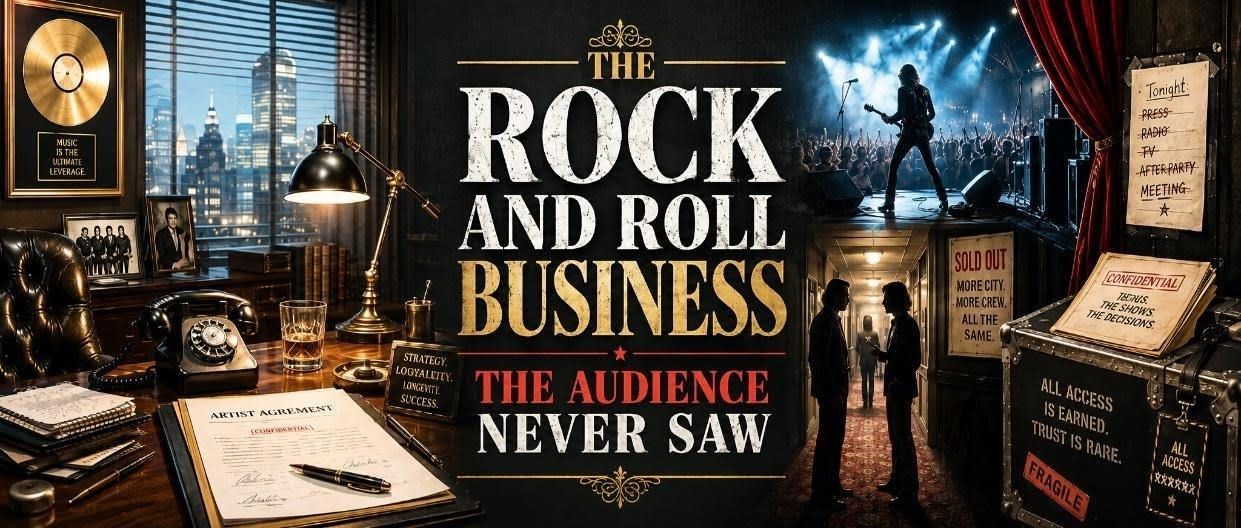
The public image of rock and roll was built from photographs: singers under spotlights, guitarists leaning into amplifiers, limousines, hotel rooms, screaming fans, and the appearance that success came from talent colliding with destiny. Talent was essential, but destiny usually had an office, a telephone, a contract, and several people arguing over who controlled the next move.
That is the world I describe in Once A King, Now A Prince. It is a rock and roll book written from the agency side of the desk, where careers were negotiated, tours were assembled, egos were managed, and decisions made in a few minutes could follow an artist for years.
My path into that world was hardly glamorous. I began by promoting local shows and managing a group called The Emeralds. That work brought me to Associated Booking Corporation on Park Avenue, where I entered the major agency business and signed Rod Stewart and Faces and Savoy Brown. After Joe Glaser’s death, changes inside the company convinced me that it was time to leave.
I joined Sol Saffian and Jeff Franklin at Action Talent. We rented space in an Eighth Avenue building whose tenants included Woody Allen and enough working girls to make the address memorable. From that unlikely beginning, we built American Talent International.
We eventually moved into a high-rise near Carnegie Hall and became one of the most competitive rock agencies in the country. ATI represented artists that included Deep Purple, Nazareth, Uriah Heep, The Eagles, ZZ Top, and many others. The growth looked impressive from the outside. Inside, it was relentless. Every success created new pressure, every artist brought different demands, and every partner carried personal ambitions that did not always remain private.
The stories people remember are often the funny or outrageous ones. After a Faces concert at Cobo Hall in Detroit, Rod Stewart and I were spotted in the hotel lobby by a wave of groupies. We ran up twenty-six flights of stairs and reached the rooms just ahead of them. The pounding on the doors continued after we had escaped. It sounds like familiar rock and roll madness, but it also reveals something more accurate: the people working around the artists were living inside the same uncontrolled momentum.
Other realities were less comic. Deep Purple could deliver performances that helped define an era, while dealing with Ritchie Blackmore required patience that no ticket buyer would ever see. Rory Gallagher was one of the most genuine people I represented, a world-class guitarist with an appetite for performing that required an agent capable of keeping him on the road. Nazareth were not yet kings when I began working with them, but I treated them as though they mattered because careers are often shaped by whether someone with power behaves as if an artist has a future before that future becomes obvious.
That was the hidden role of the agent. The audience saw a band walk onto a stage. It did not see the negotiations that determined the billing, the routing that kept the tour financially possible, the argument that prevented a cancellation, or the calculated decision to place one artist beside another. The artist might remember the performance. The agency remembered everything it took to make the performance happen.
The business also tested loyalty. My partners at ATI began representing artists outside the agency, which I considered a conflict of interest. Rather than accept it quietly, I responded in the aggressive way a younger man with strong instincts and insufficient patience might respond. I chose to manage an artist myself. That decision contributed to the eventual break with the company I had helped create.
That is not the polished version of success. It is the truth about building something powerful, discovering that the people beside you do not necessarily share your rules, and learning that ownership does not protect anyone from betrayal. A music industry executive can be surrounded by famous clients and still make emotional decisions, misjudge loyalties, and walk away from an empire he helped build.
Most music memoirs are understandably written from the stage. Mine comes from the rooms where the stage was booked, financed, routed, promoted, and sometimes rescued. It is also a music autobiography in the broader sense because music was the thread that carried me from a damaged Brooklyn childhood into a business where I could finally exert some control, even though control in rock and roll was always temporary.
A real music business book should not read like a lecture or a cleaned-up corporate history. It should admit that the business contained creativity and greed, friendship and betrayal, hilarious excess and genuine danger. It should also acknowledge that careers do not always end with applause. By 1990, after the agency wars, management battles, record deals, touring, and personal upheaval, I understood that the business no longer gave me what it once had.
My rock and roll memoir is not a victory lap. It is a record of what happened before the stories were polished into legend. The audience saw the stars. I saw the machinery, the private conduct, the shifting loyalties, and the price paid by the people who kept everything moving. Those events were rarely public at the time, but they were part of rock and roll history all the same.