
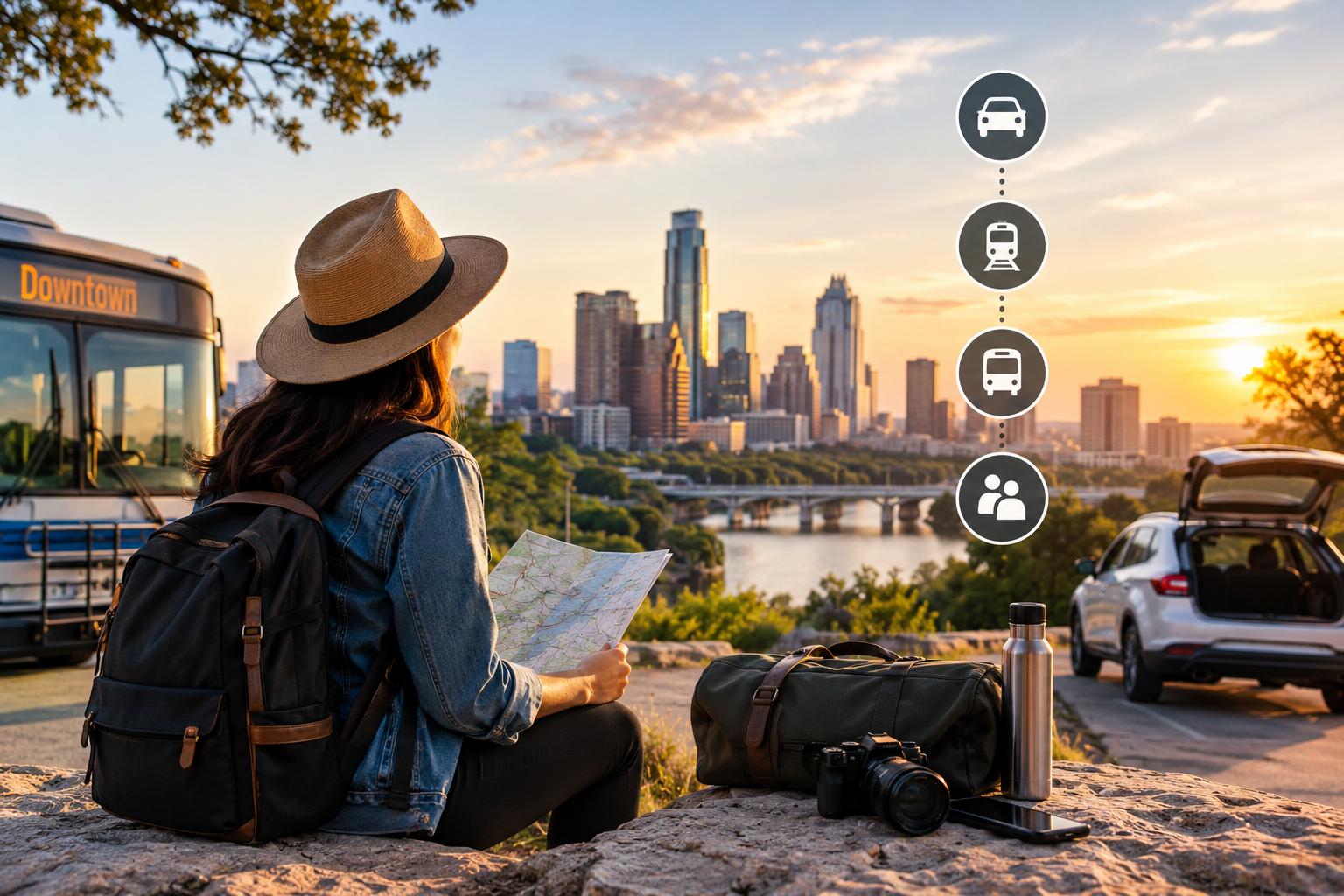
Five percent!
That’s roughly the share of Texas households without a vehicle. Could be a choice. Could be circumstance. Either way, it forces a different kind of thinking about getting around the state.
Texas is vast — five of the country’s 15 largest cities sit within its borders, and the distances between them swallow entire afternoons. But here’s what many people miss: car-free doesn’t mean stuck. It means you build trips differently.
Texas Is Big. Your Car Doesn’t Have to Be Yours
Texas rewards flexibility. One weekend might mean coffee shops and galleries in Austin. Another could involve a borrowed sedan, a rental, and a dusty road toward the Hill Country.
That’s the useful distinction: needing access to a vehicle isn’t the same as needing to own one. For travelers, creatives, and younger residents, transportation can be arranged around the trip rather than permanently parked outside.
Here’s how Texans manage it!
1. Borrowing From a Friend
A borrowed car can be the simplest answer for a weekend escape. You might leave Austin after breakfast, stop for barbecue outside Lockhart, and reach San Antonio before the heat settles in.
Still, borrowing isn’t as casual as grabbing someone’s keys. Make sure you understand the owner’s insurance and whether you’re covered to drive the vehicle.
If you need liability protection because you don’t own a vehicle and have an SR-22 requirement, non-owner sr22 auto insurance in Texas can be relevant.
Non-owner SR-22 policies are designed for qualifying drivers without a vehicle and generally provide liability coverage when driving eligible borrowed or rented vehicles, rather than coverage for damage to the vehicle itself.
2. Renting When the Highway Calls
Borrowing depends on someone else’s schedule. Renting gives you a little breathing room.
A creative carrying camera cases between Austin and Houston might need a car for two days, not twelve months. Someone visiting Dallas could pick up a car for the weekend, then return it.
Check the boring bits before booking: mileage limits, fuel rules, deposits, pickup locations, and one-way fees. Those details can change the final price.
3. Mixing Driving and Public Transport
Here’s a slightly different idea: don’t drive everything.
Use a bus or train for part of the journey, then rent a car for the places where transit gets thin. It can also give your attention a break. Watching Texas slide past a window can beat gripping the steering wheel.
Around larger cities, you may not need a car sitting around all day. Walk, ride, explore, then grab wheels when the map starts getting sparse.
4. Building the Trip Around Access, Not Ownership
This is where the whole idea starts to feel less strange.
Instead of asking which car you should buy, ask what transportation this particular trip needs. A borrowed car could handle a family visit, while a rental might suit a photography project. Transit can cover a city-to-city stretch, with a short ride filling the gap.
Texas logged 6.2 billion more vehicle miles in 2024 than in 2023, according to TxDOT. The roads clearly aren’t going anywhere. You just don’t have to own a vehicle to experience them.
Leave Room for the Unexpected
The best part of a car-free Texas road trip may be the flexibility. You can decide where wheels actually add value, instead of paying for them when they’re sitting idle.
Maybe you stay another night in Austin. Maybe San Antonio deserves the slow afternoon you hadn’t planned. Either way, the journey doesn’t have to begin with ownership. Sometimes, it begins with a plan and a little willingness to improvise.



