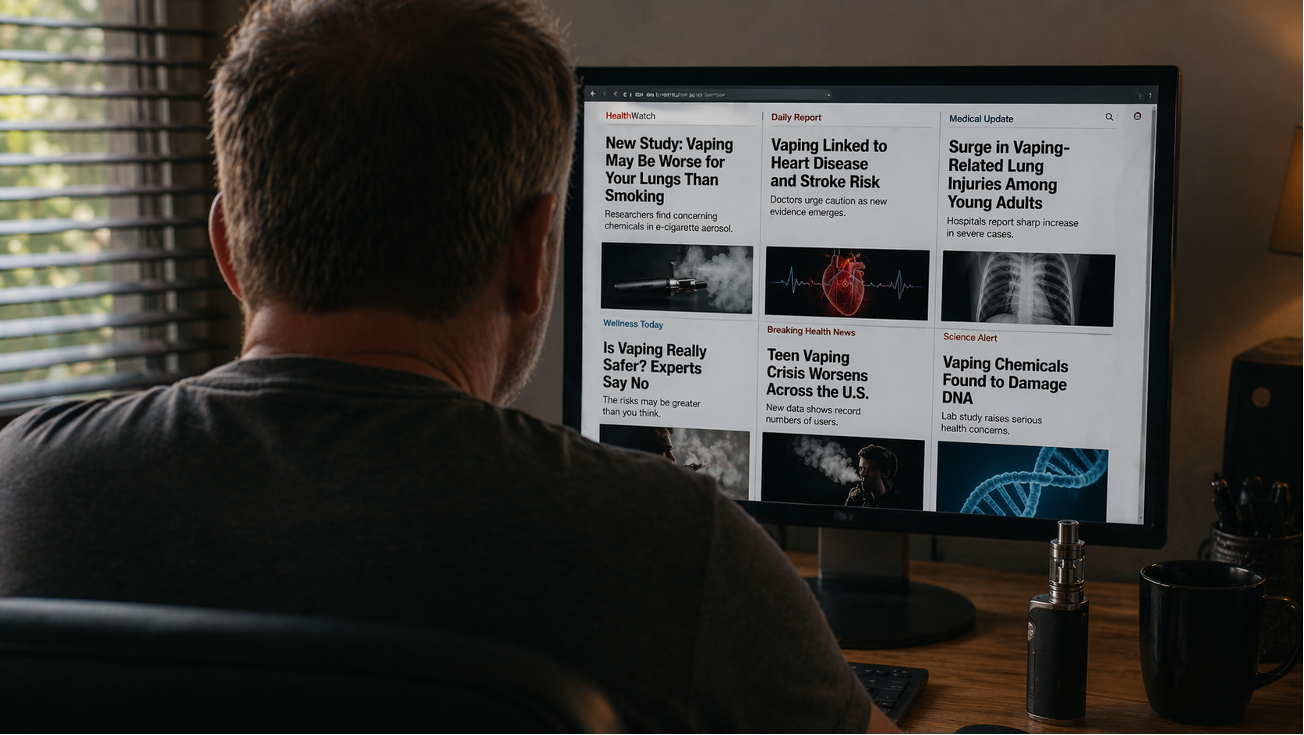
Consider, if you will, the situation of a man named Dennis.
Dennis has smoked a pack a day for twenty-three years. His doctor has mentioned this on more than one occasion. His concerned wife has mentioned this rather more frequently than his doctor. Last year, inspiration arrived in the form of his colleague, who switched to vaping, lost the morning cough as a result, and hasn’t shut up about it since.
Dennis is now deeply curious about vaping. He does a quick search, reads a few headlines, watches a news segment or two, and concludes that vaping is probably just as dangerous as cigarettes, possibly worse. He lights another Marlboro.
The thing is, Dennis did not arrive at this conclusion by accident. His hand was held, metaphorically. He was guided there, patiently, cleverly, and methodically, by the combined efforts of American public health communication over the past decade.
A study published in Nicotine and Tobacco Research in March 2026 found that the proportion of US adults who believe vaping is more harmful than smoking has risen to over thirty percent. Americans didn’t fall into this misperception, but rather were nudged into it by their own public health apparatus.
EVALI
In 2019, a lung illness swept through the United States. 2,807 people were hospitalized. Sixty-eight died. The CDC called it the E-cigarette or Vaping-Associated Lung Injury, EVALI for short, and the name was everywhere. Vaping, so the headlines would have you believe, was hospitalizing people. More than that, vaping was killing people.
What the headlines did not lead with, and what took months to communicate clearly, was that the culprit was vitamin E acetate, an adulterant found in black-market THC cartridges. Illicit cannabis products – absolutely nothing to do with nicotine vapes. The products implicated were not sold in vape shops, were not regulated under tobacco law, and bore approximately the same relationship to a standard nicotine e-cigarette as a bathtub gin operation bears to a licensed distillery.
By the time the correction arrived, the damage was firmly done. EVALI had entered the public consciousness as a vaping story, and, as misinformation tends to do, it stayed there. Dennis, along with many others, never saw the correction.
Institutions Could Have Fixed This
In Britain, the misperception problem exists too. Around sixty-three percent of British smokers now believe vaping is equally or more harmful than cigarettes, up from twenty-seven percent in 2019. The trend is real, and it concerns people. The difference is that Public Health England, Action on Smoking and Health, and the NHS have all run active counter-messaging campaigns specifically designed to correct it.
British smokers looking to switch can browse a wide range of properly regulated options, including broader products such as nic salt e-liquids, with the confidence that the government considers this a sensible option.
In America, the federal body mandated to do exactly this kind of work was the CDC’s Office on Smoking and Health, which was shuttered in 2025 as part of broader health restructuring. The office that existed to tell smokers the truth about relative risk no longer exists, at a moment when smokers have never been more confused about relative risk.
In short, the agency most qualified to say, actually, vaping is considerably safer than cigarettes has been replaced by a website called Every Try Counts and, more recently, a laminated card. The timing, you might agree, is less than optimal.
Big Tobacco Couldn’t Have Paid For This Level of Exposure
A Bristol University study published in 2025 found that smokers who correctly understood vaping to be less harmful than cigarettes were more likely to have successfully switched six years later. The knowledge gap, in other words, is certainly not academic.
You would be entirely forgiven for thinking that Big Tobacco engineered the misperception, seeded the panic, and sat back to enjoy the results, but the more unsettling version is simpler: nobody engineered it. The FDA banned flavors, and the public inferred danger. EVALI hit the news cycle, and the correction didn’t. Moral panic, once properly ignited, requires very little maintenance.
The cigarette companies didn’t need to write this particular script. American public health wrote it for them, and Big Tobacco couldn’t have budgeted for a better outcome if it had tried.
Dennis thought about switching; he really did. He just isn’t sure he’s ready to trade one health risk for another. The problem is that nobody told him he wouldn’t be – and they should have. One can only hope that the next time he feels inspired to swap tobacco for vaping and jumps online to research it, he finds this article.