
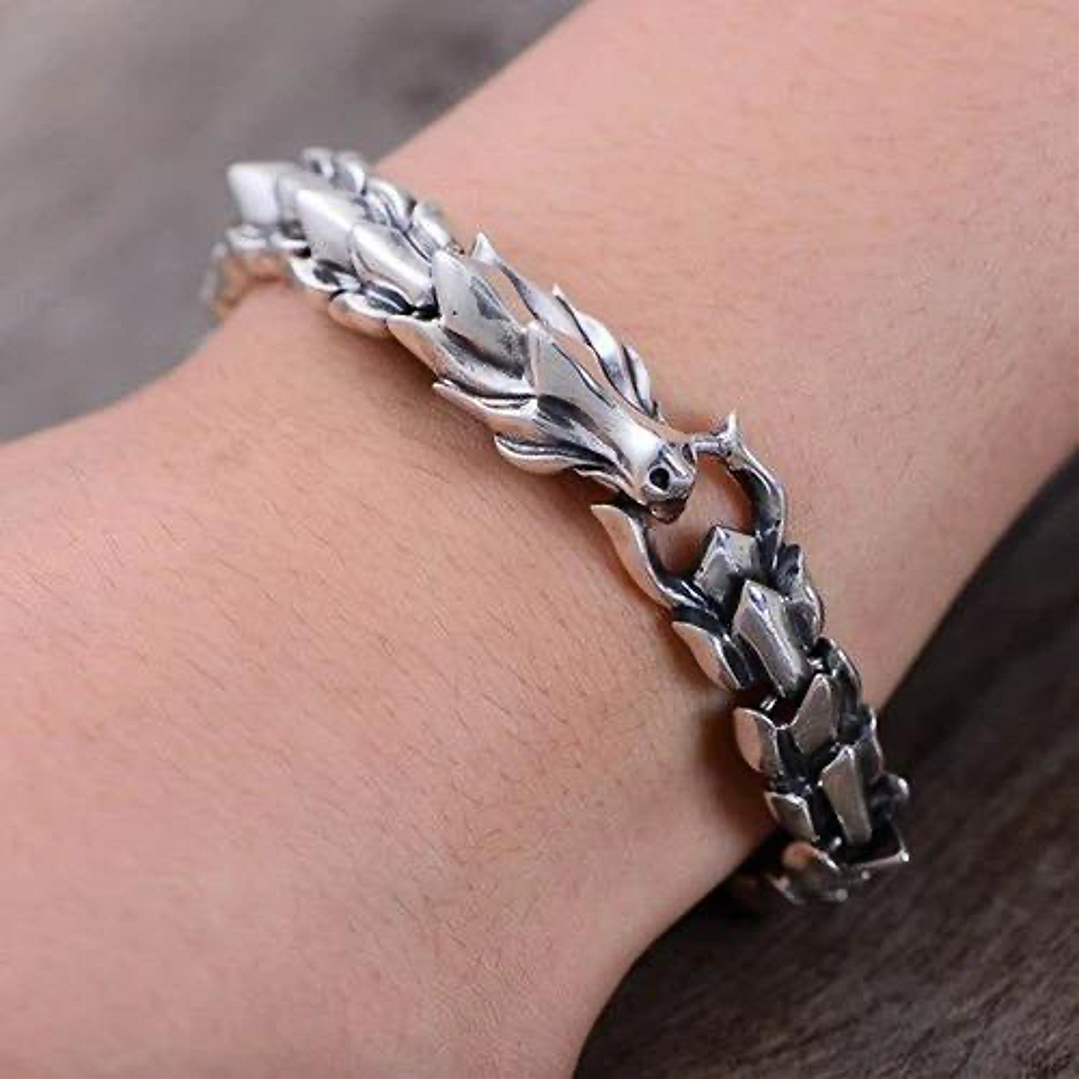
You find a silver bracelet you like, measure your wrist, and check the available sizes. Your wrist is 7 inches, so should you order a 7-inch bracelet?
Usually, no. Your wrist measurement is the starting point, not the bracelet length you need. The bracelet needs extra length to account for its thickness and leave room for comfortable movement.
Here is how to work out the size without making it complicated.
1. Measure Your Wrist First
Wrap a soft measuring tape around the wrist where you plan to wear the bracelet. Keep it snug against your skin, but do not pull it tight enough to make an indentation.
No measuring tape? Use a strip of paper, mark where the ends meet, then measure it with a ruler.
Example: Your wrist measures 7 inches. Write down 7 inches, even if you want a loose fit. You will add the allowance later.
2. Why Does the Bracelet Need to Be Longer?
Think of wrapping a thin string around your wrist. Now imagine doing the same thing with a thick rope. The rope needs more length to go around the same wrist.
A silver bracelet for men works much the same way. Thick links take up space when they curve around your wrist, leaving less room inside.
The thicker the bracelet, the more length it generally needs.
| Same wrist, different bracelets | What changes? |
| Thin, flat chain | Less added length is needed to account for thickness |
| Thick, rounded chain | More added length is needed to account for thickness |
This is why an 8-inch bracelet might feel loose in one design and snug in another. The length is the same, but the space inside is different.
Width is not thickness
These measurements are easy to mix up:
| Measurement | What it means |
| Width | How broad the bracelet looks when viewed from above |
| Thickness | How high the bracelet sits when laid flat on a table |
A bracelet advertised as “10 mm wide” is not necessarily 10 mm thick. A broad, flat chain can be much thinner than a rounded chain of the same width.
Use thickness when checking the sizing chart below—not width.
3. Add an Allowance for Thickness
Start with the seller’s recommended wrist-size range, if one is available. A note such as “fits a 7–7.5-inch wrist” is more useful than the bracelet length alone.
If there is no wrist-size recommendation, a thickness-based chart can help you estimate a starting size. The following examples come from Jewelry1000’s bracelet sizing guide.
| Bracelet thickness | Approximate length to add for a snug fit | Starting bracelet length for a 7-inch wrist |
| 3 mm | 0.4 inch | 7.4 inches |
| 4 mm | 0.6 inch | 7.6 inches |
| 5 mm | 0.7 inch | 7.7 inches |
| 6 mm | 0.9 inch | 7.9 inches |
| 7 mm | 1.0 inch | 8.0 inches |
| 8 mm | 1.2 inches | 8.2 inches |
These are estimates, not guaranteed fits for every chain. Link shape and clasp construction can change the result, so the seller’s advice for the particular bracelet should come first.
Notice how an 8.2-inch bracelet can be a starting size for a 7-inch wrist when the bracelet is thick. That added length does not mean you will have 1.2 inches of loose space around your arm. Much of it accounts for the bracelet itself.
4. Work Through One Simple Example
Suppose you have:
- A 7-inch wrist
- A bracelet that is 5 mm thick
- A preference for a close fit with a little movement
Here is the calculation:
| Step | Measurement |
| Your wrist | 7 inches |
| Allowance for 5 mm thickness | + 0.7 inch |
| Starting bracelet length | 7.7 inches |
If you prefer a slightly looser fit, the same guide suggests adding another 0.2 inch, giving you a starting length of 7.9 inches.
What if the available sizes are 7.5 and 8 inches?
Based on this estimate, 8 inches is the more sensible size to check with the seller. The 7.5-inch option falls below the calculated starting length.
You can send a straightforward question:
“My wrist measures 7 inches, and I prefer a close fit with a little movement. Would the 8-inch size work for this bracelet?”
That gives the seller the information needed to advise you.
5. Decide How Much Movement You Want
“Fits” and “feels comfortable” are not always the same thing. Some people like a bracelet to stay close to the wrist; others prefer it to move freely.
| Fit | What it should feel like |
| Snug | Sits close to your wrist, with slight movement and no digging into your skin |
| Regular | Has a little extra room to slide along your wrist without constantly dropping onto your hand |
| Loose | Moves farther up and down your arm; more noticeable with a heavy bracelet |
For a substantial silver chain bracelet, think carefully before choosing a very loose fit. A heavy bracelet sliding toward your hand can become annoying, especially when typing or driving.
If you wear a watch on the same wrist, extra movement also makes the bracelet more likely to knock against it.
An existing bracelet can help you decide what you like. But only copy its length if the new one has a similar thickness and construction. A thin 8-inch chain and a chunky 8-inch chain may not fit alike.
6. Check These Details Before Ordering
You do not need to become an expert in bracelet construction. You just need clear answers to a few questions.
| Check | Why it matters |
| Does the seller give a wrist-size range? | This can save you from calculating the fit yourself |
| Is the measurement width or thickness? | They are different, and confusing them can lead to the wrong size |
| How is the bracelet length measured? | An open end-to-end measurement may differ from the usable length when fastened |
| Does the clasp need extra room to close? | A toggle clasp, for example, needs enough slack to pass its bar through the ring |
If the page does not provide enough information, ask before buying. Your message can be as simple as:
“My wrist measures ___ inches. I prefer a close / relaxed fit. Which size would you suggest for this bracelet?”
The sizing logic is straightforward: measure your wrist, account for the bracelet’s thickness, then choose how much movement you want. Once you separate those three things, the size options become much easier to understand.




