By Tom Oakley
As the AAA video game market surges towards an estimated $77.9 billion valuation, a critical, yet often unseen, component drives its explosive growth: unparalleled audio engineering and the jobs it creates. As part of this sonic revolution is Udit Srivathsan, a Music Designer and Audio Engineer at Sony Interactive Entertainment America, whose expertise shapes the immersive soundscapes of blockbuster titles like Ghost of Yōtei, Kena: Scars of Kosmora, and Marvel’s Wolverine, among others.
Srivathsan’s work on Ghost of Yōtei just received a 2026 Motion Picture Sound Editors Golden Reel Award for Music Editing this week.
As a specialist in interactive media, film, and immersive audio, Srivathsan is excited for the outstanding award for music editing. “I’m incredibly grateful to the team at Sony Interactive Entertainment and Suckerpunch for giving me this opportunity,” he said. “It was my first game project at Sony Interactive Entertainment and the support shown through my colleagues and mentors in guiding me through those first hurdles, and throughout the game’s development, is something I cherish.”
He won the Outstanding Achievement in Music Editing at the 73rd MPSE for Game Music for Ghost of Yōtei alongside the team at Sony Interactive Entertainment. The full team that won the award includes Supervising Music Editors Andrew Buresh, Sonia Coronado, Ted Kocher, and Scott Shoemaker, as well as the Music Directors Peter Scaturro, and Keith Leary, and the other Music Editors he worked directly alongside, including Andrew Karboski, Yuen Man Chung Kelvin and Monty Mudd.
Srivathsan’s insights reveal how the art of sound, and the award around it, is not just an accompaniment, but a cornerstone, of the AAA experience. While AAA gaming is a core part of the entertainment industry defined by massive budgets, cinematic storytelling, and cutting-edge technology, there’s much more to it than that.
The AAA games market, traditionally dominated by high-end consoles and PCs, is projected to achieve a robust 4.1% Compound Annual Growth Rate (CAGR) through 2035. In other words, people love gaming and will spend more time logged into these games, than they did in the recent past. Srivathsan attributes this remarkable expansion not just to technological advancements, but significantly to increased accessibility.
“The AAA games market provides a lot for gamers today; it’s much easier to experience high quality games than it’s been before,” Srivathsan explains. “One example is that games that used to be exclusive to consoles and PCs – which can be a financial burden on many – are now available to play on mobile devices or on consumer laptops for example.” This democratization of high-fidelity gaming experiences, from expansive open worlds to intricate narratives, is clearly fueling the market’s trajectory and bringing blockbuster gaming to a wider audience than ever before.
To truly match the visual spectacle and cinematic storytelling characteristic of AAA titles, audio quality must be equally meticulous. For Srivathsan, who works within one of the industry’s titans, the standard is clear. “The attention to detail and mindset of perfection is a principle in the music team at PlayStation,” he said. “From producing the score, to recording and mixing, and finally to editing and implementation there’s a lot that goes on and it’s done with diligence.”
This dedication ensures that every auditory element, from a sweeping orchestral score to the subtle rustle of leaves, meets the exacting standards expected of multi-million dollar productions.
What differentiates AAA game audio engineering from traditional music production, Srivathsan explains, “is that we have to consider the needs of music designers and editors.” This involves a highly collaborative and strategic approach. For example, delivering compositional layers detailed enough for editors to manipulate, and planning recording sessions to capture orchestral parts separately – isolating high and low strings, or distinct short versus long musical phrases – provides unparalleled flexibility in an interactive medium.
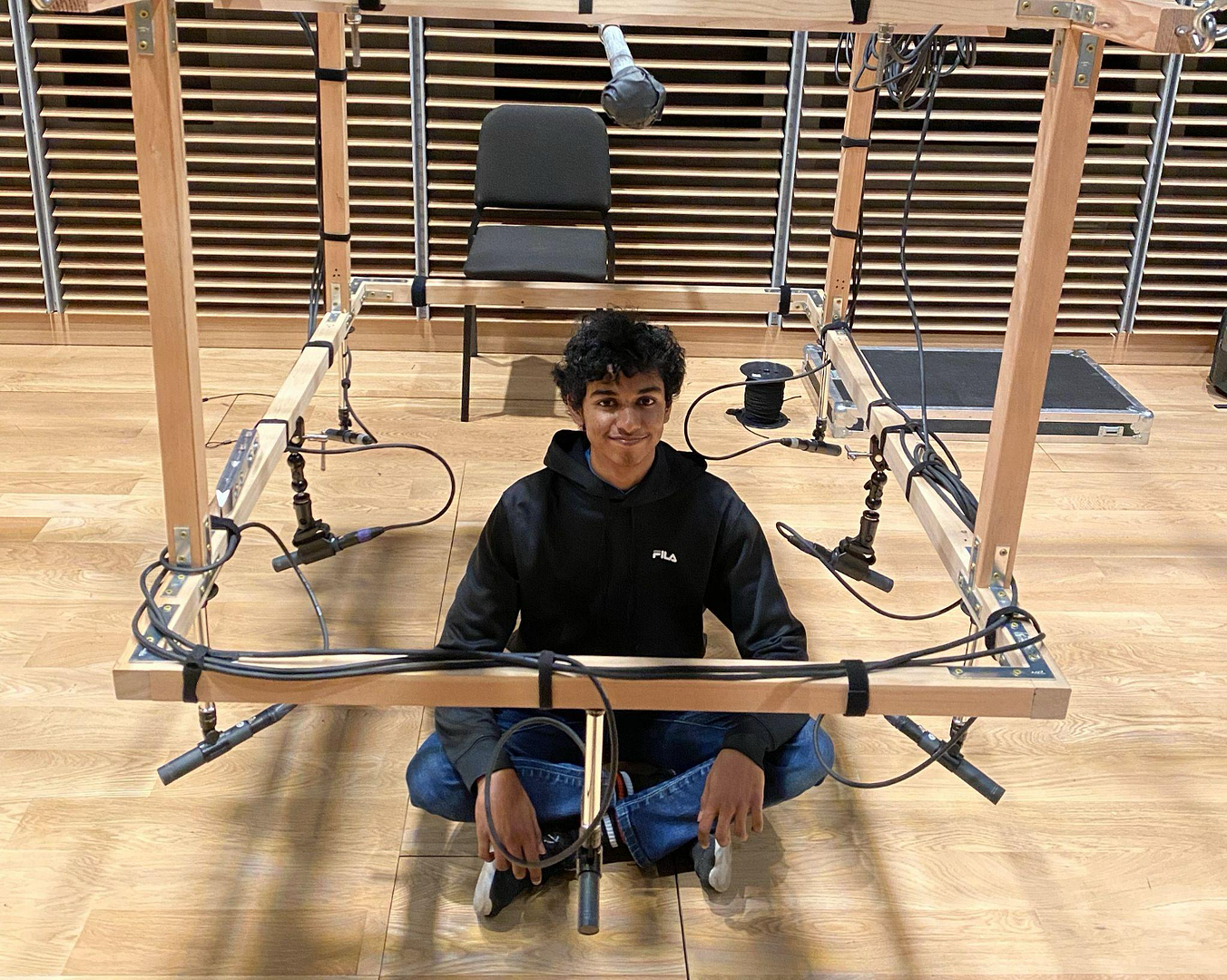
Research in this specialized field, he notes, is deeply rooted in “experimentation and collaborating with others.” Srivathsan credits veteran audio engineers like Anthony Caruso, Scott Bergstrom, and Kellogg Boynton IV for their invaluable insights. He highlights collaborative efforts like the “Echo project for spatial audio,” which explored cutting-edge orchestral immersive recording techniques, underscoring the continuous pursuit of innovation in game sound.
Srivathsan’s innovative approach to immersive audio is evident in his role as Upmix Engineer for the Counter-Strike 2 soundtrack album. His task was to give gamers a ‘surround sound’ feel, transforming traditional stereo mixes into a deeply spatial experience.
“Working with a variety of music and genres was a great way to experiment with making a cohesive sounding spatial album while retaining the unique qualities of each tune,” he recounts. The core challenge was achieving consistent width and filling the spatial dimensions across tracks with vastly different original mixes – some “tight and dry” and others “dripping with reverb.”
Acknowledging the nascent nature of immersive mixing, Srivathsan sees “room for experimentation.” His collaboration with mastering engineer Michael Romanowsky during the project solidified his understanding that “Atmos mixes are a totally different beast than stereo, and must be treated as such.” His experience also extends to working with composers like Austin Wintory and Ben Bromfield on other immersive music releases.
The power of spatial audio in AAA games, according to Srivathsan, is “extremely powerful.” Defined as immersive audio coming from multiple directions beyond just stereo, it’s a game-changer for player engagement, especially when the goal is deep immersion.
“When the aim of a game is to immerse a player in a world/story, audio cues are often more heavily relied on than the visuals,” he states, recognizing that most players interact with a two-dimensional screen. In fast-paced titles like first-person shooters, auditory cues—such as footsteps and gunshots—are “crucial to make split second decisions,” often preceding visual confirmation. While music enhances the experience, it’s typically designed not to pull attention away from gameplay or narrative.