Selling an engagement ring is rarely as simple as people expect, and most sellers don’t realize how much their diamond’s size and quality affect where they should sell it.
A small stone in a basic setting isn’t going to get the same offer, or even fit the same buyer, as a large certified diamond in a designer band. That mismatch is exactly why so many sellers end up frustrated, walking away with way less than their ring is actually worth.
Here’s the good part, though: once you know your diamond’s size and quality, picking the right buyer gets a whole lot easier. Different buyers are built for different kinds of rings, and figuring out which one fits yours can seriously change your final offer.
This article breaks down exactly where to sell based on what you’re actually holding.
1. Specialized Online Diamond Buyers
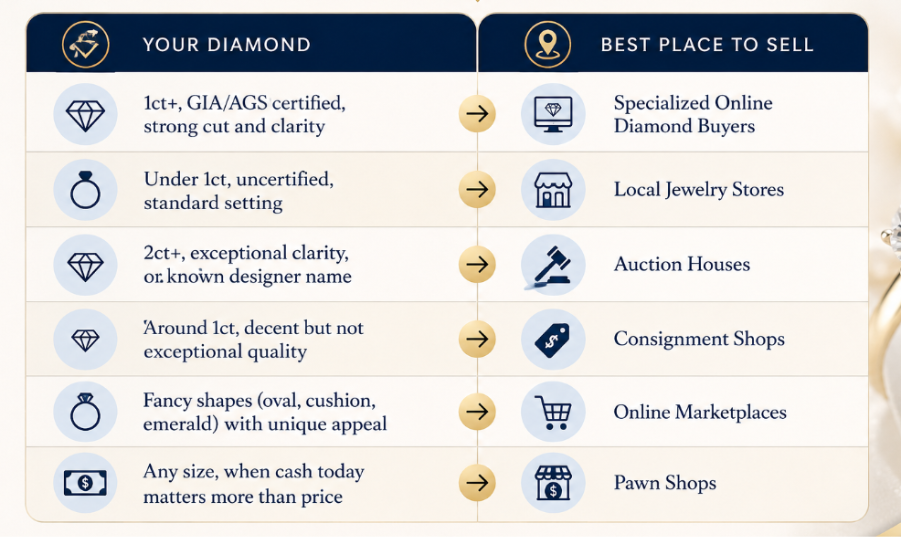
If your center stone is a carat or larger, especially with a GIA or AGS certificate, this is usually where you’ll land the strongest offer. Figuring out where to sell engagement ring pieces like this matters, since these buyers work with a national market instead of whoever happens to walk through a local door. That wider reach means more competition for your ring, and more competition usually means more money in your pocket.
Certification pulls real weight here, too. Certified stones almost always sell for 10 to 30 percent more than uncertified ones, just because the buyer isn’t left guessing at quality. Better clarity, stronger color grades, and a sharper cut push that number up even more.
Also, mid-size stones, in the 1-2 carat range, work well through this channel as long as quality is maintained. There are insured shipping and clear return policies that come standard, so there’s nothing to lose with a low offer. This is typically the best place to begin once you have a diamond with a real size or a certified quality.
2. Local Jewelry Stores
Local jewelers can work out fine for smaller or lower-quality stones, especially ones under a carat without a certificate. You walk in, show your ring, and often walk out with cash or a check that same day. That kind of speed is genuinely appealing when money is tight.
Local shops, however, purchase for their local customer base, and this dictates how much they are willing to pay once the stone moves beyond the average size and quality. A larger, high-clarity diamond might be demeaned here, just because it doesn’t fit into what the store usually resells. Smaller or lower-grade stones tend to see modest numbers no matter where you take them, but local shops handle that reality better than most.
Larger chains can be even more limiting, since higher overhead eats into what they’re able to offer. If the diamond is small, uncertified, or relatively average in all areas, it may be worth considering a local jeweler. Just don’t expect the offer to remain competitive if the stone is larger or more than average quality.
3. Auction Houses
Auction houses make sense only for rare and the exceptional rings, such as a large center stone ring with excellent clarity, or a well-known designer name attached. This route can be profitable if your diamond is two carats or more, internally flawless, or from a company such as Cartier or Harry Winston. Outside of that, it’s probably not worth the wait.
The process itself can take weeks, sometimes months, and there’s no guarantee your ring will sell. In addition, there are commissions ranging from 10 to 28 percent, which directly reduces your payout. Considering all the waiting, that’s a lot of money for a stone that’s not really all that exceptional.
For standard-size, standard-quality rings, the math just doesn’t work out. Unless your diamond genuinely stands out in size, clarity, or brand, faster and more predictable options will serve you better. Save this path for rings that actually deserve the extra attention.
4. Consignment Shops
Consignment tends to suit mid-size, mid-quality stones- something around one carat with decent but not exceptional clarity- that don’t quite hit auction-house standards but still hold some value. You hand over your ring, it gets listed, and then you wait for a buyer to show up. Simple enough on paper.
In reality, this option moves slowly, and commissions can climb as high as fifty percent of the sale price. Even a well-cut, one-carat stone can net you far less than expected once fees are taken out, which makes this a rough fit for smaller or lower-grade stones with thinner margins to begin with. You also hold onto ownership until it sells, and that can drag on for months.
There’s one more catch: your ring might never sell at all, regardless of how solid its quality looks on paper. This path suits people who aren’t in a rush and don’t mind sitting with that uncertainty. For most sellers, the low effort just doesn’t make up for the slow timeline and shrinking payout.
5. Online Marketplaces
Selling through marketplaces like eBay or Facebook can work well for rings with unusual shapes or standout traits, fancy cuts like oval, cushion, or emerald especially, that catch a specific buyer’s eye. These shapes sometimes perform better here than with generalist buyers, since the right person is actively hunting for that exact look, regardless of carat size. That upside is exactly what pulls sellers toward this route in the first place.
Still, real risks come with it no matter what your stone looks like. Fraud is a genuine concern, and buyer protection is thin to nonexistent if something goes wrong mid-transaction. A large, high-clarity stone is actually more exposed here too, since it makes a bigger target than a smaller, modest piece would.
This route tends to work best for sellers who already know how to spot red flags and protect themselves. Even a high-quality, well-certified stone doesn’t guarantee a safe sale. Go in carefully, and keep your guard up the whole way through.
6. Pawn Shops
Pawn shops offer one clear advantage, and that’s speed, no matter your diamond’s size or grade. Walk in, walk out with cash the same day, no waiting involved. If getting money fast is your priority, this option delivers on exactly that.
That speed comes at a cost, though, since pawn shops usually offer the lowest prices around. They’re generalists, not diamond specialists, so even a well-cut, certified stone often gets priced like an average one. Your ring’s real quality rarely gets the credit it deserves here.
Because of that, pawn shops are best treated as a last resort for rings of any caliber, not a first choice. If you’re not in a genuine cash crunch, other options will almost always pay more for the same stone. Save this route for moments when speed truly matters more than getting a fair number.
Quick Guide
Conclusion
Where you sell your engagement ring really comes down to knowing your diamond’s size and quality, then matching that to the buyer built for it. A small, uncertified stone and a large, GIA-certified one simply don’t belong in the same selling channel.
Once you’ve sized up those details honestly, picking a channel stops feeling like guesswork. Match your ring to the right option, and you’ll walk away with a fair result instead of a rushed, regret-filled one.