By Nick Barr
The New York–based designer’s award-winning rings offer a point of entry into a broader practice, where growth, open composition and colored gemstones function as structural forces rather than ornament.
In 2026, New York–based jewelry designer Yi Xiong (Aris) received two Silver A’ Design Awards in Jewelry Design for Heart in Bloom Ring and Lily of the Valley Ring. The honors bring her cumulative score to eight points and place her at No. 98 in the current DAC Jewelry Design Classification, moving her into the category’s top 100. Both works are listed in the official A’ Design Award archive: Heart in Bloom Ring and Lily of the Valley Ring.
The awards recognize the resolution of two individual pieces, but their significance becomes clearer when the rings are considered within Yi Xiong’s wider practice. Together, they suggest a design language that has been taking shape across her collections, defined less by a recurring motif than by a consistent way of organizing form, space and color.
Yi Xiong is a designer at Aris Fine Studio, a New York fine jewelry house working primarily with 18-karat gold, natural colored gemstones and bespoke commissions. Its collections occupy distinct territories. Seasons draws from botanical forms and the emotional associations of the natural world; Guardian translates companion animals, personal symbols and intimate memories into miniature sculptural narratives; Lumen looks to New York architecture, urban light and celestial movement.
The subjects may appear visually unrelated, yet they are connected by a shared method. Across the studio’s work, nature is not simply represented, space is never passive and color is used to build relationships rather than embellish a finished form.
Nature as a Method of Construction
Nature has long been central to Yi Xiong’s work, but her jewelry rarely treats it as an image to be faithfully reproduced. She is less interested in copying the appearance of a flower than in understanding how it grows: how one form extends from another, how weight is distributed, how opposing directions find equilibrium and how irregularity can still produce coherence.
Her jewelry borrows the behavior of nature, not only its surface.
Branches emerge from the ring shank rather than sitting decoratively around a central stone. Flowers, leaves and gemstones occupy different elevations, creating relationships of proximity and distance. Forms reach outward, descend, overlap or stop unexpectedly. The resulting silhouettes resist static symmetry and seem caught in the process of becoming.
In Heart in Bloom Ring, a 1.1-carat peach-orange heart-shaped natural sapphire does not function as an isolated centerpiece. It becomes the point from which the composition unfolds. Gold structures extend around it, drawing the gemstone into a larger movement of branching lines, suspended details and open intervals. The centralized, frontal order of the conventional solitaire gives way to a form whose balance shifts subtly with the viewer’s perspective.
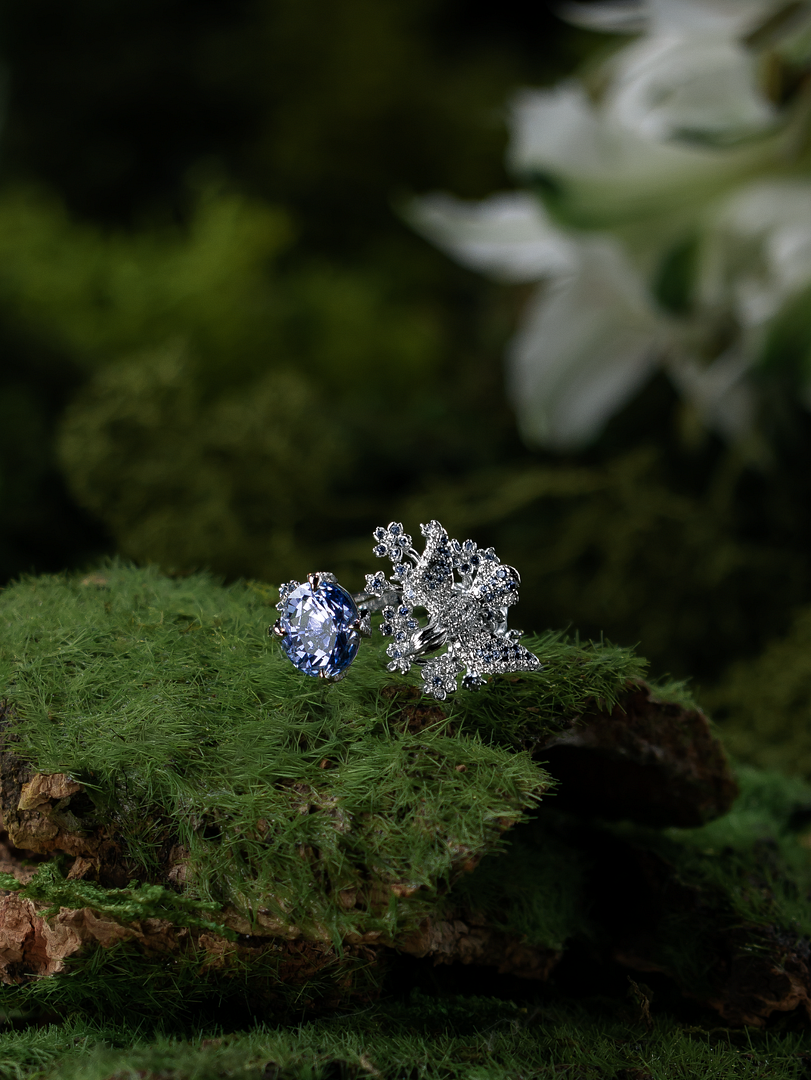
Lily of the Valley Ring develops a more intricate spatial rhythm. Drooping lily-of-the-valley blossoms are set against the outward movement of wild strawberry leaves, while green-gold and pink gemstones appear at different heights. Rather than replicating a botanical specimen, the work reconstructs the tensions within a living environment: descent and ascent, delicacy and density, growth and restraint. The ring reads as a small sculpture around the finger, with no single prescribed viewpoint.
This structural idea extends beyond the award-winning works and throughout Aris Fine Studio’s collections.
Within Guardian, portraits of companion animals are placed in relation to gemstones, plants and symbols drawn from the client’s own history. These elements do more than frame a central likeness. Through gestures of encircling, facing and reaching, they form intimate micro-environments in which the animal seems to inhabit the narrative rather than simply illustrate it.
In Seasons, the direction of a branch or the unfolding of a flower often determines the architecture of the entire piece. The eye moves along stems, across gemstones and between different elevations, following a rhythm that feels organic without becoming literal.
In Lumen, the same instinct shifts into a more abstract vocabulary. Botanical extensions give way to architectural lines, arcs, points of light and orbital movement. The growth is no longer floral, yet the underlying logic remains. Separate elements gather through direction, tension and spatial response rather than strict symmetry or a fixed center.
Across these collections, design does not begin with a completed outline waiting to be decorated. The whole emerges from the relationships among its parts.
Open Composition: Space as Material
Closely connected to this sense of growth is Yi Xiong’s recurring use of open composition.
Traditional gemstone jewelry is often organized around a clearly defined center, a closed perimeter and an immediately recognizable front. Yi Xiong frequently unsettles that order. A ring face may be divided, a line may stop before reaching its apparent destination, a gemstone may be suspended away from the main structure or two elements may approach one another without fully meeting.
The space between them is not treated as absence. It becomes active.
This is especially visible in the open rings of the Guardian collection, where a companion animal portrait may occupy one side of the composition while a gemstone, plant or private symbol appears on the other. The distance between them creates a sense of recognition or exchange. It also allows the wearer’s skin to enter the work, lending the forms a subtle feeling of suspension.
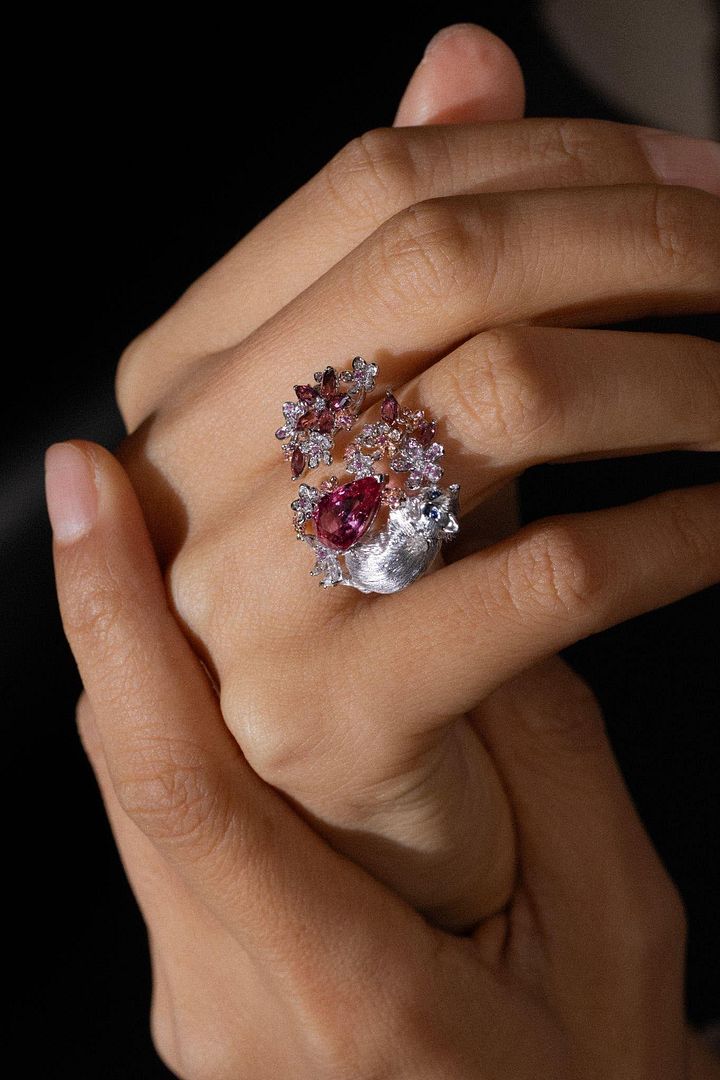
Open composition, however, is not synonymous with the open-ring format. It can also appear through pierced structures, interrupted lines and carefully measured distances within otherwise continuous rings, necklaces or bespoke pieces. In each case, negative space allows the eye to pass into and through the jewelry, revealing depth that would disappear within a fully enclosed surface.
This spatial openness gives the work its movement. The eye travels from gemstone to branch, crosses an interval and arrives at a partially concealed detail. No single element explains the piece in its entirety, and no single angle exhausts it. The jewelry reveals itself gradually as distance and perspective change.
Openness does not imply looseness. Yi Xiong’s compositions rarely depend on bilateral symmetry, but they remain carefully balanced. A form extending in one direction may be answered by the visual weight of a gemstone elsewhere. A descending flower may be countered by an ascending line. At times, empty space itself provides the necessary resistance.
The equilibrium is relational rather than mirrored. What appears spontaneous is sustained by underlying precision.
Richness Without Excess
Yi Xiong is not a minimalist in the conventional sense. Her jewelry often accommodates multiple gemstone cuts, contrasting colors, botanical or figurative forms, architectural lines and private symbols within a remarkably small physical space.
What keeps this abundance from becoming excessive is hierarchy.
From a distance, a piece first registers through its silhouette, directional movement and dominant color. Only at closer range do secondary layers emerge: a concealed leaf, a smaller gemstone outside the principal palette, a shift in height or a symbol legible only to its wearer. Information is not presented all at once. It unfolds as a sequence of discovery.
Color is essential to this ordering.
Yi Xiong’s early training in painting informs an approach to gemstones that begins with chromatic relationships rather than the isolated prestige of a single stone. Instead of defaulting to the familiar formula of a colored center stone surrounded by colorless diamonds, she often introduces a second, less expected hue. That additional color can redirect the eye, alter the apparent depth of the composition or introduce tension into an otherwise harmonious palette.
In Lily of the Valley Ring, green-gold and pink remain distinct rather than dissolving into a seamless gradient. Gold branches, spatial intervals and changes in elevation bring the colors into a measured dialogue. In Heart in Bloom Ring, the peach-orange sapphire is more than a material chosen for a completed design. Its unusual tone becomes the emotional and structural origin of the work, prompting a composition associated with flowering, expansion and renewal.
Across the broader practice, colored gemstones behave almost like passages of pigment in a painting. Some establish the first point of attention; others recede or alter the perceived distance between forms. A smaller contrasting stone may remain nearly invisible at first, only to shift the composition when it is noticed later.
In Guardian, color can respond to the eyes or coat of a companion animal or carry an association known only to the wearer. In Seasons, subtle variations in hue evoke changes in botanical life, time and light. In Lumen, differences in brilliance, saturation and darkness articulate the atmosphere of the city after nightfall.
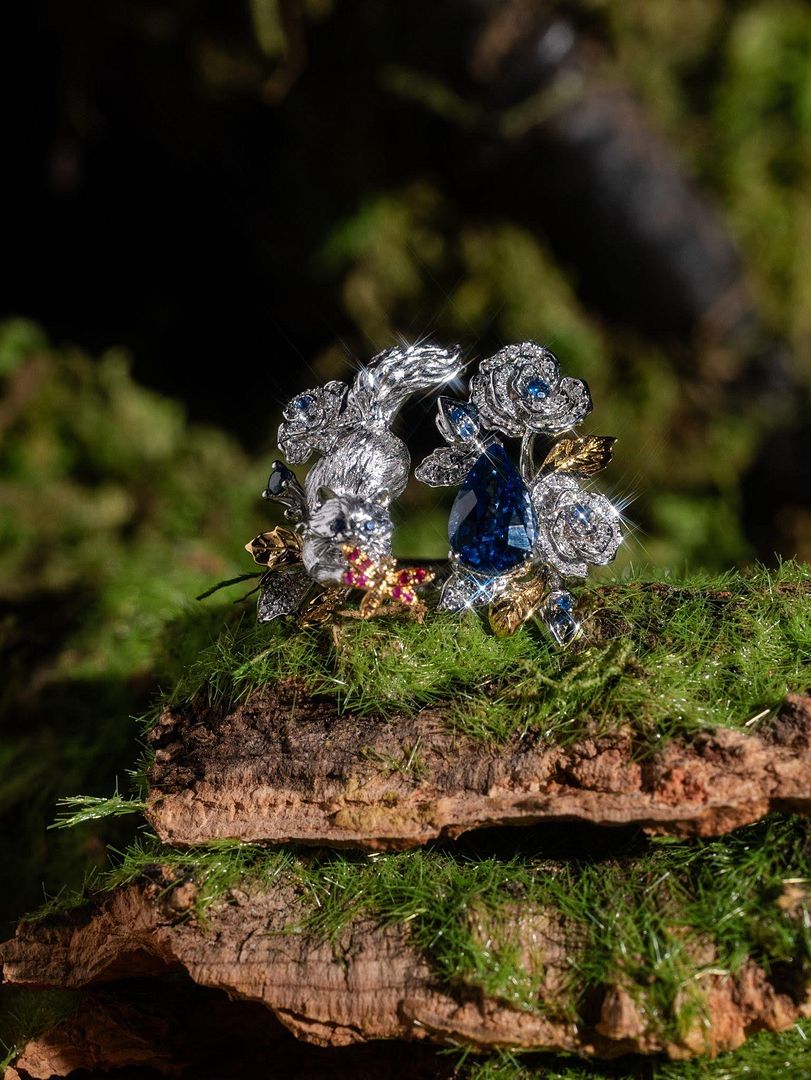
The result is a restrained abundance. Modernity is achieved not by erasing detail, but by giving each element a specific role and a particular moment in which to be seen.
A Jewelry Language Built to Evolve
The identity of a jewelry house is often established through the repetition of a recognizable emblem: a flower, an animal, a geometric link or a proprietary setting. Yi Xiong appears to be pursuing a different kind of continuity.
Rather than asking one image to carry the identity of Aris Fine Studio, she is developing a design grammar capable of absorbing change. A companion animal’s expression, the arc of a branch, the silhouette of a New York building, a constellation of urban light or a private memory can each initiate a new work. What remains consistent is not the subject itself, but the way it is transformed.
Forms grow rather than accumulate. Space interrupts without fragmenting. Color establishes hierarchy as well as emotion. Personal narratives are embedded in structure rather than applied as explanation.
This allows Guardian, Seasons and Lumen to retain distinct moods without appearing disconnected. One may be intimate and figurative, another botanical and sensuous, and another architectural and celestial. Each still belongs to the same creative world because it is governed by a related sense of space, balance and movement.
The two Silver A’ Design Awards therefore read less as a conclusion than as a marker of development. They recognize a moment when personal intuition is becoming an articulate and repeatable method.
A recognizable style can be produced by repeating a successful motif. A lasting design language must do something more difficult: it must change without losing its internal coherence. Yi Xiong’s work is increasingly defined by that capacity, moving from lilies to companion animals to Manhattan geometry while preserving its own sense of order.
The world of Aris Fine Studio is not held together by a single emblem. It is held together by a way of making: growth given structure, space given agency and memory given material form.
By Nick BARR