For decades, the act of renting an apartment in Tokyo has been a quietly mythical hurdle for foreigners. There is the guarantor system, the non-refundable key money, the agent’s fee, the fire insurance, the lock change, the empty apartment that arrives without so much as a curtain rail. The traditional Japanese rental, beautiful in its precision, has a way of making the city feel just slightly out of reach.
A newer generation of operators has been quietly rewriting that script. Among them is Cove Japan, the Tokyo arm of a regional furnished-rental company that now runs eight properties across the city, each one furnished, paperwork-light, and available on a month’s notice. What’s interesting is not so much the model, which has analogues elsewhere, but the map it traces across the city. Cove’s eight addresses sit in eight quite different Tokyos. Taken together, they read almost like a primer on how to live in the capital.
Kinshicho, Sumida
East of the Sumida River, Kinshicho still carries the working-edge charm of a neighbourhood that never quite made it onto the tourist map. Renaissance Court Kinshicho II is a five-minute walk from the station, on a corridor of subway and JR lines that funnel into central Tokyo in under fifteen minutes. The 1-bedroom apartments here are spacious in a way central Tokyo rarely permits, and the surrounding streets, full of late-night izakaya and Sumida’s quiet warehouse architecture, reward the kind of tenant who likes their city slightly off-axis.
Kiyosumi, Kōtō
A few stops further east, Kiyosumi has become shorthand for a particular kind of Tokyo lifestyle: pour-over coffee, contemporary galleries, the green expanse of Kiyosumi Garden on a Sunday. Cove Kiyosumi Shirakawa, a nine-minute walk from the metro, is one of Cove’s most accessible price points. The studios here are compact in the proper Tokyo sense, but the neighbourhood expands outward into one of the most quietly liveable corners of the city.
Komaba, Meguro
Komaba is the kind of address that Tokyoites tend to keep to themselves. A residential pocket of Meguro-ku that sits beside the University of Tokyo’s Komaba campus, it is leafy and low-rise, and just two stops from Shibuya on the Keio Inokashira line. Grande Komaba is three minutes from the station, and its 1-bedroom apartments suit the long-stay student, the postdoc, the writer on assignment. Somewhere between the city’s noise and its silences.
Senzoku, Meguro
A little further south, along the Tokyu Meguro line, Senzoku is one of those neighbourhoods that does not appear in guidebooks. Prime Urban Senzoku, a Luxe-tier property, sits in walking streets of small bakeries and family-run cafes. The Tokyu Meguro line runs direct into central Tokyo via Meguro, which means residents can disappear into the quiet whenever the city becomes too much.
Yoyogi, Shibuya
Yoyogi is the part of Shibuya-ku that lets you live next door to the noise without being inside it. Joyous Gard Yoyogi, an eight-minute walk from the nearest rail station, sits within easy reach of Yoyogi Park and the small grid of streets between Yoyogi and Sangubashi where some of Tokyo’s most particular coffee shops have set up. The studio apartments here suit the freelancer, the consultant, the long-stay creative.
Okachimachi, Taito
If Yoyogi is Shibuya without the volume, Okachimachi is Ueno without the tourists. GENOVIA Okachimachi Skygarden is five minutes from Okachimachi station on the Hibiya line, with Ueno Park, the Tokyo National Museum, and the great covered market of Ameya-Yokocho all within walking distance. Tokyo Station is a short hop in one direction; Akihabara in the other. The studios here are a particular favourite of professionals who want their morning commute to be three stops or fewer.
Asakusa, Taito
Few neighbourhoods reward the long-term resident quite like Asakusa. The Gatehouse Asakusa Kaminarimon, four minutes from the metro on the Ginza line, lives at the end of one of the most cinematic streets in the city, where Senso-ji Temple presides over the morning crowds and Nakamise-dori opens its shutters to the day. The Gatehouse offers the widest range of 2-bedroom apartments in the Cove portfolio, which makes it the natural choice for couples or partners settling in for longer than a few months.
Ebisu, Shibuya
Ebisu, the last and most recent address on the map, is Tokyo at its most quietly upscale. Cove Ebisu by Tokyo Beta opened in April 2026 as a fully furnished share house with shared common spaces, a small departure from the private-apartment model elsewhere in the portfolio. For tenants who want a softer landing into the city, with neighbours already in the building, Ebisu is a kind of Tokyo nobody quite arrives at by accident.
Rent in Tokyo with Cove Japan
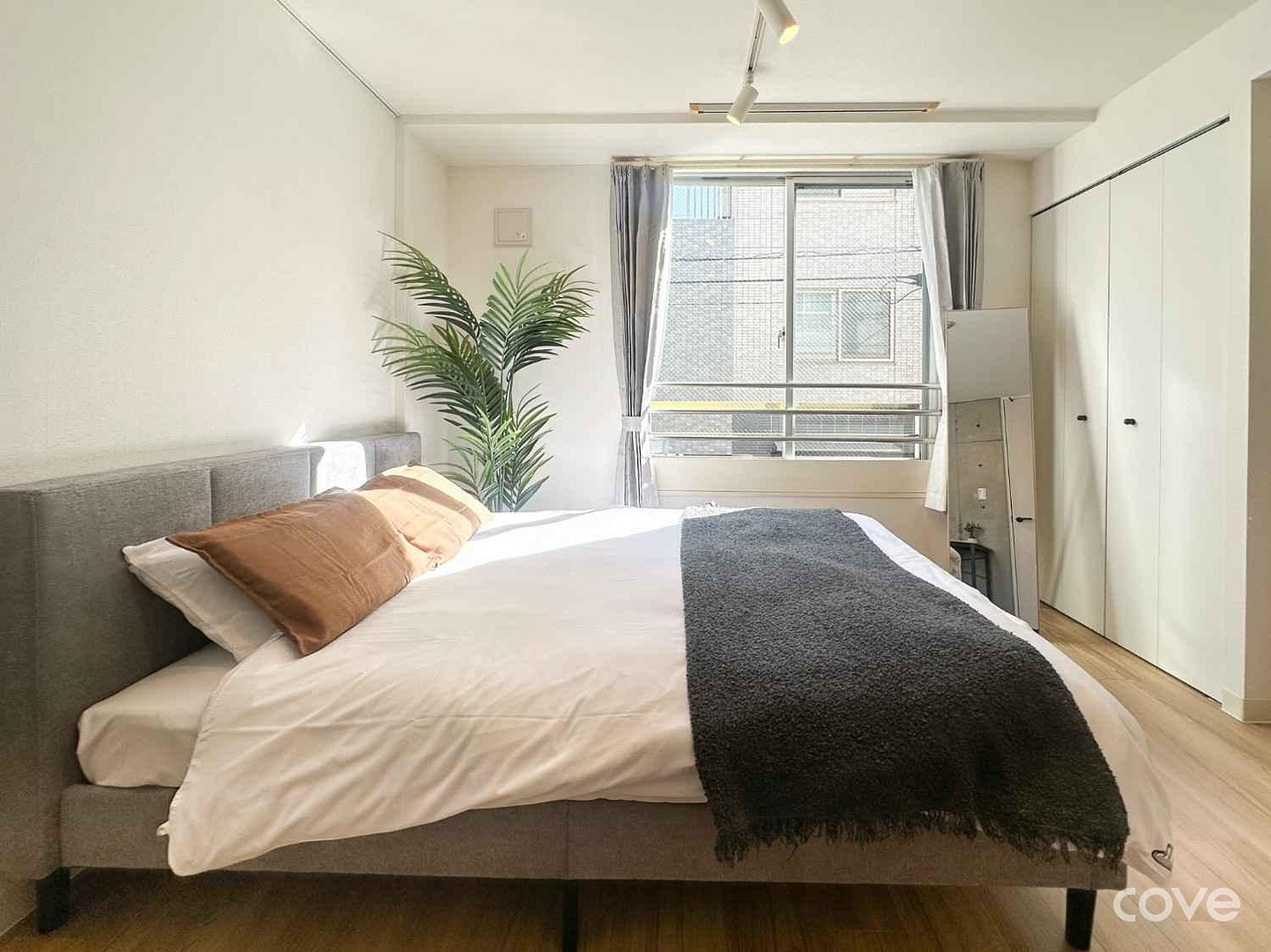
What is interesting about the Cove map is that it does not insist on any one Tokyo. Across the eight addresses, a tenant can choose Old Tokyo or upscale residential, business-adjacent or quietly suburban, the high streets of Shibuya or the back lanes of Kōtō. The baseline is the same in every case: furniture, appliances, fast Wi-Fi, English support, no key money, no guarantor, a one-month minimum stay. The variable is the city itself.
For anyone considering a longer stretch in Tokyo, a sabbatical, a relocation, a year between things, the furnished apartments now on offer across the city make the question less about whether you can live in Tokyo, and more about which Tokyo you’d like to live in.