
Choosing a rafting company in Colorado shouldn’t feel like speed-scrolling past the same sales pitch. Skip the wave photos and “30-year” claims and zero in on one number: the count of distinct river sections the outfitter is licensed, permitted, staffed, and prepared to run on your date. When you count sections – not marketing trip names – the right choice surfaces fast.
A guide’s résumé matters, but hours on your river matter more
Colorado law requires every commercial raft guide to complete 50 hours of on-river training, at least 30 with an instructor in the boat, according to the Colorado Code of Regulations. That laminated card proves baseline skill; it doesn’t show mastery of the stretch you plan to paddle.
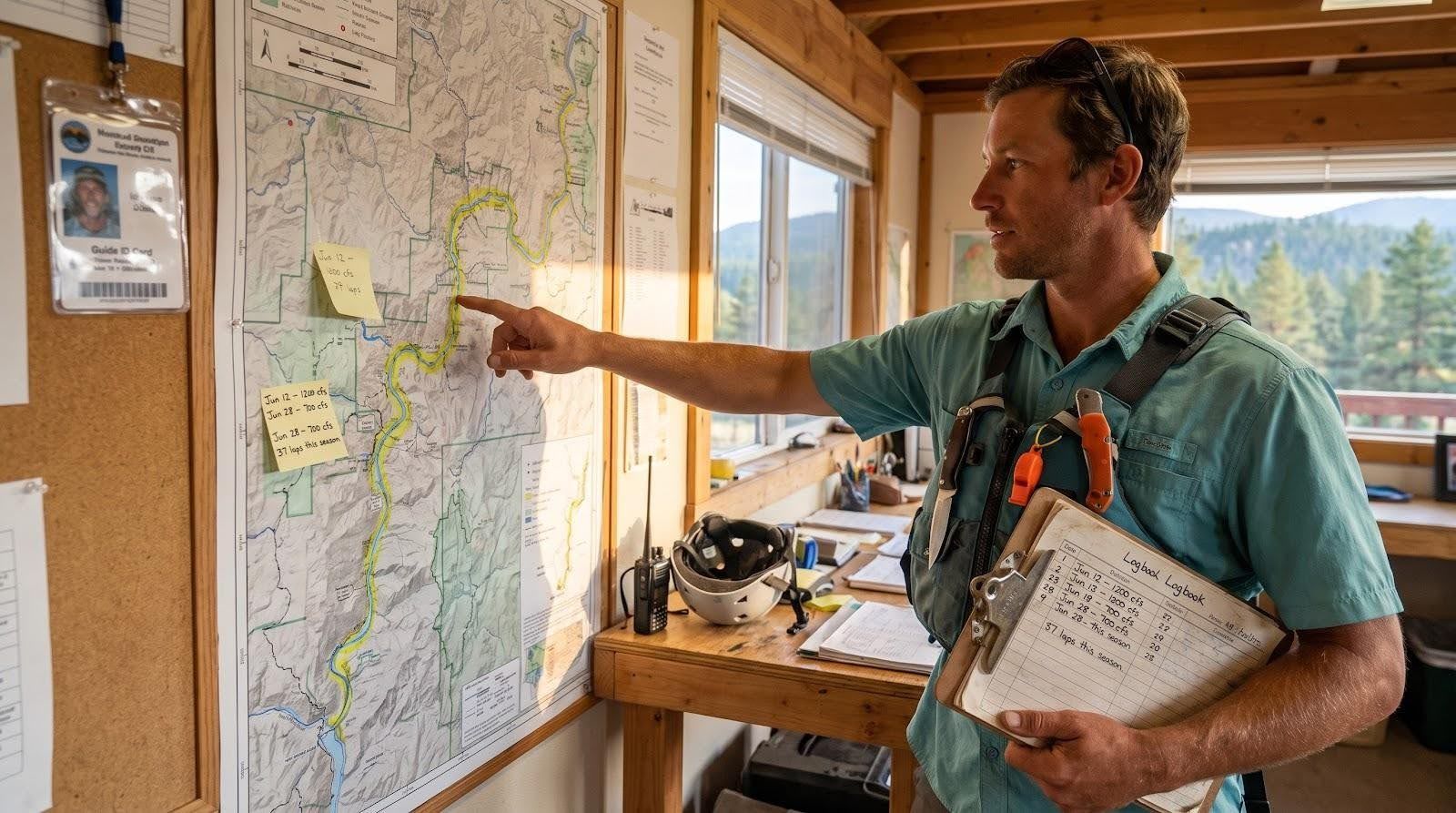
Mastery grows from recent laps on the identical section at the current flow. Each run locks in details: the rock that hides at 400 cfs, the eddy that buys a rescue minute during a spike, the low-water sneak line that keeps first-timers relaxed.
Before you put down a deposit, ask and record three simple answers:
- When did our guide last run this section at a similar flow?
- Who will lead the trip, and how many seasons has that leader steered this reach?
- What drills keep guides sharp after they meet the legal minimum?
Crews that track mileage, scenarios, and flow thresholds reply without pausing. Vague lines like “lots of experience” signal you should keep searching.
Equipment works only when muscle memory matches the water below your raft. Pick the outfitter that values fresh local laps as much as plastic credentials.
1. Does this option cover a genuinely different put-in-to-take-out reach?
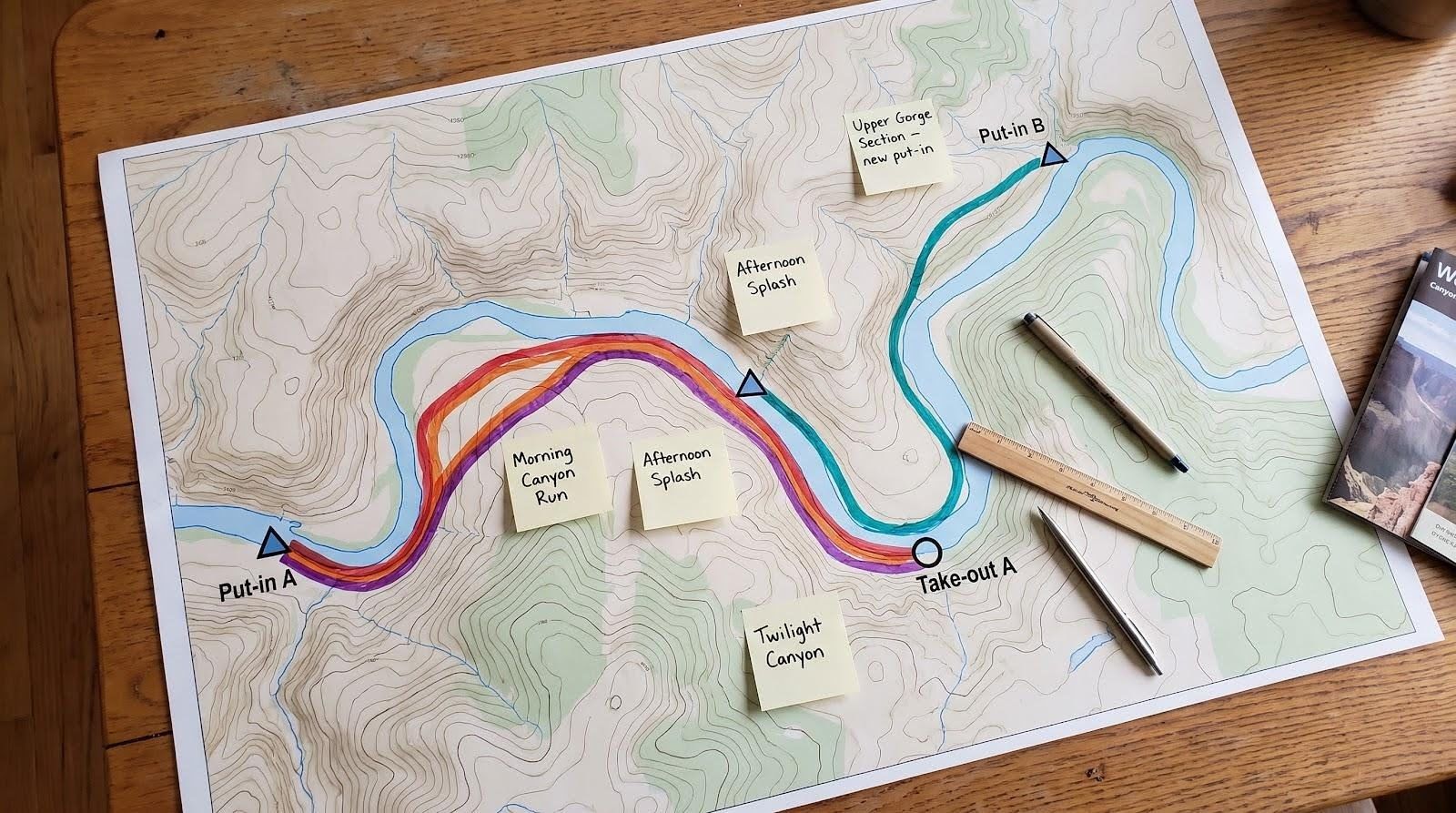
Think map, not clock. If two trips launch from the same beach, run the same rapids, and land at the same ramp, one before lunch and one after, you are looking at a schedule change, not a new section. Count it once.
When you call, ask the outfitter to email a simple map or the GPS coordinates for both launch and take-out.
- Lines that overlap equal one reach.
- Lines that start or finish at new river-mile markers mark a truly different stretch.
Do this quick map check and many “12-trip” menus shrink to four or five distinct pieces of water, giving you a far clearer picture of real choice.
2. Is the company actually permitted to run that reach right now?
Maps show geography, but permits confirm legal access. The four-point checklist published by Colorado’s best whitewater rafting company puts it plainly: a legitimate Colorado outfitter holds a river-outfitter license from Colorado Parks and Wildlife and operates under permits from land managers such as the Bureau of Land Management. A section only counts if the outfitter holds a current, river-specific authorization from the agency that manages that water. The state license covers the business, while a Special Recreation Permit (SRP) from the Bureau of Land Management, U.S. Forest Service, or a local parks district covers the riverbed. According to the Bureau of Land Management, the agency revised its SRP categories on February 2, 2026 under the EXPLORE Act.
When you ask for proof, don’t accept “We’re good.” Request the permit number and an expiration date that extends beyond your trip. Outfitters who value transparency often post PDFs online or email a copy within minutes.
Echo Canyon River Expeditions goes a step further.
Its river-permit guide-updated March 18, 2026-walks readers through which Colorado rivers require a permit for a self-guided trip, which run on a seasonal lottery, and where to apply, linking to recreation.gov and the National Park Service where reservations are handled online. It is written for private boaters, but it doubles as a plain-English map of who controls which stretch of river, so you know which agency an outfitter has to answer to before you hand over a deposit.
No permit? No section. Even the sharpest guide crew cannot replace a missing signature, so cross that reach off your list and keep looking.
3. Will water levels let you run the section when you arrive?
Permits open the gate; today’s flow decides whether you paddle through it.
Colorado rivers rise or fall with snowpack. On June 1, 2026, the USDA reported snowpack in the Arkansas River basin at 18 percent of the median, leaving rafts scraping rocks where they usually glide. A single heatwave, dam-release change, or wildfire closure can turn “prime” into “closed” overnight.
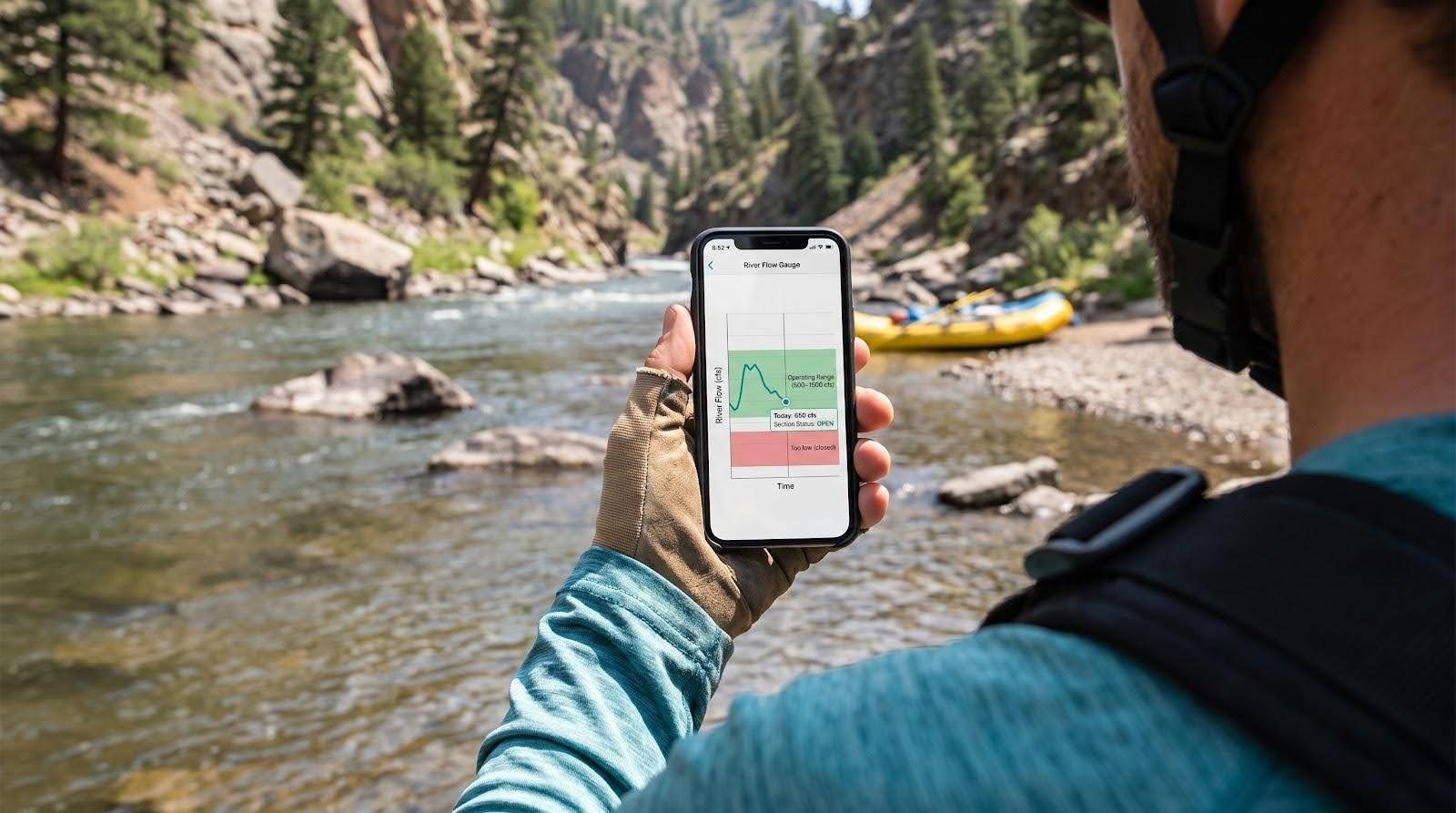
Ask your outfitter two specifics:
- Operating range. “What cubic-feet-per-second (cfs) keeps this section open, and where can I check the gauge?”
- Contingency playbook. “What happens at each trigger: fewer passengers, earlier launch, switch to inflatable kayaks, or a reroute to a dam-regulated reach?”
If the reply is vague – “We usually make it work” – treat it as a yellow flag. Count a section only when current data show it will float on your date, or when the company can promise a backup you would gladly accept.
4. Does the section suit the least-experienced person in your group?
A raft’s pace is set by its most cautious passenger.
A Class IV chute may delight veterans, yet it can make a first-time 11-year-old or a nervous adult clamp both hands on the thwart. Good outfitters catch that mismatch before the van leaves the outpost. They ask about age, swimming confidence, medical issues, and appetite for splash, then recommend, or decline, a section.
Run the same test on any menu you review:
- Cross off reaches that list age minimums above your youngest guest or require continuous paddling a sore shoulder can’t manage.
- Check water temperature; a mellow Class II at 45 °F feels harsher than the same rapid at 60 °F.
- Confirm PFD size ranges and whether there is a walk-out option if someone panics mid-run.
If the company says everyone “usually does fine,” press for specifics: minimum age at today’s flow, weight range for a proper PFD fit, distance between restroom stops. Clear thresholds and honest cautions show the outfitter puts people first.
Count only the sections every guest on your reservation can enjoy. Choosing inclusion over bravado safeguards both your budget and your memories.
5. Are guides, boats, and shuttles already booked for that section?
A section can be legal, flowing, and beginner-friendly yet still unavailable if no crew is scheduled to run it.
Outfitters shuffle guides between rivers, pull rafts for repair, and reassign shuttle vans to private trips – changes you will not see on the online schedule.
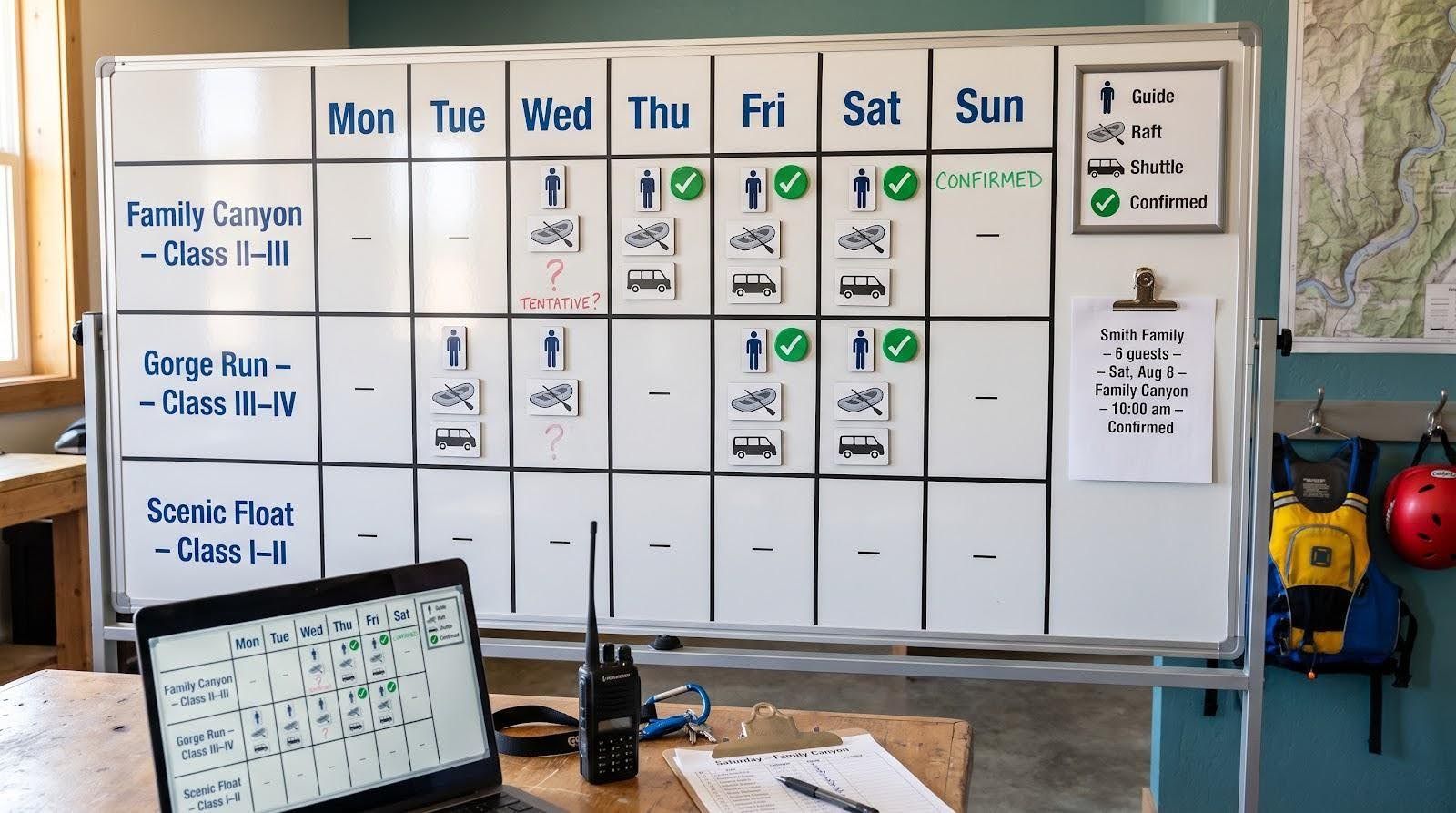
Before you pay, ask:
- How many trips on this section are already scheduled during the week we arrive?
- Is our reservation assigned a guide team, raft, and shuttle now, or is it tentative until more seats sell?
Clear, specific answers signal an operation in control of its calendar. Vague promises like “We’ll know closer to the date” create risk. If staffing slips, your planned Class III ride might downgrade to a slow float or leave you scrambling for space with a competitor.
Count a section only when the outfitter confirms in writing that guides, boats, and shuttle seats are locked for your group. Everything else is potential, not capacity.
Is more always better? Specialist versus multi-section outfitters
A homepage that lists seven rivers can wow you, and so can the small shop that runs the same canyon all season. Which one fits you depends on two numbers working together:
- Breadth = the count of distinct, runnable sections that pass the five-filter audit.
- Depth = how many times each of those sections is guided this season.
| Operator style | Main advantage | Key limitation | Best for |
| One-section specialist | Guides know every rock and eddy, often running the stretch daily. | No fallback if flows crash or a closure hits. | A technical bucket-list rapid with flexible dates. |
| Several sections on one river | Deep local knowledge plus easy and hard alternatives minutes apart. | A basin-wide drought or fire can shut everything at once. | Families and mixed-ability groups based in one gateway town. |
| Multi-river company | Geographic and seasonal flexibility; can shift you to a different watershed. | Guide reps may thin across outposts; check recent mileage. | Fixed travel dates or groups with diverging tastes. |
| Large multi-activity resort | Turnkey logistics: lodging, zip lines, dining, meetings. | Extra activities do not prove white-water skill; verify river depth. | Corporate events, reunions, or “one-stop” weekend bundles. |
Rule of thumb: choose depth when you are chasing a specific rapid and can move your date; choose breadth when your date is locked or Aunt Joan still prefers the bunny slope. A wide-ranging menu only helps if each section is staffed, permitted, and safe for the least experienced paddler in your boat.
Match difficulty to the least-experienced rafter
Section math puts you on legal water, but comfort decides whether the van ride home is full of high-fives or quiet stares.
Start with the most cautious person in the group; their confidence sets the ceiling for everyone. A Class IV drop may look heroic on Instagram, yet the swim below that hole can scare a child who still needs pool floaties.
Ask the outfitter for specifics:
- Rapid-by-rapid rundown. What are the biggest features at today’s flow?
- Low-temperature point. At what water temperature do they raise the minimum age or require wetsuits? Cold water tightens the rules at most shops; ask for their exact trigger rather than assuming yours still applies.
- Paddle demand. How much continuous paddling is required, and can a guest choose an oar raft instead?
Good companies adjust age limits and swim-skill rules as flows rise or fall. Great ones keep a gentler section ready the same morning if nerves spike at check-in, no guilt attached.
Choose the trip that lets every passenger smile through the splash, not clamp a thwart in silence.
Ask how the company responds to changing conditions
Colorado rivers ignore itineraries. A cool night slows snowmelt; a sudden heatwave can double flow; wildfire smoke may close a canyon road. What matters is how quickly your outfitter pivots when nature rewrites the plan.
Call and listen for a practiced system:
- Daily checks. “We pull USGS gauge data at 6 am, meet guides by 7 am, and call guests by 8 am if a section turns red.”
- Written playbook. Exact flow or smoke-index numbers that trigger each option – later launch, lighter crew, alternate reach, or full refund – show forethought.
- Local authority. A river manager on site beats a corporate desk in another time zone when a go-or-no-go decision is needed.
- Quality of substitutes. Swapping a splashy Class III canyon for a flat-water float may save the day for small kids but disappoint thrill seekers; a clear downgrade policy prevents surprises.
Choose the company that turns uncertainty into transparent choices, not last-minute compromises.
Compare boat type and group size before you click “book”
Not every raft or seating chart offers the same ride.
- Paddle raft. Everyone paddles. It feels social and active, yet demands teamwork.
- Oar raft. You sit while the guide rows, a good choice for photos or resting a sore shoulder.
- Paddle-assist. The guide rows from the center and calls for extra strokes when a rapid turns pushy.
Capacity matters, too. A standard Colorado paddle raft typically seats six to eight guests plus the guide, and outfitters adjust crew size up or down with the flow. Ask what your boat will carry on your date rather than assuming the website photo.
Ask three quick questions:
- Which craft will you use on this section at today’s flow?
- How many guests ride in each boat, and does that change if flows spike or drop?
- Can we reserve a private raft for our group’s own rhythm?
Clear answers help you match the vessel and the vibe, whether you want a lean crew punching waves or a laid-back float where no one worries about missing a paddle call.
Know exactly what the price buys
Online quotes look tidy until hidden fees pop up like rocks beneath frothy water.
Ask for a bottom-line figure that bundles every mandatory charge: land-use fee (often $5–$7 per person on the Arkansas River), shuttle, helmet, PFD, splash jacket, wetsuit, and state tax. Insist on the total in dollars, not percentages, before you click “Pay.”
Clarify the extras:
- Are professional photos included, or will a download cost extra?
- Is lunch part of a full-day trip, or a surprise $15 sandwich at the outpost café?
- What is the cancellation policy? Some operators keep only a $10 per-person fee if you cancel 48 hours out, while others hold 50 percent once you book.
Request the quote in writing (email or invoice). If the rep cannot outline every line item without shuffling papers, keep looking. Transparent pricing respects both your budget and your trust.
Inspect equipment and facilities with the same scrutiny
A helmet should cradle a forehead, not wobble like a dashboard bobblehead.
At check-in, scan the gear rack: wetsuits should snap back, buckles stay uncracked, and PFD labels remain legible, not sun-bleached blanks. Ask how often the crew inspects jackets and retires helmets. There is no federal retirement schedule for either, so the answer tells you whether the shop runs on a written maintenance calendar or on eyeball checks. Good operators cite an interval and a damaged-label rule of their own.
Facilities count, too. Clean bathrooms, private changing stalls, and secure storage show respect for guests. Well-marked shuttle vans with spare throw ropes signal an operation that prepares for flat tires instead of relying on luck.
Good gear and tidy grounds do more than pamper; they prove a maintenance culture that reaches ropes, rafts, and river safety.
Consider the wider day only after the river checks
Rivers set the adventure, but vacations stretch beyond the take-out ramp.
Once safety, section fit, and logistics line up, weigh the add-ons that color a full weekend. Some outfitters bundle zip lines, via ferrata, hot-spring soaks, or cabins at basecamp. Others partner with breweries, rail tours, or bike rentals in town, saving you an hour of driving and taming post-raft hunger.
Treat these extras as dessert. A slick three-line booking form that skips flow thresholds or refund terms is too thin, no matter how tempting the après-raft tacos. Pick the river first, then choose the perks that make your Colorado getaway shine.
Which kind of rafting company fits your trip?
No two groups share the same mix of ages, nerves, and bucket-list goals. Use the matrix below to spot the outfitter model that fits you, then verify each option with the five-filter test.
| Traveler type | Section capacity to check first | Extra details to confirm |
| First-time couple | 2 mellow sections in case flows spike | Small boats, photo package, short drive |
| Family with young kids | 1 gentle reach plus an equal-class backup | PFD fit, launch bathrooms, shaded wait area |
| Mixed-ability friends | Multiple difficulty levels on one river or split-group service | Synced shuttles so everyone meets for lunch |
| Advanced paddlers | Specific technical section with current guide reps | Recent mileage, rescue drills, ≤6 seats per boat |
| Fixed-date weekender | High low-water resilience across different basins | Early launch slots, clear reroute and refund terms |
| Corporate or celebration | Launch capacity ≥40 seats and private boats | Catering, transport plan, fallback activities |
| Experience-gift buyer | Transferable certificate valid on ≥2 beginner trips | Long validity, simple reschedule rules |
Treat this table as a guide, then let the five filters confirm that each “section” truly exists for your crew.
Why section flexibility matters during Colorado’s 2026 season
Snowpack was thin last winter, and on June 1, 2026, the USDA reported snowpack in the Arkansas River basin at 18 percent of the median. Outfitters trimmed passenger loads, switched to smaller craft, and moved trips to dam-regulated reaches.
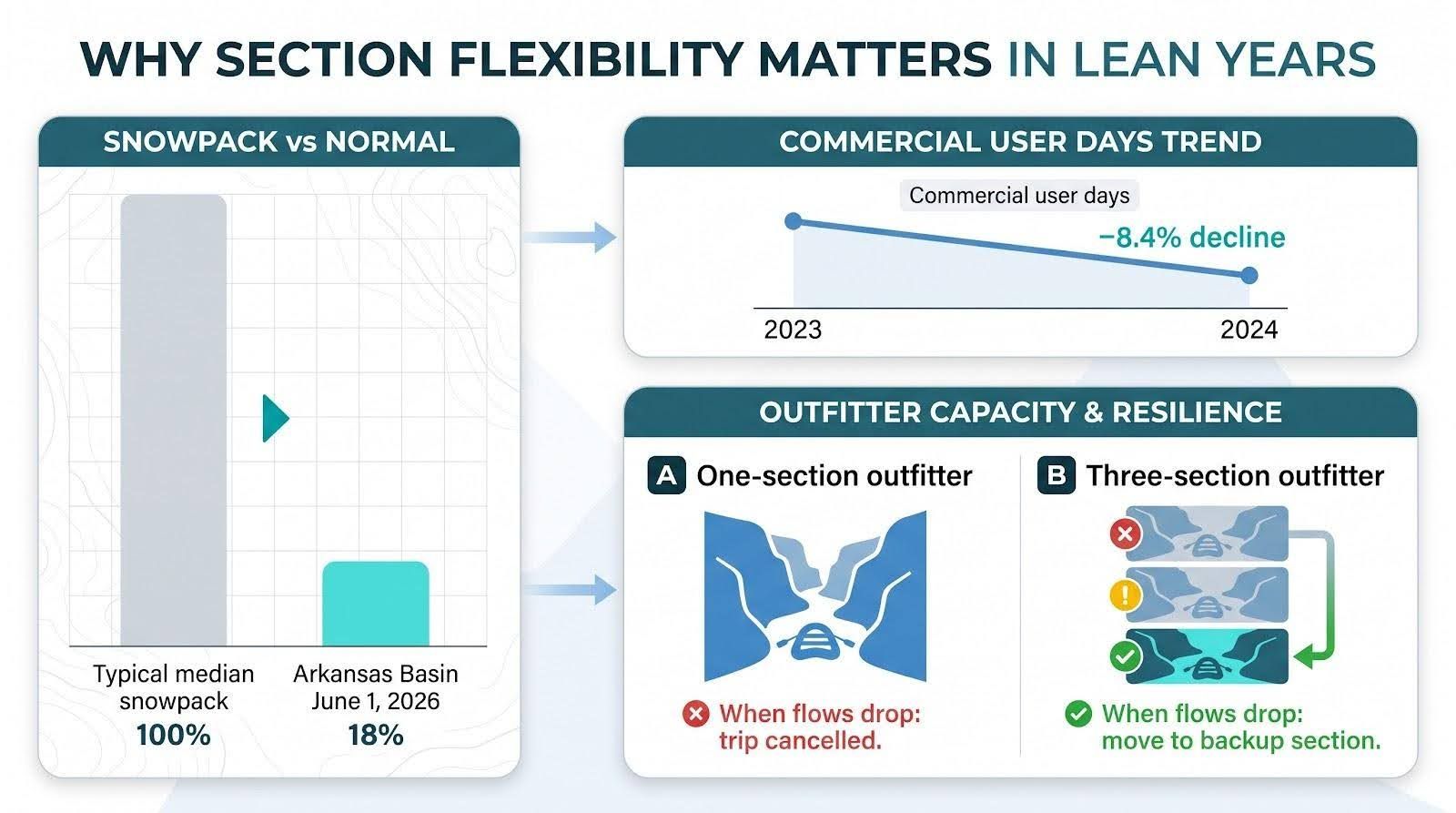
The slowdown reached the ledger, too. Commercial user days fell to 496,999 in 2024, a drop of 8.4 percent year over year. Operators still report late bookings and price-sensitive guests.
In a lean-water year, an outfitter with three truly different, fully staffed sections holds a critical advantage: it can move your reservation instead of cancelling. That backup reach can save a fixed-date vacation, keep a corporate outing on schedule, or let kids splash through waves instead of scraping rocks.
This season, flexibility is not a marketing flourish; it is operational insurance for you, your group, and the river towns that count on your visit.
Build your shortlist with a simple comparison worksheet
Copy or screenshot the grid below and fill it while you talk to each outfitter. Blank cells force clarity; unknown shouts louder than a vague assurance.
| Company | CPW license? | Distinct sections | Good for our group? | Backup reach confirmed | Recent guide reps | Boat / group size | All-in price | Reroute and refund terms | Review notes |
Start with the state license number. No number, no deal. Then list only the reaches that survive the five-filter test. If the outfitter hesitates or talks in circles, mark the box red and keep searching.
Most guests trim a dozen search results to just two contenders once this sheet is complete. That shortlist sets up one final step: a ten-minute call armed with the questions below.
Frequently Asked Questions
Ten questions to ask before you hand over a deposit
- Are you currently licensed by Colorado Parks and Wildlife, and what is your license number?
- Which exact river sections are you permitted and scheduled to run next month?
- How many of those sections suit the least-experienced person in our group?
- What is your backup plan if our chosen reach closes?
- How many recent runs has our guide logged on that reach this season?
- Which rescue, first-aid, and CPR credentials does that guide hold?
- What boat type and guest-to-guide ratio will we have?
- What does the total price include: gear, shuttle, lunch, photos, and taxes?
- If the route, duration, or difficulty changes on launch day, what are our refund or reschedule options?
- Will you recommend a competitor if you cannot offer a safe, suitable trip on our date?
Conclusion
Write the answers verbatim and ask for a follow-up email so every detail is in writing. Your notebook becomes a contract, your clarity a safety net, and your river run a memory worth framing.



