
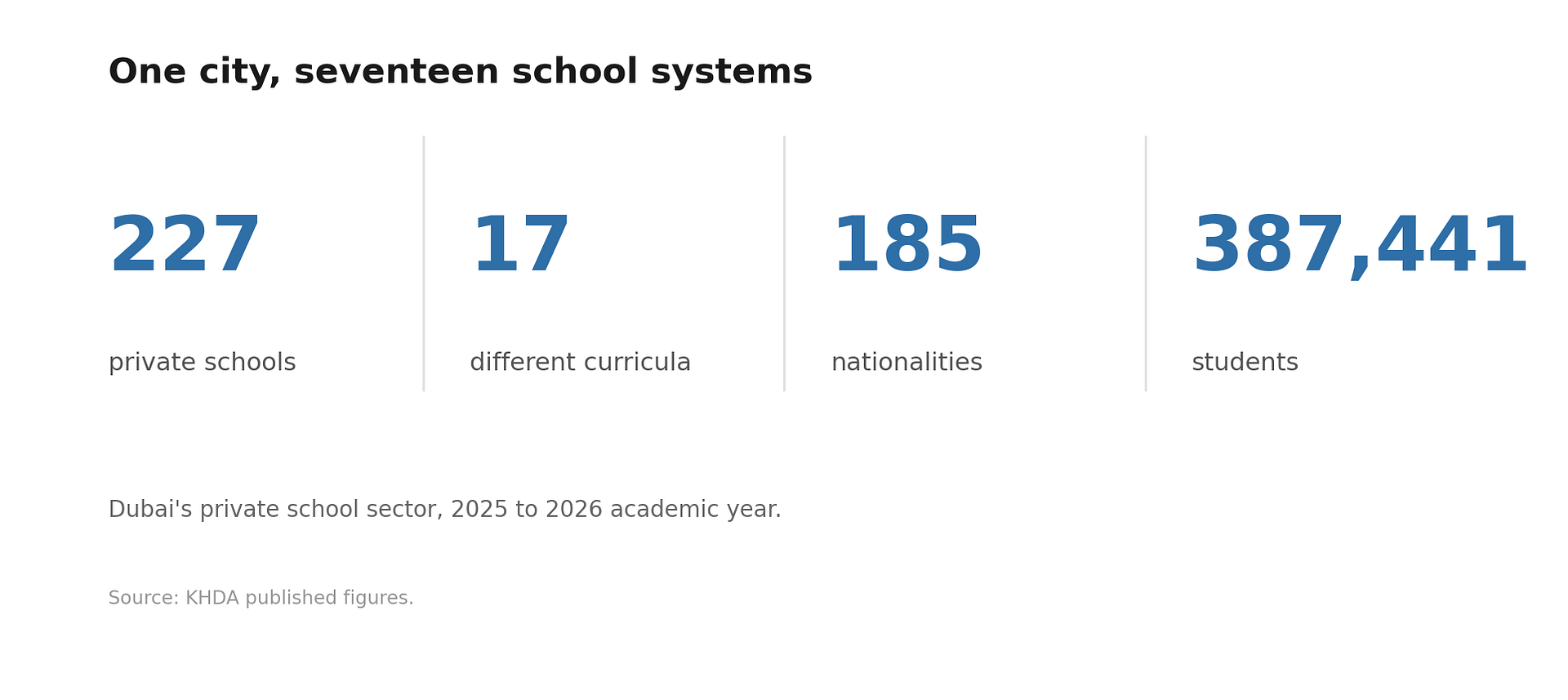
Ask a teenager in Dubai where they are from and you will often get a pause, then a list. Passport from one country, born in another, schooled in a third country’s education system, and none of it lived in. It is not confusion. It is accuracy. Dubai’s private schools teach 387,441 students from 185 nationalities across 17 different curricula, according to the emirate’s education authority, and a generation is coming of age inside that arrangement. What emerges is a particular kind of adolescence: fluent, mobile, and quietly complicated in ways the adults around them rarely have language for.
The city as a classroom, sort of
Seventeen curricula in one city is a strange thing when you sit with it.
A fifteen year old in Jumeirah might be sitting IGCSEs. Her neighbour attends a CBSE school and is preparing for Indian board exams. A friend from swimming is in an American school doing APs. Another is somewhere inside the International Baccalaureate. They live on the same street. They will apply to universities on four different timetables using four incompatible sets of paperwork.
None of them find this remarkable, which is itself the interesting part. Ask about it and you get a shrug. This is simply the shape of things.
What it produces is a generation unusually skilled at translation. Not language, though there is plenty of that. Translation between systems. These teenagers know that a grade means one thing here and another thing there, that a school year starts in August in one building and April in another, that the word college shifts meaning depending on who is saying it. They navigate this the way earlier generations navigated bus routes.
The third culture question
There is a term for children who spend their formative years outside their parents’ passport country. Third culture kids. It was coined by sociologists in the 1950s and has been circulating ever since, mostly among expatriate parents trying to explain their own children to themselves.
The research on it tends to describe the same cluster: high adaptability, strong cross cultural fluency, a persistent difficulty with the question of where home is.
Teenagers themselves are usually less romantic about it. Ask what is hard and the answer is rarely identity. It is that people leave.
Dubai’s population is increasing. Contracts end, companies restructure, families relocate. A friendship group can lose three members in a single summer. Teenagers here learn early to make friends quickly, because there is no time for the slow accumulation of trust that happens elsewhere, and they learn to hold those friendships loosely, because holding tightly hurts more.
That combination, fast warmth and practised detachment, is one of the most distinctive things about growing up here. It looks like confidence. It is partly a defence.
What the school day is actually like
The stereotype of Gulf international schooling involves marble atriums and swimming pools. Some of it is true. Plenty of it is not, and the fee range across the sector is enormous.
The rhythm is more distinctive than the buildings. School starts early, often before eight, because of the heat. The academic year is punctuated by exam sessions that vary depending on curriculum. Summer means most of the student body dispersing across the world for two months, then reassembling in September with a slightly different roster.
Extra tuition is close to universal, and it is worth being honest that this is not always about struggling. In a city where families have relocated specifically for opportunity, academic expectation runs high. Some students carry it lightly. Others carry it in ways their parents do not fully see. The market has adjusted accordingly, and services like Tuitional, an online tutoring platform exist because a student in Dubai might be sitting a British curriculum with a tutor in another timezone entirely, which nobody involved finds strange.
The pressure is real. It is also not the whole story, and teenagers here get tired of being described only through the lens of academic achievement.
What they build instead
Spend time around this generation and the improvisation stands out.
Because nobody shares a single national culture, they assemble one. Music arrives from everywhere and gets flattened into a common playlist. Slang borrows from Arabic, Hindi, British English and American internet in the same sentence. Food is the most obvious version: a group will eat Filipino, Lebanese and South Indian in the same week without treating any of it as an event.
This is not multiculturalism as a school assembly theme. It is just what is available, so it is what gets used.
There is a creative consequence to this that tends to surface later. Young people who grew up switching registers constantly often turn out to be good at noticing the arbitrary. When you have lived under four different sets of rules about what counts as normal, you stop assuming any particular set is natural. That is a useful instinct for anyone who ends up making things.
The part nobody prepares them for
The difficulty arrives at the exit.
At eighteen, most of these students leave. University takes them to Britain, Canada, Australia, India, the United States. And for the first time many of them land somewhere with a dominant local culture, full of people who have known each other since primary school and share a childhood of references.
Students describe a specific disorientation here. They have spent years being fluent in difference, and now difference is not the environment. Being from everywhere works well in a place built on it. It works less well in a town where everyone is from there.
Some go back to Dubai afterward. Others discover they cannot, because the version they remember has already turned over. The schools are the same. The people are not.
Worth saying plainly
It would be easy to write this as either a privilege story or a loss story. Neither quite lands.
What is true is that a large number of young people are growing up in a genuinely new configuration, one that barely existed two generations ago, and that the categories available to describe it are borrowed and imperfect.
They are not rootless. They have roots, just distributed ones. They are not culturally confused. They are unusually clear about how constructed most cultural rules are, which is a different thing and occasionally an uncomfortable one to be around.
And they are, mostly, fine. Better than fine. Ask a seventeen year old in Dubai what they want to do and you tend to get an answer that assumes the world is reachable, because for them it has always been. That assumption is worth something.
Whether the rest of us can keep up with the vocabulary is another matter.



