
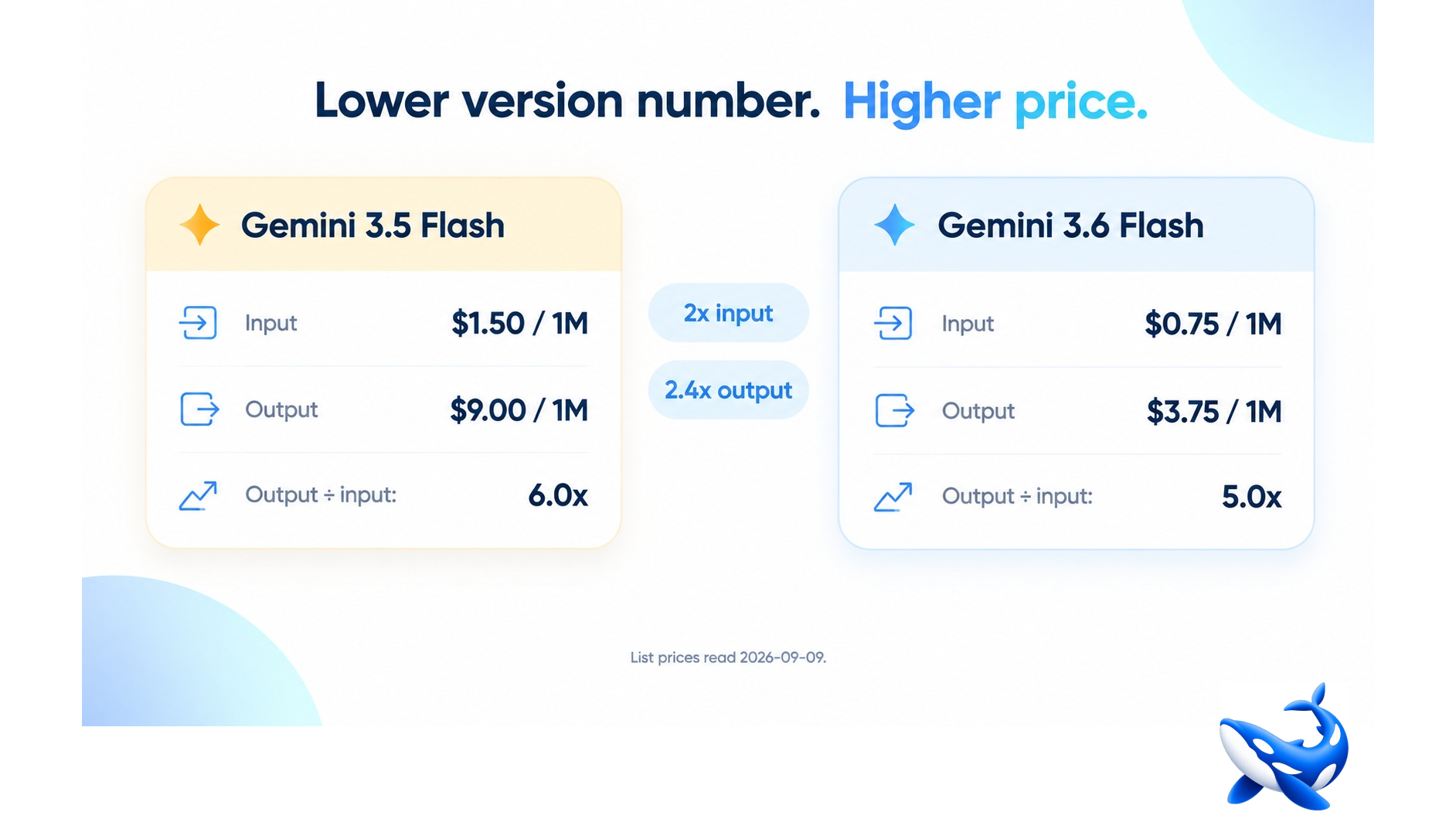
Version numbers do not order price. On OrcaRouter today, Gemini 3.5 Flash costs $1.50 in / $9.00 out per million while Gemini 3.6 Flash costs $0.75 in / $3.75 out — same family, same tier name, and the lower version number is twice the price on input and 2.4 times on output. OrcaRouter lists both side by side so the gap is visible rather than inferred — and if you built against Flash at some point and never revisited the model string, that is exactly what a stale llm pricing comparison costs you.
Prices read 2026-09-09.
The comparison
| Gemini 3.5 Flash | Gemini 3.6 Flash | |
| Input /1M | $1.50 | $0.75 |
| Output /1M | $9.00 | $3.75 |
| Output ÷ input | 6.0x | 5.0x |
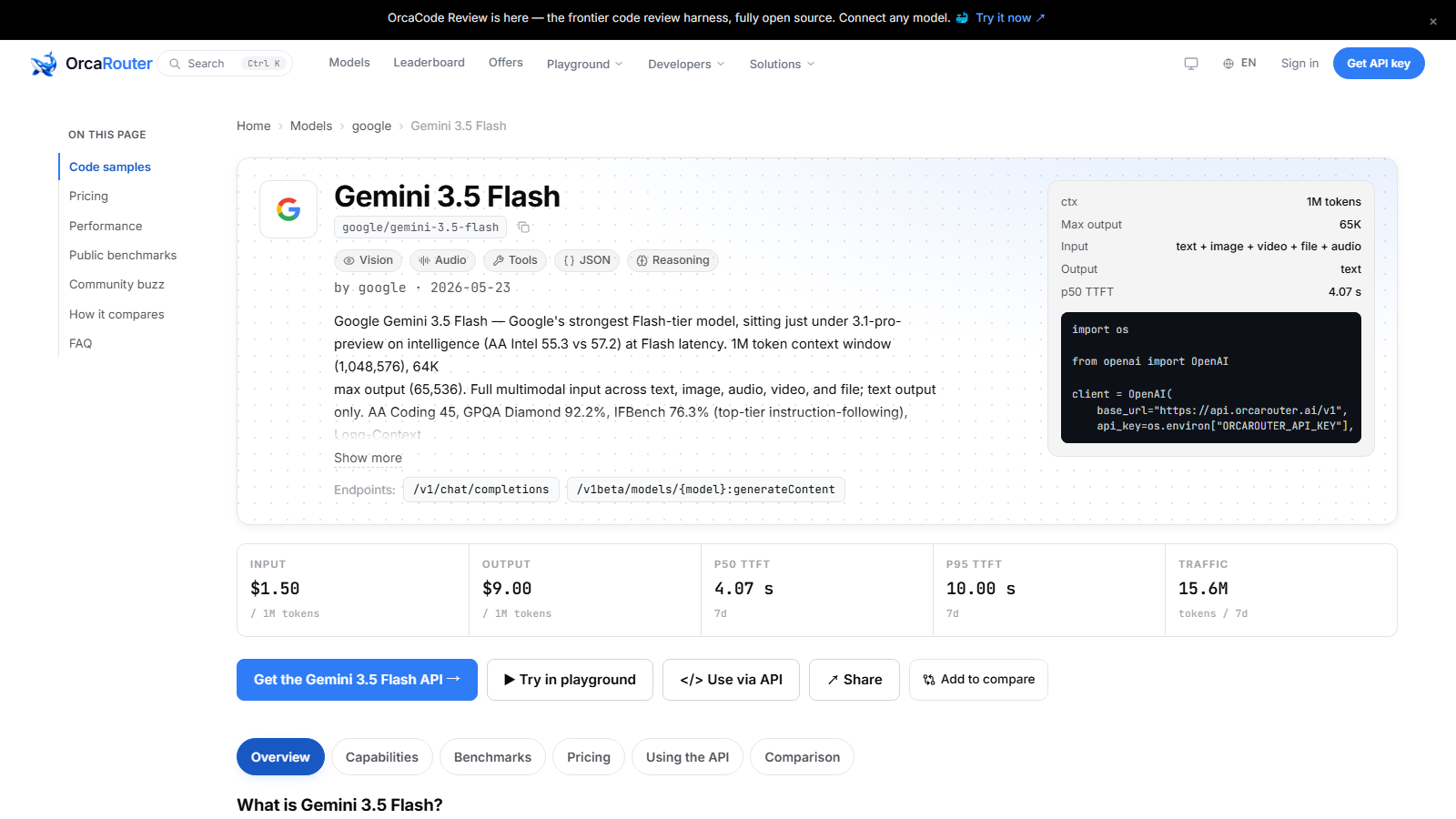
| p50 first token | 4.06 s | 10.00 s* |
\* A reporting ceiling rather than a measured value — see the caveat below.
On price this is not close. On a read-heavy call (20,000 in / 500 out) 3.5 Flash costs $0.035 and 3.6 Flash costs $0.017 — half. On a generation call (500 in / 6,000 out) it is $0.054 against $0.023.
Why this happens
Vendors price a tier, not a version. When a successor ships into the same tier, the vendor is free to re-price it — and increasingly does, downward, because serving costs fall and the competitive pressure at the cheap end is severe. The old version keeps its old price for as long as it stays available, because changing it would surprise the people still calling it.
So the drift is structural, not an oversight. Your integration named a version, the vendor shipped a cheaper successor into the same slot, and nothing in your stack noticed. No error, no alert, no change in the pricing page you originally budgeted from — because that page is about the model you are not using.
It is not only Gemini
The same pattern shows up as a *latency* inversion elsewhere in the catalogue, at identical prices:
| Same price | p50 first token |
| Claude Opus 5 — $5 / $25 | 2.52 s |
| Claude Opus 4.8 — $5 / $25 | 4.38 s |
| Claude Fable 5.1 — $10 / $50 | 4.14 s |
| Claude Fable 5 — $10 / $50 | 6.70 s |
| Qwen3.8 Max (0902) — $2 / $6 | 2.82 s |
| Qwen3.8 Max — $2 / $6 | 4.09 s |
Three pairs, identical prices, newer release faster by 1.27 to 2.56 seconds. Combined with the Gemini case, the general rule is: within a family, the newer release is at worst the same price and often better on price or speed — and your config is probably naming the older one.
The honest caveat about the Gemini pair
Two things stop this being a pure free upgrade.
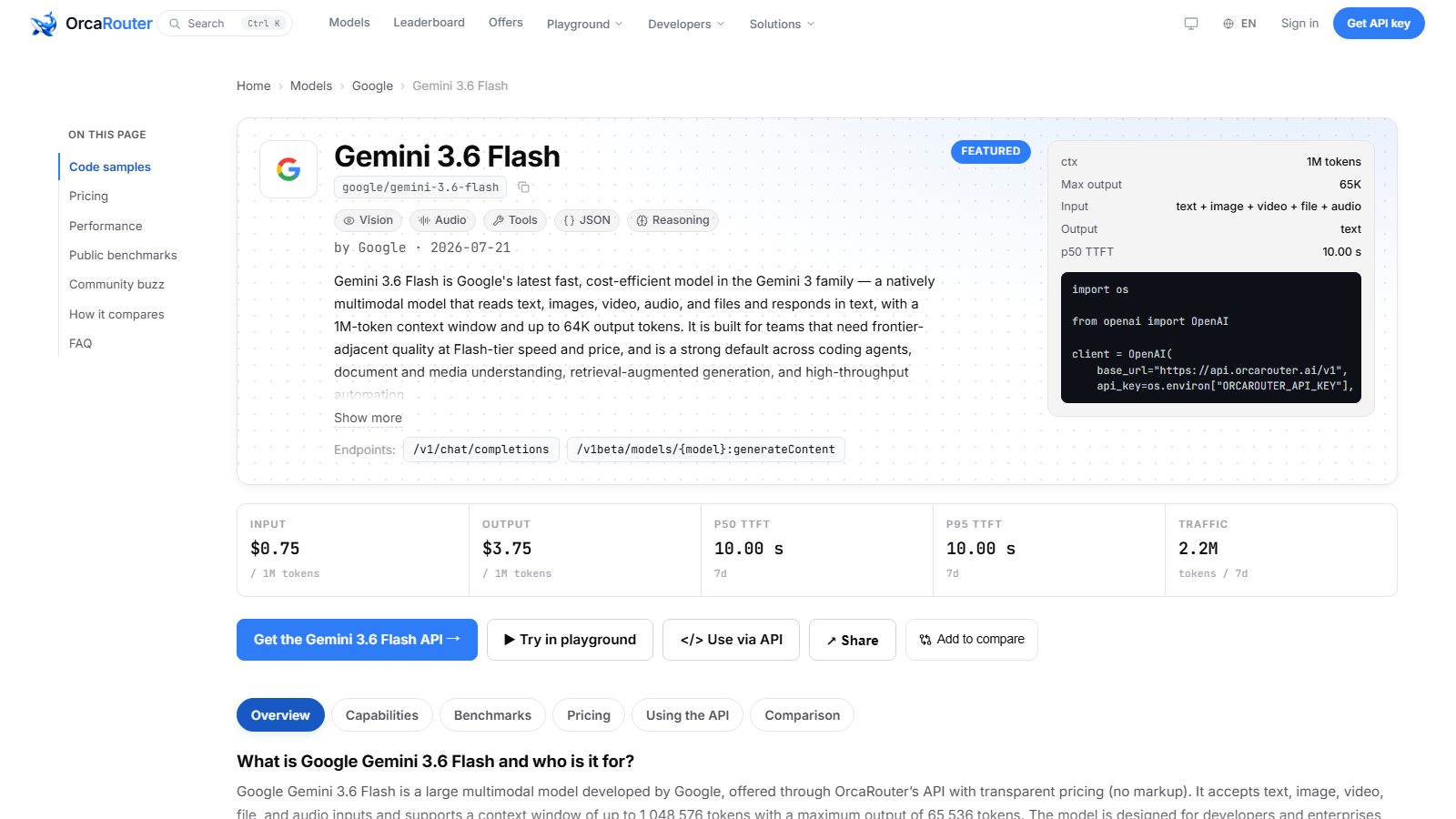
The latency figure for 3.6 Flash is not a measurement. It reports 10.00 s, which is a reporting ceiling in that telemetry rather than an observed value. So on the one axis where 3.5 Flash appears to win — 4.06 s against 10.00 s — I cannot actually tell you the newer model is slower. It might be faster. It is unmeasured, and presenting it as a trade-off would be inventing one.
Price parity is not quality parity. A cheaper successor in the same tier is usually at least as capable, but “usually” is not a substitute for testing on your task. What the price difference establishes is that the test is worth an afternoon, not that the swap is safe unseen.
Which makes the honest recommendation: run twenty of your real prompts through both, compare output quality and measure your own first-token latency, and if they are equivalent, take the half-price one.
The ten-minute audit
Once a quarter:
1. List every model string your code sends — primary, fallback and batch routes. The fallback is the one nobody revisits.
2. Open each model’s page and note input rate, output rate and p50 first token, with the date.
3. Check whether a newer release exists in the same family. If it is cheaper or faster at the same price, you have found something actionable with no analysis required.
4. Test before switching. Free to try is not the same as free to assume.
That is the whole procedure, and the Gemini pair above is exactly what it catches: a 2x saving sitting in a version string.
Where else version drift hides
The Flash pair is the expensive example. Three others are worth checking in any long-lived integration.
Dated snapshot strings. Some providers expose both a floating name and pinned snapshots — a bare model name alongside a dated variant. Pinning is the right call for reproducibility and it is also the mechanism by which you end up two releases behind, because a pin never updates itself. This catalogue contains such pairs, and the dated variants are not always the faster ones.
Fallback routes. Whatever your primary is, the fallback was configured once during an incident and has never been reviewed. It is the most likely place in your stack to find a superseded model, and it is the route that serves your users when things are already going badly.
Batch and background jobs. Nightly summarisation, embedding refreshes, report generation — all configured once, all invisible when they work, and all running whatever model was current at the time. This is usually where the largest token volume sits, which makes it the worst place to have a stale, expensive string.
The audit covers all three only if you enumerate model strings from the code rather than from memory. Search the repository for the model-name pattern and you will typically find more distinct strings than anyone expected — that list, not your recollection of the architecture, is what needs checking against current prices.
A final note on why this is worth a calendar reminder rather than good intentions. Version drift has no symptom: the integration keeps working, the invoice looks like last month’s, and the only signal is a number on a page nobody has opened. Every failure mode that announces itself gets fixed eventually; this one persists precisely because it is silent, which is why the fix has to be scheduled rather than triggered.
The takeaway
Gemini 3.5 Flash costs about twice Gemini 3.6 Flash on both sides of the meter, and the only reason anyone is paying it is that version strings outlive the pricing decisions behind them. Three other pairs on the same platform show the equivalent inversion in latency at identical prices, newer being 1.27 to 2.56 seconds faster. Vendors price tiers, not versions — so the newer release is rarely worse on cost and frequently better, and the audit that finds it takes ten minutes a quarter. Just test quality before you switch, because price parity is not capability parity.
Sourcing note: Input and output rates and median time-to-first-token figures are the list prices and production telemetry OrcaRouter passes through, read 2026-09-09. Latency figures are 7-day rolling windows that move daily and reflect its traffic mix and regions. The 10.00 s value for Gemini 3.6 Flash sits at a reporting ceiling and is not a measured latency — no claim is made here about which of the two Flash releases is faster. Prices are not a claim about output quality, which has to be tested per task.



