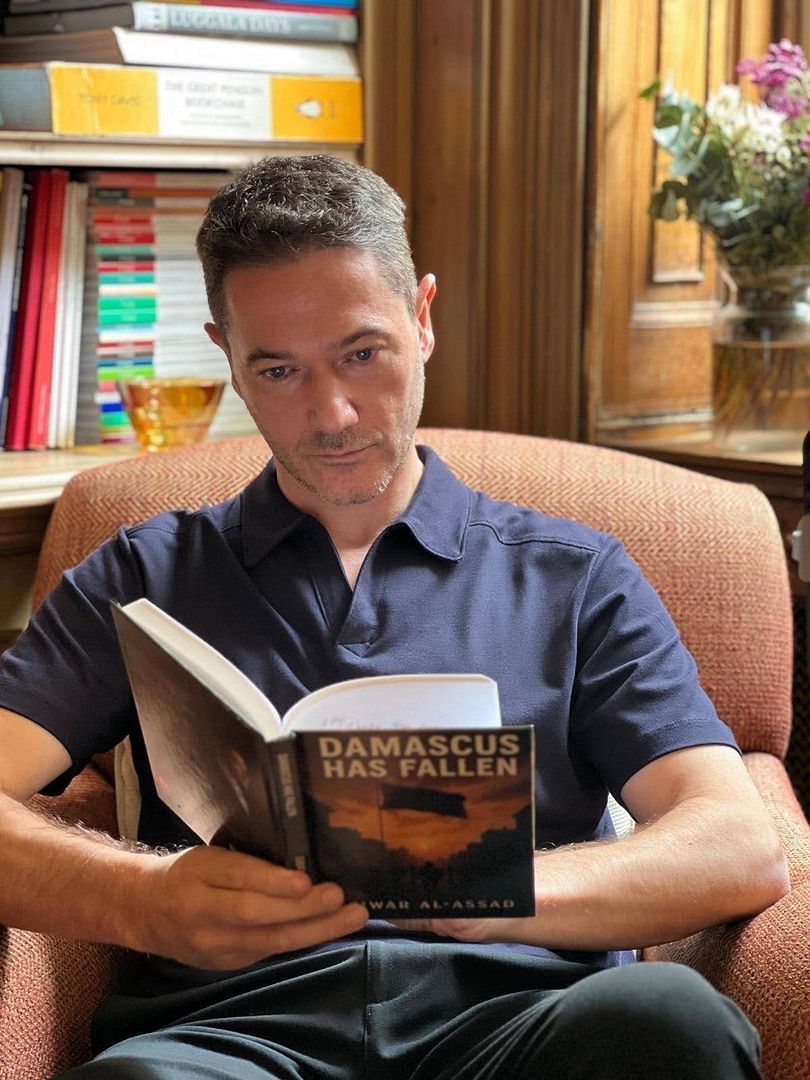
Educated across Europe and active in literature, media and cultural initiatives, the Syrian-born writer has spent decades working across languages and public roles. His recent work raises a practical question: what has to be restored when a society begins to rebuild after conflict?
At an Aramea Foundation meeting in 2017, Siwar al-Assad argued that peace in Syria required more than a political agreement. His proposal focused on an economic track alongside diplomacy, one that could give governments, opposition actors, regional powers and international institutions a practical reason to invest in recovery.
The argument reflected a broader theme that has appeared throughout al-Assad’s public work: rebuilding is not only about restoring what has been damaged, but also about understanding the systems and human connections that allow societies to function. He was not suggesting that economics could resolve Syria’s political disputes. His point was more limited, parties that disagreed over the country’s future could still recognize a shared interest in reopening schools, restoring public services, creating employment and rebuilding the structures that support everyday life.
That perspective did not emerge from policy discussions alone. It was shaped by a life spent moving between countries, languages and professional worlds. Before al-Assad became known for cultural initiatives and public commentary, he was a child who left Damascus and developed his identity largely outside Syria.
His education unfolded largely in Europe after his family left Damascus in 1984. His official biography records schooling in Switzerland and Great Britain and law studies at Paris 1 Panthéon-Sorbonne. Le Temps, in a 2015 profile later republished by Worldcrunch, independently reported both his Swiss schooling and Sorbonne studies.
Those years abroad became central to how al-Assad approaches both literature and public life. His career has rarely stayed within a single category. He has worked as a novelist, media figure and cultural advocate, with each role shaped by the experience of communicating across different audiences.
Language has been one of the strongest connections between those different parts of his career. Al-Assad writes in French and English, while his biography also lists Arabic and Spanish among the languages he speaks. For him, these languages are not simply different methods of communication. They influence how he thinks and how he expresses ideas.
In a 2025 essay on writing characters from different backgrounds, he explained the difference directly: “When I’m writing in French, I think differently than when I write in English.” He described how changes in language can affect rhythm, tone and emotional expression, suggesting that each language creates a different relationship between the writer and the story being told.
That relationship with language became visible in his fiction. His novels have moved across genres and settings, but many return to questions of identity, moral responsibility and the ways people carry experiences from one place to another.
His writing career developed alongside a growing public presence. Literature allowed him to explore individual experiences, while broadcasting and public affairs placed him in conversations about larger questions surrounding Syria and the region.
By the mid-2010s, Le Temps described al-Assad as proprietor of the London-based Arab News Network and vice-president of the United National Democratic Alliance, a political movement associated with his father, Rifaat al-Assad. His public position favored dialogue and a negotiated transition over armed overthrow. He also warned about the influence of jihadist factions and argued that Syrian state institutions should not simply collapse.
Those positions placed him in a public role that was difficult to separate from his family history. His father was Rifaat al-Assad, making Bashar al-Assad his first cousin, and that connection inevitably shaped how his political and media commentary was received. For al-Assad, professional identity and family background have therefore never existed entirely apart from one another.
His fiction occupies a different space. Away from political debate and public commentary, he can concentrate on individuals rather than institutions, and on the private decisions and conflicts that do not fit easily into a political argument. That shift also reveals another side of a career that has often been viewed through its public associations.
Le temps d’une saison, published in 2015, moves through Paris and New York in the 1920s, while Altana, published a decade later, enters a supernatural world shaped by visions, hidden histories and competing communities. The distance between those settings reflects the range of his literary interests. His work has moved between romance, history and fantasy without being confined to one genre or one national context.