
There is a moment, in the busiest Indian restaurants from Toronto to the Bay Area, when the whole room seems to lean toward one corner of the kitchen. A cook reaches into a waist-high barrel of fire, forearm wrapped in cloth, and presses a pale disc of dough against the inside wall. Thirty seconds later it comes out blistered, puffed and freckled with char, and the smell that follows it through the pass is older than almost anything else on the menu.
That barrel is a tandoor, and it is quietly one of the oldest pieces of cooking equipment still working a full dinner service anywhere in the world. The dishes it produces — naan, tandoori chicken, seekh kebab, paneer tikka — are now so familiar across North America that it is easy to forget they all depend on a single, stubbornly ancient idea: fire, contained inside clay.
Follow the clay oven back far enough and you arrive somewhere a long way from a stainless steel kitchen line. Follow it forward and you land in some of the most demanding commercial kitchens on the continent. The story in between explains why the restaurants most serious about authenticity still refuse to cook without one.
A Technology Older Than the Recipe Book
Clay ovens with the familiar open-topped, cylindrical shape have been found at archaeological sites across the Indus Valley, Central Asia and the Middle East, some of them thousands of years old. The word itself travelled a long road: related forms of it turn up in Persian, Turkish, Arabic, Armenian and Hebrew, each language naming its own version of essentially the same device. Long before anyone wrote down a recipe for naan, people across a vast stretch of the ancient world had worked out that a thick-walled clay vessel, heated from below, could bake bread and roast meat better than an open fire ever could.
In the villages of Punjab, the northwestern frontier and Afghanistan, the tandoor was rarely a private appliance. It was a shared one. A communal clay oven, often dug partly into the ground or built up in mud and straw, would be fired in the late afternoon, and families would bring their dough to the neighbourhood baker or take turns at the oven themselves. The tandoor was where news was traded and marriages were discussed while the bread cooked. Its heat was a public resource, and its bread was the daily rhythm of village life.
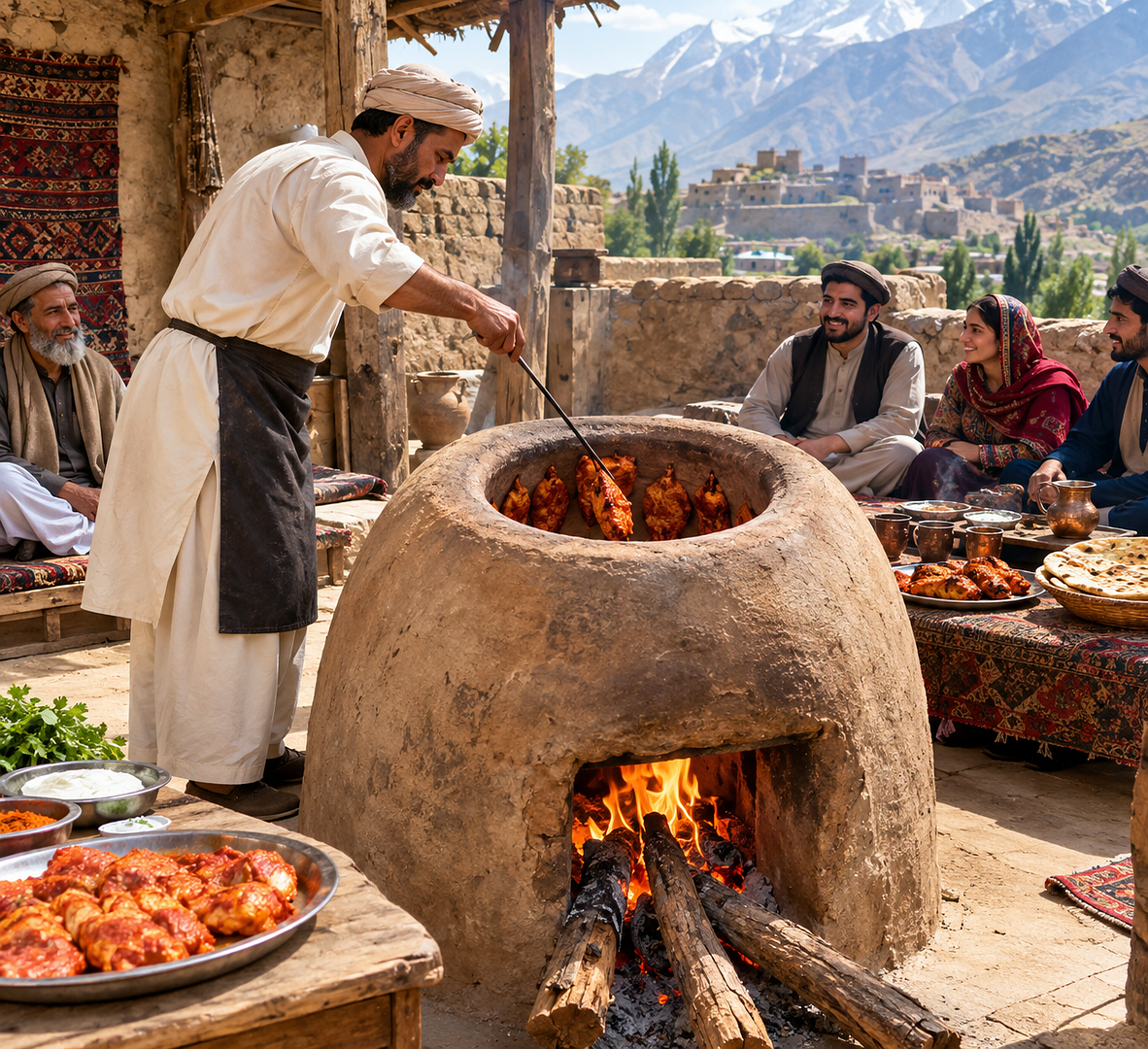
Those early ovens burned whatever the landscape offered — wood, dried dung, charcoal from the local fires. The clay was dug nearby, mixed with straw or animal hair to hold it together, shaped by hand and cured slowly in the sun and then in the heat of its first firings. No two were identical, but all of them did the same remarkable thing, and it is worth understanding exactly what that is.
Why Clay Changes Everything
A tandoor cooks in three ways at once. The fire at the base throws direct, live-flame heat upward. The clay walls absorb that heat for hours and radiate it back inward with an intensity that metal simply cannot match, holding working temperatures of 800 to 900 degrees Fahrenheit. And because the top is open, a column of hot air rises through the chamber the whole time, wrapping everything inside in convection. The result is a cooking environment that is both brutally hot and remarkably even.
That is what makes the signature dishes possible. Naan is slapped directly onto the hot wall, where gravity stretches it into its characteristic teardrop shape as the underside sears against the clay and the top blisters in the rising heat. It is done in well under a minute and stays soft inside. Meats go in vertically, threaded on long iron skewers lowered into the core of the oven. The outside sears almost instantly while the juices run down the skewer and baste the meat as it cooks, rather than dripping away onto a grate the way they would on a grill.
Then there is the flavour, which is the part every chef mentions first. Food cooked in a clay oven carries a smokiness that is hard to describe and impossible to fake: part char from the wall, part perfume from fat meeting live flame, and part the faint, earthy note of the clay itself. It is the difference diners feel between a restaurant tandoori chicken and a home version made under a broiler, even when the marinade is identical. Chefs sometimes describe it simply as the taste of the oven.
From the Village to the World
For most of its long history, tandoori cooking was regional village food. The modern restaurant version — the one that eventually crossed oceans — is widely traced to the upheaval of Partition in 1947, when cooks from the northwest of the subcontinent resettled in Delhi and brought their clay ovens with them. Restaurateurs in the city, most famously at Moti Mahal in Old Delhi, are widely credited with taking the tandoor out of the courtyard and putting it at the centre of a restaurant menu, turning tandoori chicken, butter chicken and naan into dishes that diners, politicians and eventually visiting dignitaries sought out.
From Delhi the style spread across India and then outward with the diaspora. In Britain it became the backbone of the curry house. In Canada and the United States it arrived with immigrant families who opened restaurants in the neighbourhoods where they settled — Edison and Jersey City, Brampton and Mississauga, Queens, Chicago’s Devon Avenue, Houston, the Bay Area — and who needed, above all else, a working clay oven to cook the food their customers had grown up eating.
For a long time that was harder than it sounds. Early restaurateurs often had ovens shipped from overseas at great cost and greater risk, or had them improvised locally by builders who had never seen one fired. Clay cracked in transit. Ovens arrived without documentation. And then they met the North American commercial kitchen, which turned out to be a very different environment from a village courtyard.
When the Village Oven Met the Health Inspector
A modern restaurant kitchen in the United States or Canada is a regulated space. Every appliance that touches food has to satisfy a health department. Every gas appliance has to satisfy a mechanical inspector and a fire marshal. Insurers want to know what they are underwriting, and landlords want to know what is being installed in their building. A hand-built clay oven with no markings, no testing and no paperwork answers none of those questions — and more than a few restaurant openings have stalled for weeks at exactly that point.
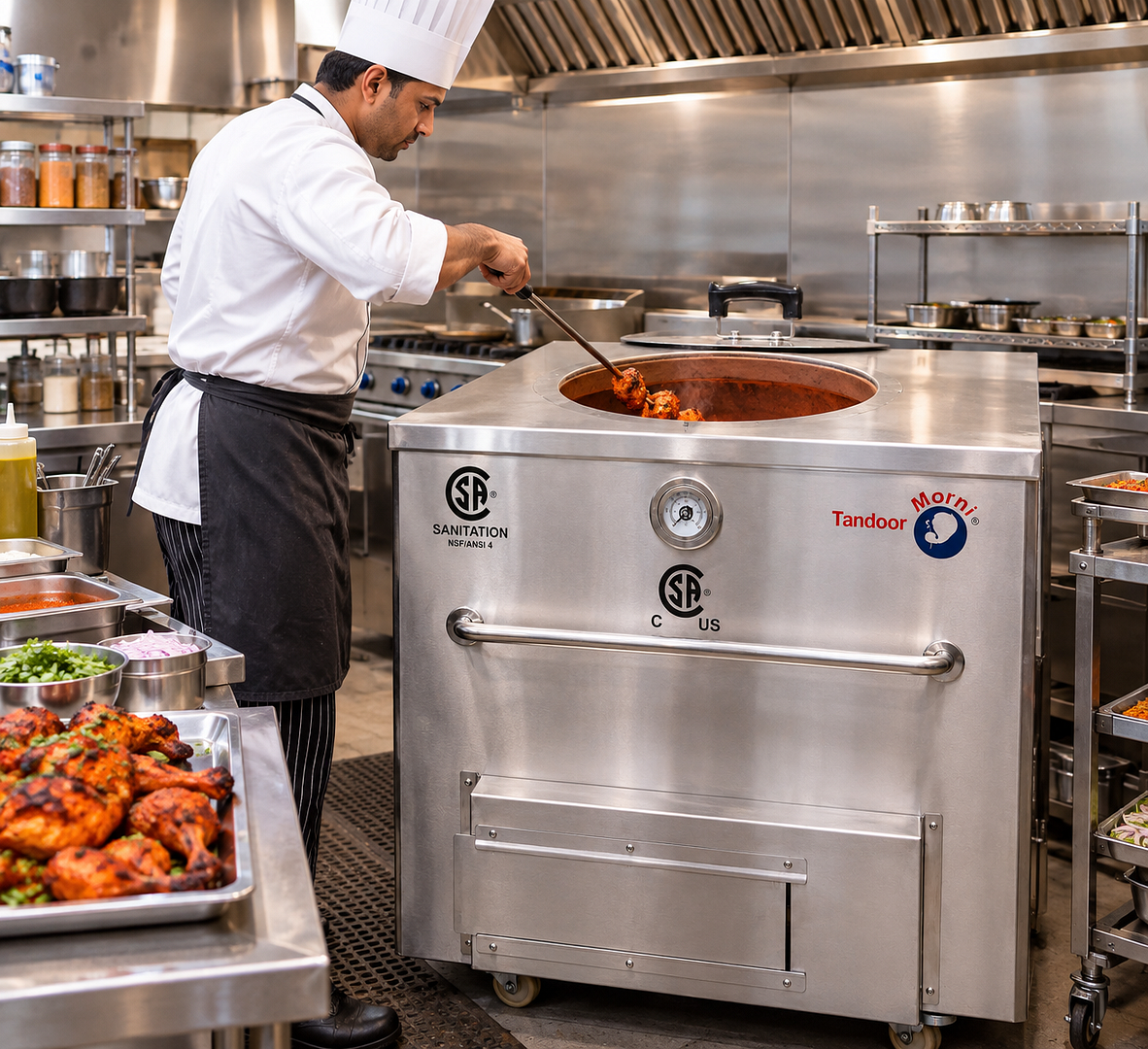
The challenge for the industry was to keep what makes the tandoor irreplaceable while engineering away everything that made it a problem. The answer that emerged was a kind of nesting: the traditional clay chamber kept at the heart of the oven, and wrapped in a modern body built for a commercial kitchen. Stainless steel outer housings that can be wiped down and sanitised. Insulation is packed between the clay and the steel so the heat stays inside the oven rather than cooking the line cook standing next to it. Tested gas burners and controls in place of an open wood fire, so the oven lights consistently and runs predictably through a ten-hour service. Wheels, so the oven can be moved for cleaning or installation.
From the outside, a modern commercial tandoor looks almost nothing like its ancestor. On the inside, where the food actually cooks, it is essentially the same oven: a clay wall, a fierce and even heat, and a live flame below.
A Workshop That Grew Up Alongside the Cuisine
One of the manufacturers that has spent decades working on exactly that balance is Tandoor Morni, which began building clay tandoor ovens in 1992 and has grown into a North American manufacturer with showrooms across the United States and Canada. The company’s philosophy has stayed notably close to the oven’s origins: the clay is still formed and finished by hand, and everything built around it is there to let that clay do its job inside a modern, regulated kitchen.
That starts with the material that matters most. Tandoor Morni builds its ovens around authentic clay that is free from chemicals — no synthetic binders or additives sitting against food at 900 degrees Fahrenheit — housed in food-grade stainless steel. That materials discipline is what underpins the company’s CSA Sanitation NSF/ANSI 4 certification, the recognised sanitation standard for commercial food-service equipment. The company states that it is the only tandoor oven manufacturer in North America to hold both that sanitation certification and CSA Z83.11 certification for gas-fired commercial equipment, the pairing that answers the health inspector’s question and the gas inspector’s question at the same time.
“The clay is the tradition, and we have never tried to replace it,” said Parvinder Aulakh, spokesperson for Tandoor Morni. “What we build around it is there so that a chef in Toronto or Houston can cook exactly the way cooks did a thousand years ago, and still pass every inspection on opening day.“
The company’s range reflects how far the oven has travelled from the village. Its ovens are built for charcoal, wood and gas, because different kitchens need different fires. Gas is the workhorse of indoor restaurant kitchens, where consistency and code compliance decide everything. Charcoal and wood-fired models are the choice of caterers, patio programmes and purists who want the deepest possible smoke and are cooking outdoors, where that smoke is an asset rather than a ventilation problem.
What Authenticity Actually Means on the Plate
It is tempting to treat authenticity as a marketing word, but in a tandoor kitchen it is surprisingly concrete. Diners have learned to read the signs. They know that real tandoor naan is teardrop-shaped from hanging on the wall, not perfectly round from a sheet pan. They know the irregular charred bubbles on its surface, the blackened edges on a proper seekh kebab, the deep red-orange of tandoori chicken that has been marinated overnight and seared in real heat rather than tinted with food colouring. In an open kitchen, they can watch the oven itself, and many of the best Indian restaurants in North America build their dining rooms so that they can.
The tandoor is also more versatile than its meat-heavy reputation suggests, and that matters in a region with a large vegetarian dining public. Tandoors are used to make both vegetarian and non-vegetarian tandoori dishes in almost equal measure. On one side of the menu: paneer tikka with blistered corners, whole cauliflower florets roasted until smoky, stuffed peppers and mushrooms, and the entire bread basket — naan, tandoori roti, kulcha, laccha paratha. On the other: tandoori chicken, seekh kebab, lamb chops, fish tikka and prawns that cook in barely two minutes. Halal grill houses, Afghan kebab restaurants and Middle Eastern kitchens run their own traditions through the same clay, which is why the oven now appears across so many cuisines at once.
The Hands That Work the Fire
None of this works without the cook. Slapping dough onto a vertical clay wall at 900 degrees Fahrenheit, without losing the bread to the coals or the hair on your forearm to the heat, is a skill built through thousands of repetitions. Experienced tandoor cooks — tandooriyas, in the kitchens of the subcontinent — are among the most sought-after hires in South Asian restaurants across North America, and many of them learned the craft from fathers and uncles in Punjab, Karachi or Kabul. They read the oven by the colour of the clay and the sound of the flame. They know which part of the wall runs hottest late in a service and where a delicate kulcha should go. The clay oven has survived for millennia partly because it was never really a machine. It is a partnership between a fire and a pair of practiced hands.
Who Is Buying Clay Ovens Now
The market for tandoors in North America looks very different from the one that existed when the first immigrant restaurateurs were hunting for an oven that would survive the journey. Full-service Indian restaurants are still the core, and many now run two ovens to keep up with bread orders on a busy night. But they have been joined by fast-casual South Asian concepts serving tandoor-cooked proteins at counter-service speed, hotel banquet kitchens and wedding caterers who use a glowing clay oven as live-cooking theatre, and food trucks carrying compact models built to travel.
For operators at that stage, the practical questions are well established. Size follows the menu: a high-volume dining room turning out hundreds of naan a night runs a large-mouth commercial unit, while a caterer may prefer several smaller portable ovens. Fuel follows the setting. And certification follows the local code, which is why buyers comparing any tandoori oven for sale are advised to check for recognised sanitation and gas certification on the oven body itself before a health inspector does it for them, and to ask who will supply the replacement clay liner and parts in year six, not just who is offering the best price in year one.
A growing share of the demand also comes from somewhere the village baker would have recognised instantly: home. Serious home cooks — the same people who put wood-fired pizza ovens and ceramic kamado grills in their backyards over the past decade — have started buying compact residential tandoors, and for many South Asian families the appeal goes beyond the food. A clay oven on a suburban patio is, in a small way, the communal tandoor of a grandparent’s village, gathering family around it on a Sunday afternoon while the bread comes off the wall.
The Oven That Refuses to Change
It is striking how little the core of the tandoor has changed, given how much the world around it has. The kitchens are different, the fuels are different, the regulations would be unrecognisable to a Punjabi village baker, and the diners now include people who have never set foot in South Asia. Yet the thing at the centre of it all is still a clay cylinder, intense heat, a live flame and a cook who knows how to use them.
That continuity is exactly why the tandoor has become shorthand for authenticity in North American dining. Much of modern restaurant cooking chases novelty; this oven is valued because it has barely moved. The engineering has simply caught up with it, making room for an ancient technique inside a modern kitchen without asking it to become something else.
For the chefs, caterers and home cooks now looking to bring that technique into their own kitchens, the gap between the village oven and the modern one has never been narrower. A certified, clay-lined tandoor for sale in North America today is, at its heart, the same oven that fed travellers and villagers for thousands of years — just built to pass an inspection, run on the fuel of your choice, and roll into place on the morning your kitchen opens.
Visit Tandoor Morni
Tandoor Morni Manteca, California
2142 W Yosemite Ave, Manteca, CA 95337
727-251-6924
Footer: Social Media Links
- Facebook: https://www.facebook.com/profile.php?id=61594602412752
- Instagram: https://www.instagram.com/tandoor.morni
- X (Twitter): https://x.com/mornitandoor
- LinkedIn: https://www.linkedin.com/company/morni-tandoor/
- YouTube: https://www.youtube.com/@tandoormorni
- WhatsApp: +1 727-251-6924 (link as https://wa.me/17272516924)



