Louise Wan’s work uses kinetic sculptures to explore labour under capitalism and the effects that automation has on human beings. I sat down with her to discuss the experiences that shaped her work and her pieces in the upcoming group show Explicate.
Thank you so much for taking the time to speak with 1883. To start, can you tell us what drew you to becoming an artist?
I’ve drawn since my childhood, and after secondary school, I chose to study art. The turning point was when I started to make more sculptures, especially kinetic sculptures, in my third year at Central Saint Martins. I realized that movement allowed the work to exist more independently, and repeat action endlessly. Before, I was making paintings or performance art, but over time I am translating those ideas into sculptural forms.
How did you get involved with the group show Explicate?
A year ago, I was in a show at LumiNoir [Art Gallery], which is where Explicate is going to be, and that show was called Enthrall. I was showing my piece Mouthless for the first time and it was when my work began to gain more visibility. I was honoured to be invited to join the new show, which is Explicate. I’m really excited to show my other pieces in this new context.
What works do you have in Explicate?
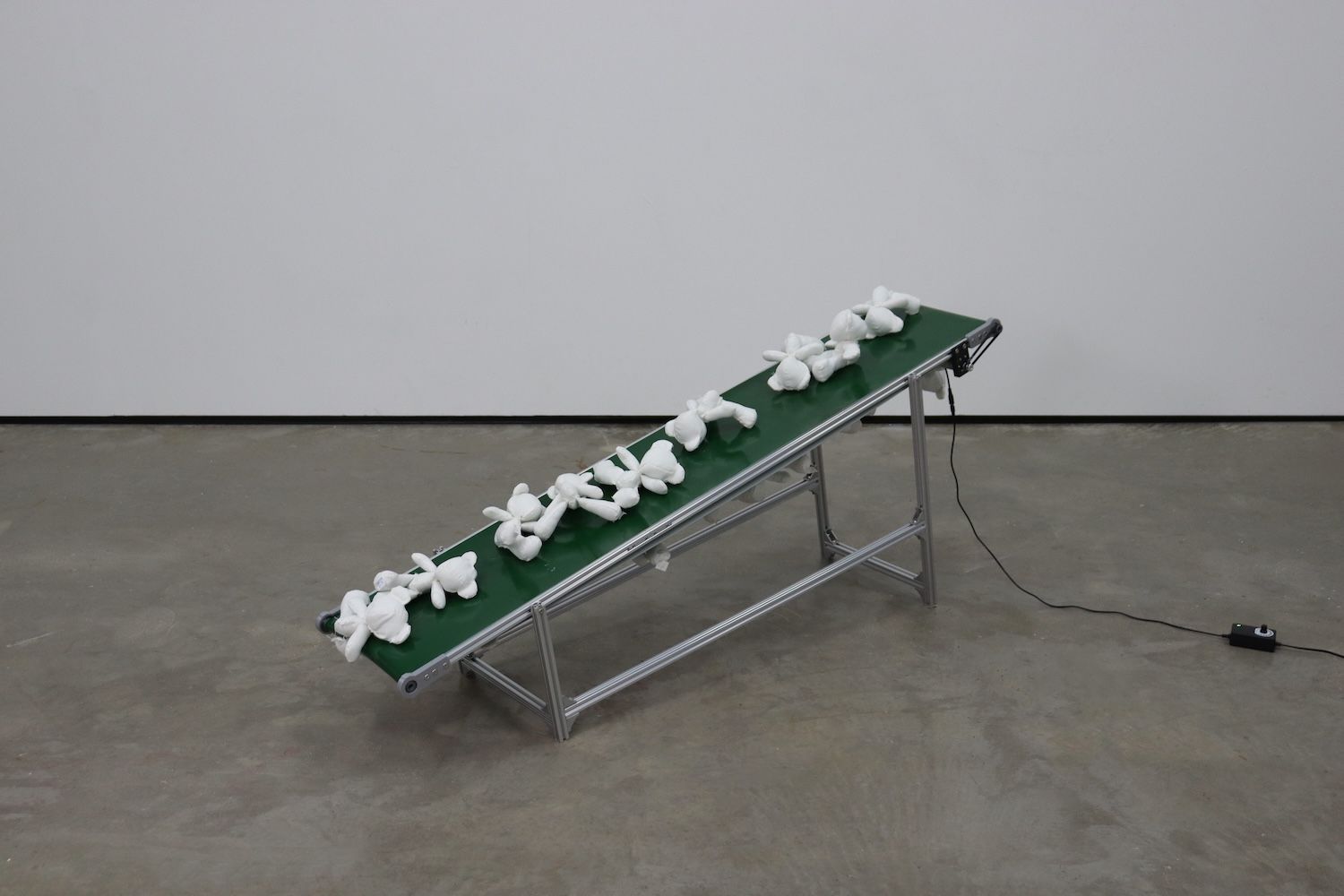
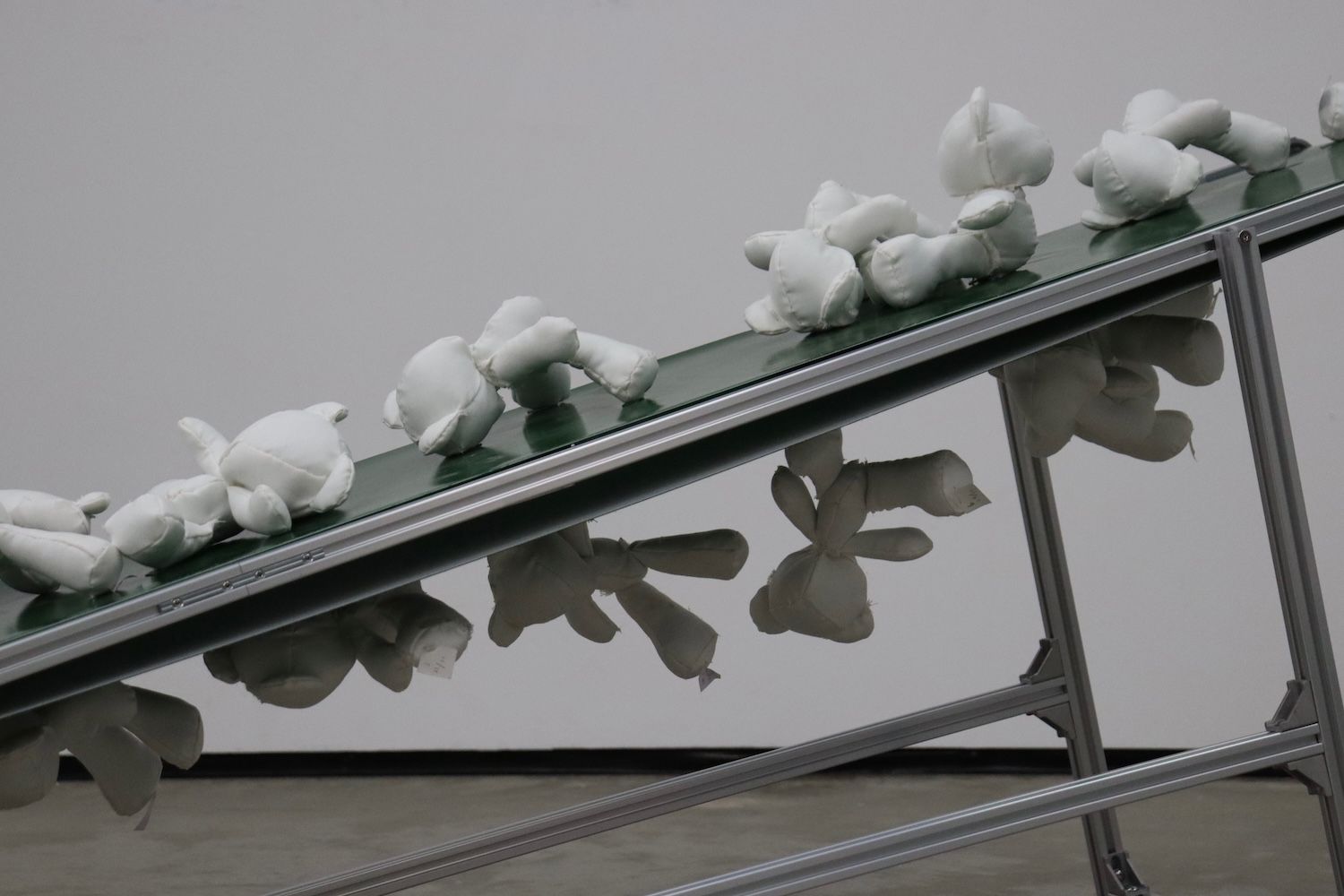
I’m showing two works that I did during my studies at Central Saint Martin’s. Collective Infection, which is a conveyor belt of stuffed toys. I sewed all of the stuffed toys myself, and I assembled the conveyor belt. It draws on the history of home based toy assembly in 1960s Hong Kong, which was inspired by my grandma’s experience of her domestic space becoming an extension of the factory. I have used this familiar image of the teddy bear, because of its ubiquitous nature. The work reflects how labour cycles persists across generations under capitalism.
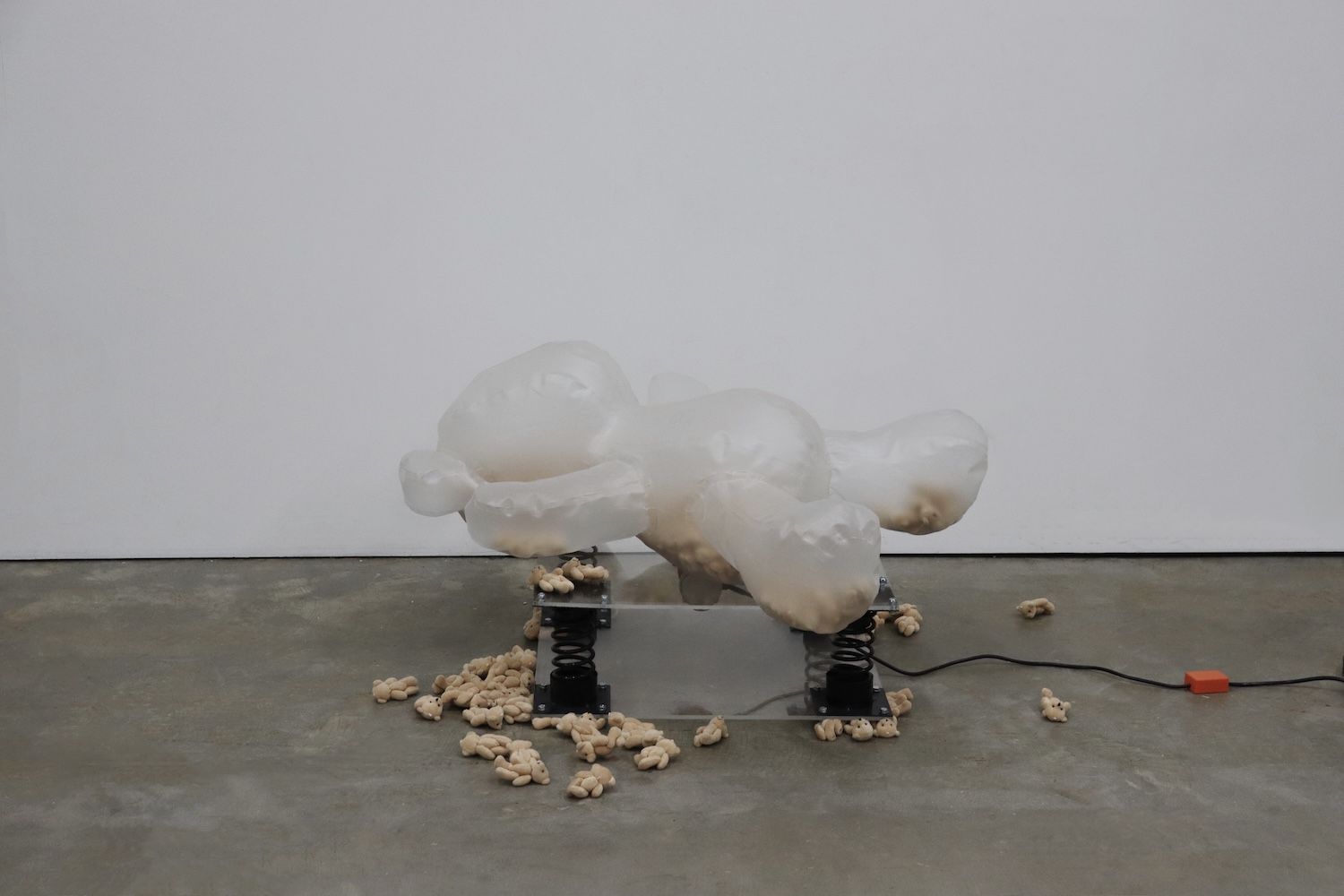
After making this work, I was trying to continue this investigation through inflatable forms. In All & 1, I used small ready made teddy bears that are mass-produced. I designed the inflatable using a 3D sculpting app, and fabricated in physical form. The work explores the tension of cuteness, exploitation and the hidden violence within the system of mass production.
Through exploring these two works I started to look more deeply into labour, and eventually I shifted the focus on labour to automation in my further practices. The idea of machines operating autonomously led me to reflect further on how automation both emerges from and perpetuates the exploitation of labour.
Your work suggests automation still depends on human labour. Are you exposing a myth of a frictionless system or something deeper about capitalism?
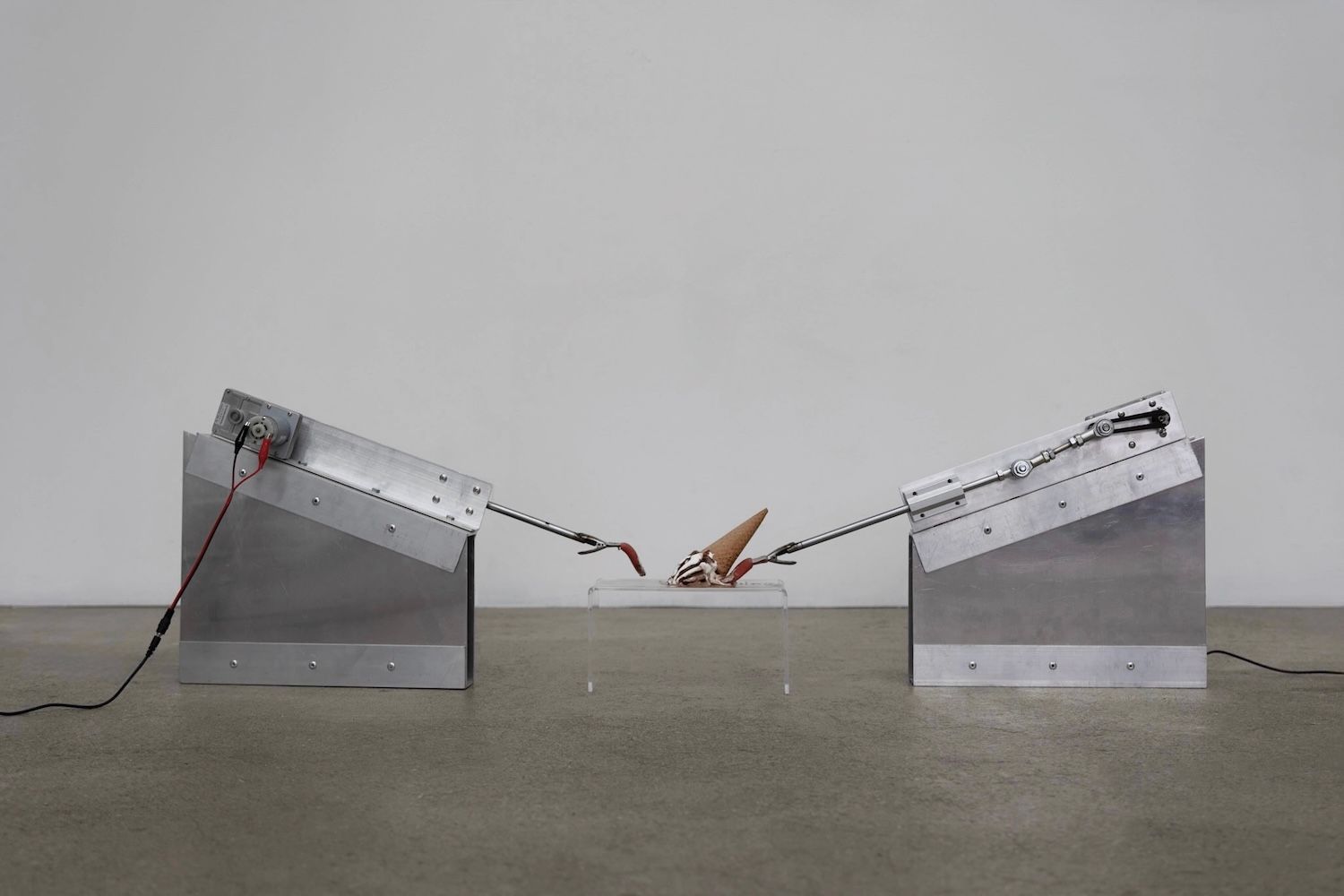
Beyond the mechanics, these machines point to something much deeper about labour under capitalism. We often think of replacing the human element, but in my practice I think of the machine as a proxy of the human body. When I’m staging a machine that performs a repetitive or futile task, I’m not just showing a machine at work, but also the automation of desire and exhaustion.Under the capitalist system, we are often reduced to functions where we are expected to be as consistent and tireless as the machines. By making these machines perform human acts I’m trying to highlight how our humanity is being ‘machined’ out of us.
You built the machines yourself, so there’s also a process of you doing manual labour to make the machines that are replacing the labour. There’s an interesting dynamic there.
Most of my works are performative, they’re not creating any productivity or doing any actual actions that could relieve our workload. That’s one of the ideas that I want to present through my works, which is more absurd because I wish to try to find the truth under the falsehood. Apart from capitalism, my work focuses on the structure of systems and how labour feels automated into exhaustions or fatigue.
Your work often stages controlled systems that quietly break down, which relates to what you were saying about exhaustion. Are you drawing out a tension between control and autonomy?
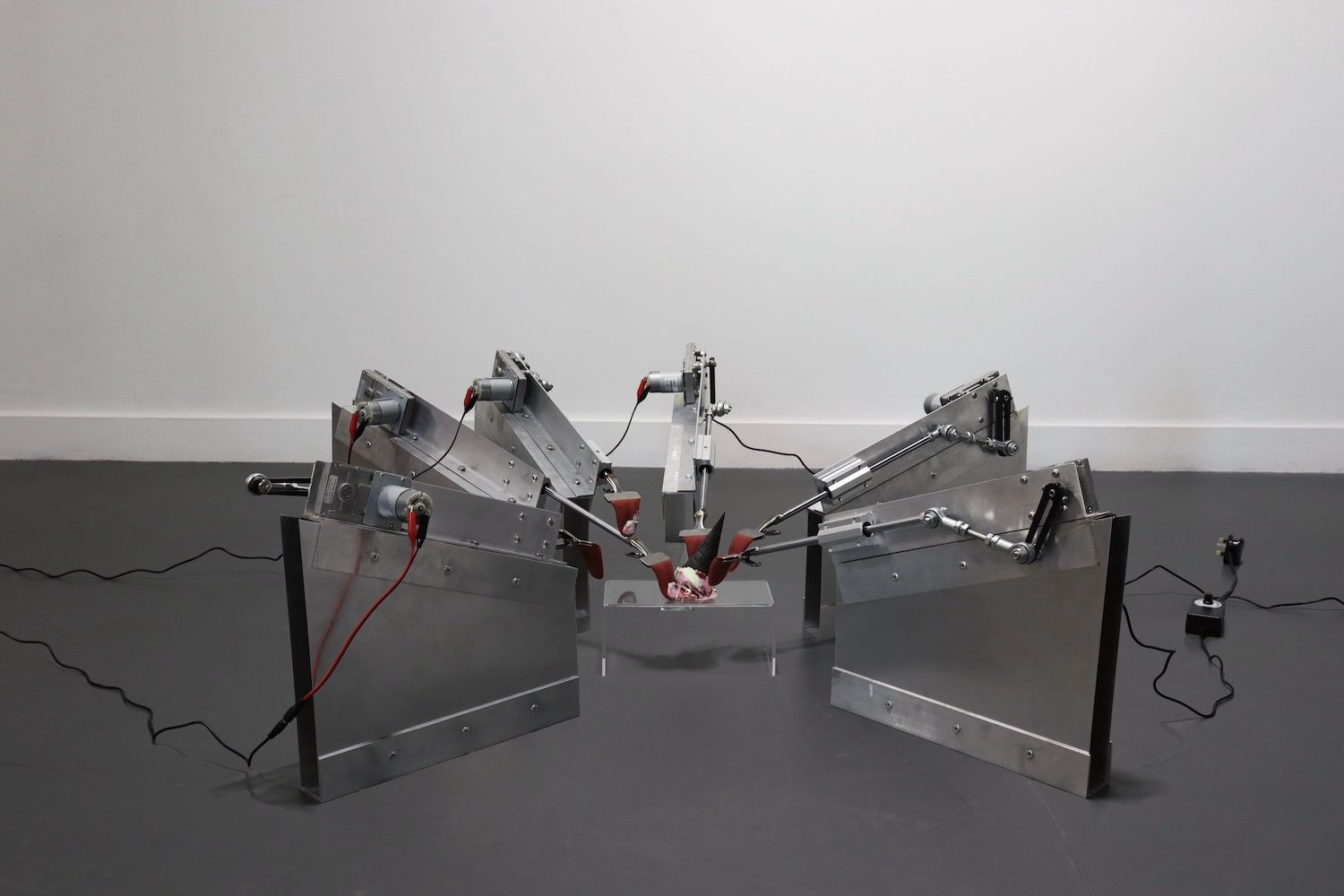
A lot of my works are under controlled chaos, which I’ve always been fascinated by. The invisible structure of our lives, the scripts, loops or protocols that we follow without questioning them. What draws me to control systems is that they represent the promise of stability and precision, but the precision is often masked for a kind of quiet violence. When I’m staging these systems, I try to make this invisible control visible.
In the piece I showed in Rebuild Babel [a group show curated by The Green Grammar], Orbit of Obedience, [consisting of devices in a circle that use fans to make balls float] it’s invisible but visible as well. What I am representing through my work is that a system can be perfect, but ultimately serve no human purpose.
I think back to autonomy and control. There’s a tension where the human element lives between. In my practice, I often use machine autonomy as a mirror for our own belief that we are moving freely, like a levitating object, or a worker in a specialized role, but we are frequently following a pre-ordained circuit. I’m interested in that friction, that point where the machine as the system and the body as the autonomy start to pull in different directions. There’s a gap between what we are told to do and what we desire.
Repetition runs through your work. Is that discipline, violence or ritual? Where does rupture sit within that?
Repetition in my work exists somewhere between discipline, violence and ritual, rather than belonging to one category. It begins as a system meant to create order or efficiency, but through continuous looping, it becomes exhausting and almost oppressive.
At the same time it carries a ritualistic quality. It is performed so often that it feels natural or inevitable. It resembles ritual, because it’s normalized and unquestioned behavior. I’m interested in how rupture exists as a glitch or a fatigue within that loop, because it is the moment a system refuses its limit by continuing to labour, even when that labour achieves nothing. There’s a friction between functioning and failing, where the tension lies.
Do you see your work as an alternative to language or is it about how language breaks down?
My sculptures exist somewhere between an alternative language and a breakdown of communication. They communicate through movement, rhythm and repetition, rather than words. Meaning is felt physically before it is understood intellectually and at the same time, the loop never fully reaches its stop.
The gestures repeat without reaching completion, which introduces a kind of communicative failure. I’m interested in the space where something is clearly expressing itself, but remains slightly inaccessible. The machine seems to speak, but they cannot explain themselves, and the tension mirrors how communication in contemporary life is often continuous but never fully satisfying.
What are the themes of Explicate and how is your work responding to them?
Explicate means to develop or analyze in detail. My pieces respond to this idea by presenting systems that cannot fully be explained through language, but become clear through experience. Rather than offering a fixed narrative, the pieces allow viewers to observe repetition, movement and break down over time.
Through these kinetic actions, the structures of labour, control and desire is revealed gradually, and the meaning emerges not from explanation, but from the audience witnessing the system operating, almost as if the work is explicating itself.
What do you have planned for the future after Explicate?
I’m thinking about how the kinetic systems can expand beyond individual sculptures into larger environments, because right now most of my pieces are quite small in scale. I’m interested in creating scenarios where multiple machines can interact with each other. Right now, they are under a controlled loop independently. I’m trying to make something where they could influence one another, to create more collective behavior and be less predictable.
Moving forward, I want to explore how audiences physically encounter these systems. How proximity, sounds and duration shape emotional responses. I hope my future work could be a space where control and autonomy are experienced collectively, rather than observed from a distance.
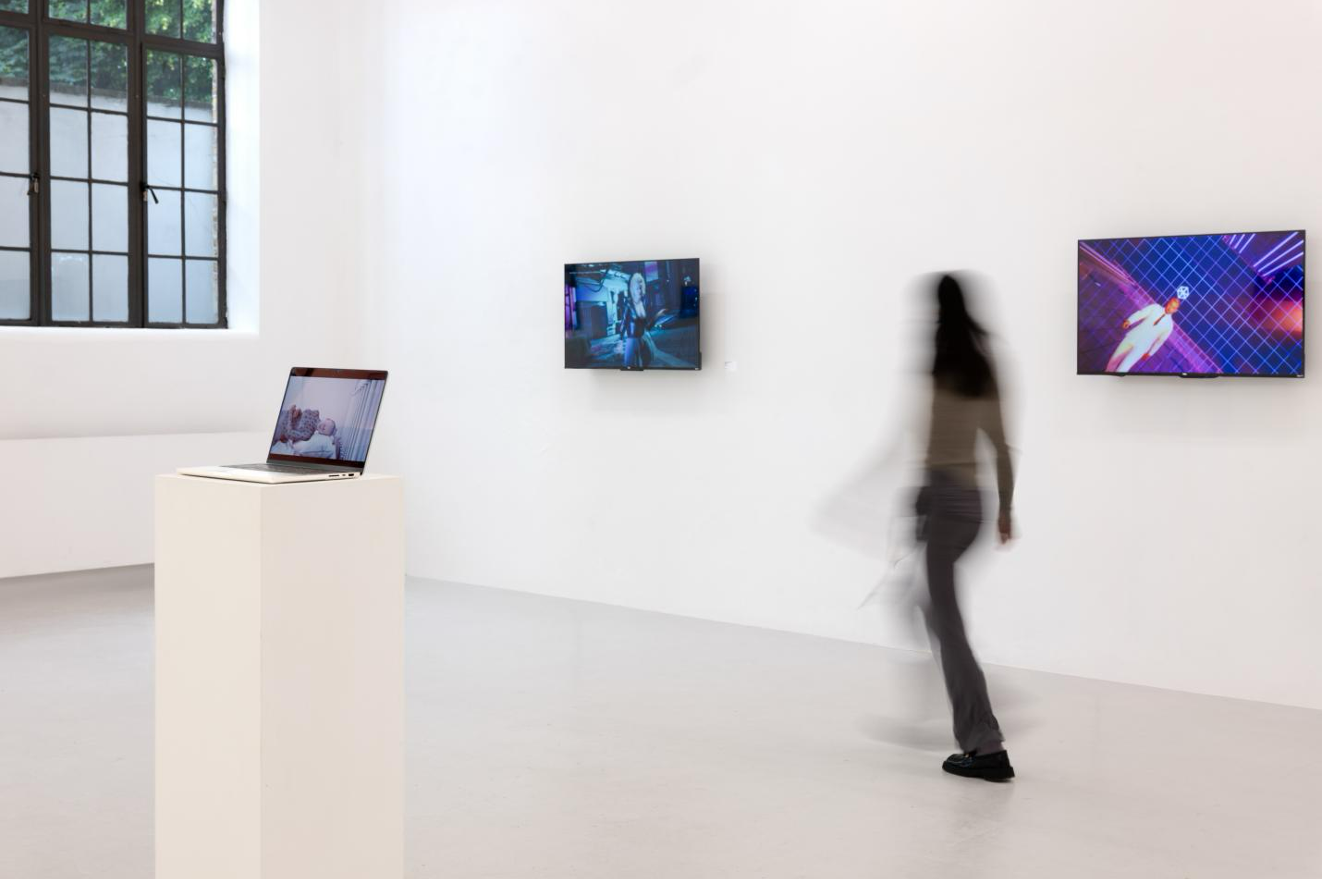
Explicate is at LumiNoir Art Gallery from Thursday the 2nd of April to Tuesday the 7th of April.
Further information about the artist at louisewan.cargo.site.
Further information about the gallery at luminoirart.co.uk.
Interview Alastair Ball