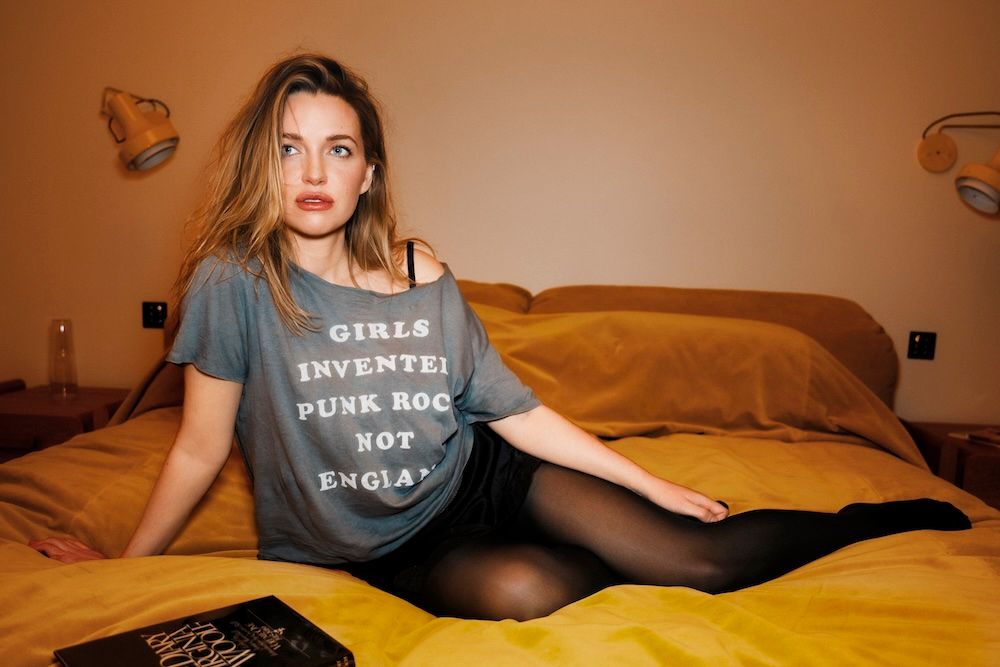
Singer-songwriter Jordan path into music has been anything but conventional. After spending years dedicating herself to political activism and social empowerment, the Irish creative ventures into fresh territory with music. Her latest single, ‘LED Moon’, is a hypnotic blend of shimmering synths and hazy, late-night dream-pop. The track transports the listener to the entrancing glow of Brooklyn nightlife, where romance and chance meetings collide. Joy leans on her studies of poetry to sonically materialise a snapshot – a cinematic, vivid story of fleeting connection, wrapped in a fantasy. A scene from a film that plays in the back of your mind. It’s clear to see that Joy is an artist who approaches songwriting not only through the lens of a poet but through the lens of unique life experience.
Before stepping into the spotlight as a musician, Joy built a praiseworthy career in civic engagement, by building up the company Speakable which empowered the public to turn empathy into positive action in response to current affairs. An endeavour which Joy took, and takes, immense pride in; her goal was to transform social unrest from online, meaningless noise into productive conversation and action. Yet beneath the surface, another dream was slowly starting to unfold. Whilst studying politics in New York, Joy took a poetry class by chance and fell in love. One thing leads to another, and Joy’s true passion is discovered, leading her down what would become a path of self-discovery and creative awakening. Over the years, Joy has quietly devoted herself to her craft, finding a voice that feels authentic to her and exploring the bounds of imagination.
Born in Dublin as the first daughter of U2’s Paul Hewson, yes, Bono, Joy fostered a deep appreciation for storytelling and literature, which may have been the anchor for her creative roots. She later took a risk in moving to New York, where she found the inspiration and encouragement to not just create, but to do so boldly, and unapologetically. ‘The weirder, the better’. This is where Joy began to pursue poetry more seriously, however London is where she first stepped through the songwriting portal. Transforming a private passion into a tangible musical identity, Joy set foot in musical studios, translating metaphor and imagery into sonic landscape and atmosphere.
After years of writing in private, Joy shared her work publicly for the first time with debut release ‘Don’t Kill The Vibe’, and received an overwhelmingly positive response. This gave Joy the courage to seriously pursue her passion with the knowledge that her art is supposed to be heard. Now, with a growing catalogue and a larger project waiting in the wings, she finds herself at the beginning of an exciting creative era.
1883 Magazine sits down with Jordan Joy to discuss her new single ‘LED Moon’, the influence of New York’s creative scene, finding authenticity in a fast-moving industry, balancing activism with artistry and the musical world she is slowly beginning to reveal.
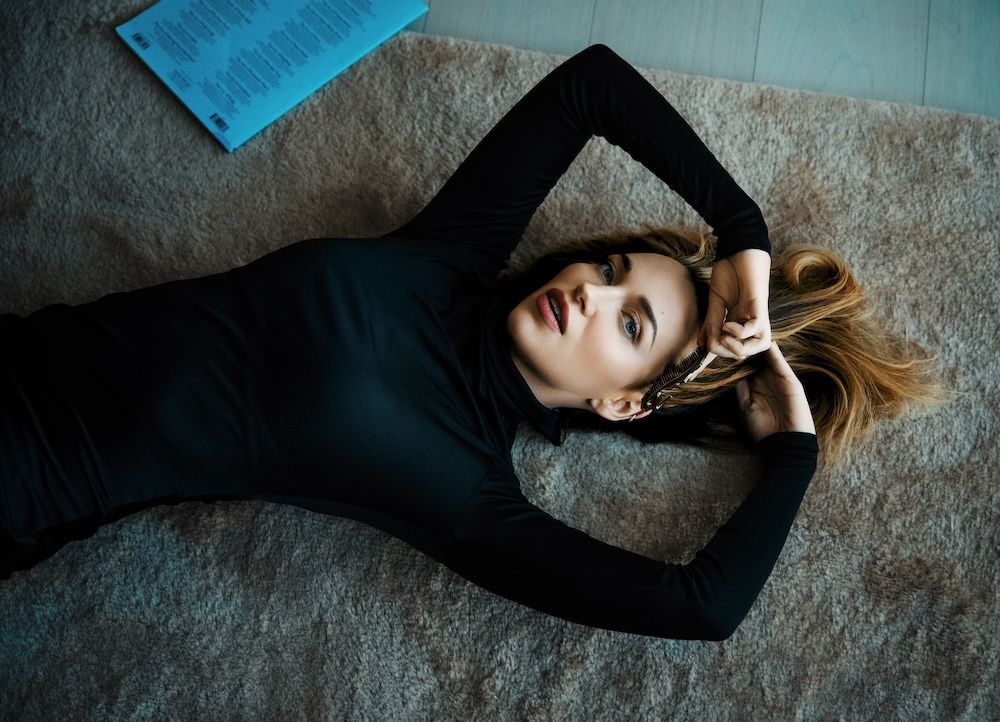
Hi Jordan, thanks for speaking with 1883 Magazine. I think ‘LED Moon’ is absolutely stunning. It feels like a dreamy take on nightlife. What’s the story behind the song, and what first sparked the idea?
The song was kind of written off the title, which sometimes I do. I don’t know where I got the idea of LED Moon, but I realised that it’s talking about this artificial romance; it’s describing a night where, you know, things aren’t as authentic as you’re making them look. And I think that’s the reference to the moon image.
I was imagining it being based in… so James Murphy from LCD Sound System has a really cool nightclub that I’ve been to once in Williamsburg and it has this light up dance floor, and I was imagining myself there back in New York, back in Brooklyn. When I was writing the lyrics, I felt like that’s where the song is set for me. It’s about meeting someone and trying to have this connection that maybe isn’t as authentic as it initially seems.
Your sound blends dream pop, indie rock, and late-night synth textures in a really distinct way. What experiences helped shape that sonic world? Did studying poetry in New York influence the way you write music?
Yeah, definitely. Poetry and songwriting are so different as disciplines and I think my goal is to find out how they inform each other. But songwriting is so much harder than poetry, at least it is for me, because you’re taking into account the constraints of melody. Words have to have sound chemistry with your melody, essentially, and that is very tricky. And then of course you have to take in pitch and everything else. But I think how poetry is influencing my lyric writing right now is just with metaphor and imagery. I feel those are things that I am drawn to and like to lean into. Maybe LED Moon is a strange title, but that would easily be the type of title that I would have if I were writing a poem. And then, yeah, I think sounds I was really inspired by are the Yeah, Yeah, Yeah’s and LCD Sound System. When we were making this song, Jackson and I, who’s a friend of mine, we were referencing a lot of those New York bands at that time, like The Strokes, and that was how that sound came together. But I feel like the sound palette is actually very indie, though very visual sounding, at least to me.
And when I listen to music, I like to imagine that I’m in a film, and that’s why it’s important for me for songs to have strong visual identities. I feel that this song has that. I hope that translates to the audience as well, but I think about that a lot and one of the things that me and Jackson would do in the studio is put a film on. There’s a little VHS TV in the corner of the studio, and we’d go down to this old VHS store and pick out a random film like Run Lola Run or something, and put it on in the corner and just have visual material going in the room. Then whenever we would listen back to songs, we would cover the monitor with Youtube clips of great films or other music videos and try to hear the song back with visuals. So that’s how we stayed inspired, but LED Moon came in like a day. It was the first song that we wrote together, so we were both kind of like, whoa, I think this looks good. It was written a year ago, so I’m happy that it’s stood the test of time and that we both still like it.
It must be rewarding if you wrote it a year ago, to finally see it live, to be experienced by the rest of the world.
Yeah, I’m sitting on a lot of music. I’ve been wanting to put out music for years, I’m just trying to figure out how to do that in this moment of the industry. There’s a lot that’s being put out right now and I just decided that I wanted to do it kind of lo-fi, independent, and just get started that way because I just don’t believe that you’re meant to sit on things. You’re meant to pass them on and it’s good for the creative process. So that’s kind of the point that I got to in myself about the music, but I see this as like a tease to a debut of a bigger project that I’ve got.
You’ve spoken before about initially keeping your songwriting private. Why did you want to protect that part of yourself at first? And now that you’re releasing music publicly, how have you found the reaction to songs like ‘Don’t Kill the Vibe’?
I came to songwriting late. I wrote my first song at 31, and I did it for myself in a moment I was going through in my life where I think I needed music to get me through that. I think I kept it private because I had such a different career. It wasn’t an artistic career – it was still creative and I think they’re very related because the company I was working on was all about expression, it was just in a civic sense. It was all about storytelling and I feel like it is related, it’s just you know about expression in a different kind of field. I just needed time, I think, to really develop it and figure out my own creative instincts. I think the truth is that probably every artist has that period in their bedroom where they’re under the covers singing, making sure that no one can hear them. Most people probably go through that as a teenager, but I just, that wasn’t where I was.
I grew up playing piano and I was pretty private about that too. I’m glad I took the time to really develop it and make sure it was coming from me. I think the songwriting has felt very natural and I trust my instincts on songwriting, but finding a sound has been a bit more complicated because I’m not a producer and I’m very eclectic about my musical taste. I’d be happy to write electronic music or a dust track or whatever. And I kind of had to decide who my collaborators were going to be and really lock in there. So I think I spent some time exploring it and trying to figure out what music is teaching me and how to be more authentic.
I was really surprised at how positive the reaction has been. I thought that with how hard it is to put out music, that maybe people who follow me on Instagram would see it and no one else. I’ve been really surprised and encouraged about how positive people have been. It’s given me a lot of momentum in myself to really get the rest of it going and I’m really, really happy and excited by the response. I think that sharing it is going to unlock a whole other part of it for me, yeah it feels good.
You’ve lived in New York, Dublin, and now London. What has each city taught you — not just about yourself, but about your creative identity and musical taste?
Ooh, that’s a good question. Dublin is where I was born and where I grew up. I lived in Dublin until I was 19 and I’m so happy to be Irish. ‘m so happy to be a part of Ireland and I think we are such a creative, soulful people. There’s so many poets and writers and I think the writer in me came from Ireland. But I strangely think I had to go to America to explore that. I do think in Ireland, writing is such a serious and respected art form. It’s almost intimidating to explore. And so when I went to college in New York, at the end of my degree where I was studying politics, I randomly took an introduction to poetry class with this amazing poet, Josh Bell.
He pulled me in right before graduation and was like, ‘What are you doing when you graduate?’ And I said, I’m going to go work in communications for a nonprofit. And he was like, ‘Why are you doing that? You should be doing this. I’ll write a recommendation letter for you to go to the master’s program. I think you’re a really good writer and like, you should take the time to develop this’. That meant so much to me. I was like, ‘no, no, I’m good’, and then I went and did my job, then I came back crawling like a year later. But the point being, New York just gave me so much freedom in my imagination.
I think there was so much encouragement there to explore that and all of the amazing writers that have come out of New York, like Frank O’Hara and you know like Lorca wrote a book about New York that’s super inspiring, just so many things there that I think inspired me to really tune into that. And so, I give New York a lot of credit for developing the creative in me and training it, you know, and giving me the audacity to pursue it. And then, I think London, where I’m living now, is actually where I started writing music and where that dream became real. So it means so much to me here because this is where the whole musical journey opened up, when I first went into studios and started writing music with people. So I feel like they have all informed me as an artist in different kinds of ways.
Is your Josh Bell influence where your focus on imagery came from?
I think maybe actually yeah, that’s so interesting that you picked that up because his metaphors are so strong and he never stays on one. When you read one of his poems. oh i’m trying to remember which one I would recommend to you but i’ll send it to you. It’s like he has this idea that beauty is always in flux and it’s never something that stays, right? Like it’s always transitioning and it’s never quite something that you can grasp and so that’s why when he writes his poetry all of the metaphors just move and deconstruct so fast. He never stays on one image and that’s part of his technique and kind of what his philosophy is.
Speaking of influences, you grew up surrounded by multidisciplinary creatives. What are some of the most valuable lessons or ‘golden rules’ you’ve taken from your family into your own career?
I think, you know, it’s so amazing to have so many artists around you because at the end of the day, I think the main thing that they can do for you is encourage you, because they’ve been in like, the lows. There’s a lot of lows when you’re going through a creative process, whether it’s putting it out or writing it. You hit a lot of walls. That’s just part of the rules. And so having artists around you to keep you going and who can say that they’ve been there and motivate you to keep going, I think has been the strongest, most positive thing that I’ve taken from it. I think if I was not in a family of artists, they’d be finding my mood very different or just wouldn’t understand, but my family gets it.
I think yeah we all understand the ups and downs of that, but I think actually the most important thing that you can do to become an artist is learn how to listen to yourself above anyone else, and so I think you don’t actually need opinions on your work so much from other artists. You have to have boundaries and certain rules because everyone comes with their own lens and their own offering, and you just have to know that yours is different. So I think that’s where advice can be dangerous sometimes if you’re an artist.
It’s like listening to too many people and just having so many people that you respect around you but at the end of the day, you have to just hear it inside you and that’s the most important thing that you can develop. A lot of it for me is done in isolation, really trying to listen to myself and once I fully trust that I know that voice inside me, I’ll find it much easier to collaborate with other artists and just to bring more community around me. But I think figuring out who I was as an artist individually, I really just had to be by myself and it was a lot of time alone.
You’ve also been deeply involved in social activism. In a time where misinformation spreads so quickly online, what’s one meaningful thing people can do to raise awareness around important issues — either digitally or in real life?
That’s a really good question. I feel right now that a lot of the conversations that are going on, on social media, aren’t really getting us anywhere. I just feel that we are not really listening to each other and it’s this energy that’s just going around that isn’t really being channeled into anything positive or impactful. And my company, what we built was a product called Action Button, and it lived at the bottom of news articles. And so the idea was if you were feeling inspired or enraged by that piece of news that you were reading, you would be able to channel that reaction into something impactful by taking an action right then and there, like whether it was a donation or getting registered to vote or finding a volunteering opportunity.
So I think my big passion in that field was to make sure that we could capitalize on people’s energy for them to want to do something positive, like all of this goodwill and intention around social issues, for that not to go to waste and for there to be ways that you could capture and funnel that into something that actually makes a difference for nonprofits who are doing the work, or whomever the beneficiary may be. So it’s hard for me to watch that go. Those conversations go on on social media, and sometimes it feels like there isn’t a clear place for them to end up, or an outcome from those conversations. I do think it’s really important for people to be talking about things that matter to them and raising awareness, I just want to see people able to take the next step. I sold my product and it got acquired by a company in California and so I’m not involved in it anymore.
I do find reading the news difficult, because for years it was my job every day to think, all right, what are we going to do about this? What actions will we pair with these headlines? It’s something I think about a lot and something I hope to be involved in again in the future. But yeah, I think it’s amazing how much people care about what’s going on in the world you know, and I feel like it wasn’t that way 10 years ago. I feel really encouraged by how much people care, I just want to make sure they know what to do with that passion. I feel like it wasn’t that way 10 years ago.
That’s such a valuable thing to give people, the empowerment to actually channel that passion into something productive, rather than letting it just get lost in the ether.
Yeah I think we said our goal was to channel the energy of empathy into impact, you know, and that was the product’s mission. I’m so proud of it, that it’s still out there, it’s growing, it’s part of a much bigger team you know, about 100 people and It has a slightly different model now, but I’m sadly not involved anymore.
I think a lot about what my next thing in that field will be, but for now, I’m just focusing on music and letting myself do something creative.
Following that, after spending years building Speakable, do you approach music with that same sense of ambition and drive, or does music feel like a different pace and space for you creatively?
I think I’m figuring that out, you know, with where the industry is and doing it independently. I was not really approaching it with so many expectations, but I am the type of person that puts everything into what I do, for better or worse. And I just know that I’m going to give this everything that I have because of how much I care about it and how good it feels to be doing this. I’m having so much fun doing it. But I suppose I’m doing it more for me and my own fulfilment. I think as an artist, you can’t make any decisions that are about pleasing other people. And so in music, it’s hard not to do that because you’re playing to crowds and you’re looking at streams and things like that.
It’s hard because you want to connect with people, but you also have to just follow that voice inside you. You have to really check your ambitions, like you work really hard but in terms of your work, you have to know that it’s authentic and that it’s being driven from a real place and a raw place, rather than like, an ambitious place I think. So that’s how I think about it right now, but I’m new to the industry so I have no idea how I’ll feel in a year.
Where do you see this musical chapter taking you?
I hope it lets me continue doing this and really build an audience around it. I’m really excited to make my first record and that’s just a huge dream of mine, probably a secret dream that I had forever and one I never really thought I would do, so I’m shocked with myself that I’m doing it. I want to fulfill my, I guess, potential as an artist and know that I have really served it well.
I think the songs come to you and it’s your job to make sure you put them out to the best of your ability and give them back to people, you know. That’s just kind of what I’m learning how to do now.
Finally, what can fans look forward to next? Is there a Jordan Joy EP on the horizon?
Well, I wouldn’t announce that yet, we do have an EP that hopefully will come out soon. But right now, I hope that they listen to LED Moon, which has just been released, and then I’m excited to just keep building the world and revealing more of it slowly. So yeah, I feel like there’s a lot to look forward to.
Thank you so much for speaking with 1883 today, Jordan. I’m excited to see what comes next for you!
Thank you, thank you for having me, it’s been a pleasure.
Interview Katie Eliza
Photography Brantley Gutierrez
Thanks Oriel Co