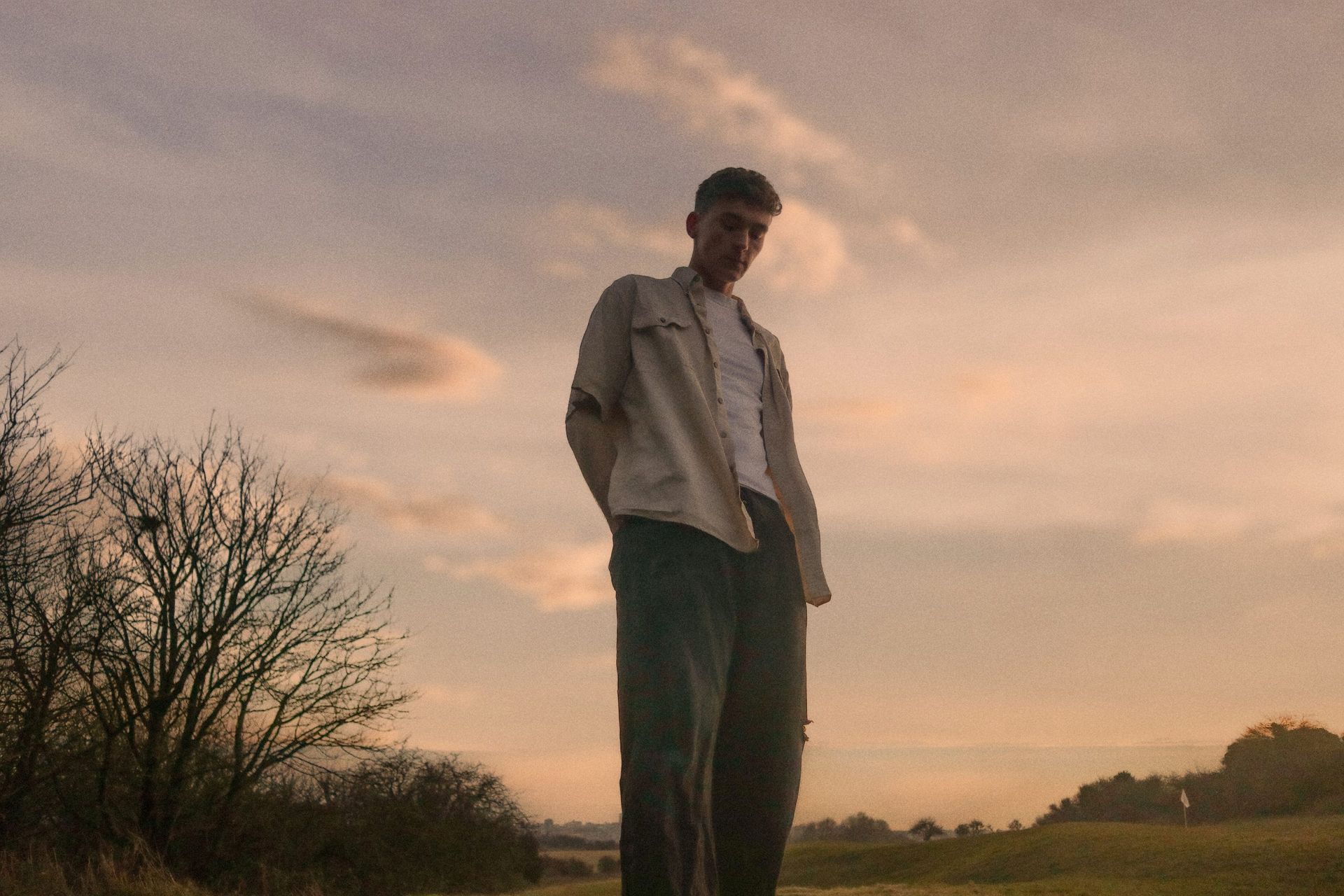
Brighton-based indie folk artist Will Hanco has steadily emerged as one of the UK’s most emotionally resonant new voices, blending intricate fingerpicked guitars, cinematic production, and raw lyricism into songs that feel both intimate and expansive. On his new six-track EP Storm Before The Calm, Hanco delivers his most personal work to date, a self-produced collection shaped by grief, reflection, and the difficult process of moving forward.
Written following the sudden passing of his father, the EP became both an emotional outlet and a creative lifeline. Retreating into his bedroom studio, Hanco immersed himself in every part of the process, from songwriting and arrangement through to production and mixing, creating a project that feels deeply human and unguarded.
Across the record, airy baritone vocals drift through layered acoustic and electric guitars, ambient textures, orchestral percussion, and moments of near-unfiltered release. Opening track “Outlier” immediately establishes the EP’s emotional and sonic scope, pairing driving percussion with expansive guitar work that balances momentum with restraint.
Lead single “Heaven Below” stands out as one of the project’s defining moments, showcasing Hanco’s ability to craft immersive indie folk rooted in melody and atmosphere while still feeling deeply personal. Elsewhere, quieter passages lean into hushed vulnerability before erupting into more intense, emotionally charged peaks.
Drawing influence from artists including Ben Howard, Bon Iver, Hozier, and Gregory Alan Isakov, Hanco continues to refine a sound that feels grounded in nature, memory, and lived experience while subtly pushing beyond the boundaries of contemporary folk.
“This EP was my only outlet in navigating how I was feeling,” Hanco explains. “It became an outlet for things I didn’t really know how to process at the time.”
For our latest track by track, Will Hanco takes us inside Storm Before The Calm.
A note on Storm Before The Calm
Storm Before The Calm is an EP that moves through uncertainty, reflection, and emotional rebuilding. Written across a period of significant personal change, it became a way of processing experiences that were still unfolding in real time rather than fully understood. The songs sit somewhere between instinct and reflection, shaped as much by feeling as by meaning.
At its core, the EP traces a series of emotional shifts rather than a linear story. There are moments of confrontation and clarity, moments of grief and disorientation, and moments of distance where understanding only arrives in hindsight. Each track captures a different response to change: the urge to break away, the search for answers, the process of looking back, and the gradual acceptance of things that cannot be undone.
Sonically, the record moves between stripped-back intimacy and more expansive, atmospheric
moments. There’s a grounding in indie-folk and alternative songwriting, but also space for more rhythmic, playful, and experimental textures to surface. That contrast became an important part of the record’s identity, reflecting the emotional unpredictability behind the writing itself. More than anything, Storm Before The Calm is about transition. It doesn’t try to resolve every question it raises, nor does it aim to offer closure in a traditional sense.
Instead, it exists in the space between where things were and where they are still becoming, a collection of songs written through uncertainty, and shaped by the process of moving through it.
Taken as a whole, it feels less like a conclusion and more like a document of change in motion.
‘Outlier‘
Outlier was a bit of a turning point for me because I’d never really written a song like it before. Most of my writing naturally leans towards being reflective or vulnerable, but this was the first time I consciously wanted to make something darker, moodier, and a little more confrontational. I wanted to capture that moment when you finally see a situation for what it is and stop making excuses for someone else’s behaviour.
The song centres around a toxic, one-sided relationship and that feeling of being overlooked by somebody who absolutely knows the impact they’re having, but chooses to act as though they don’t. The line “Don’t act like you didn’t notice me” became the emotional anchor for the whole track. It’s not really about wanting recognition from that person anymore; it’s about refusing to let them rewrite the story. Sometimes people hide behind denial because it’s easier than accountability, and I wanted to explore that frustration.
What I love about this song is that underneath all the bitterness, there’s actually a sense of freedom. The narrator starts off hurt and frustrated, but by the end they’re stepping away from a cycle they’ve been trapped in for too long. That’s where the title came from for me. Being the outlier is about being the person who finally breaks the pattern instead of repeating it. From a production standpoint, this track pushed me outside of my comfort zone as well.
The raspy, almost shouted vocals in the chorus were something I’d never really attempted to record before. I remember standing in my bedroom recording takes and wondering whether I could actually pull it off. All of the vocals were tracked at home, which means my neighbours got a front-row seat to some fairly aggressive shouting sessions. Thankfully nobody complained or called the police. The music video was another memorable part of the process. We filmed it at Seven Sisters in East Sussex during a freezing day in December. It was raining for most of the shoot, everyone was soaked through, and I think there was a collective understanding that we’d all rather be somewhere warm.
Credit has to go to the entire team, especially the actor who spent hours standing around in a thin white vest while the rest of us layered up whenever the cameras stopped rolling. The runner kept us fuelled with coffee throughout the day, which genuinely felt like the difference between survival and defeat by the end of it.
Looking back, “Outlier” feels like the opening statement for the EP. It’s the sound of someone reaching their limit, recognising a pattern that can no longer continue, and finally deciding to walk away.
‘Remnant’
Remnant was one of the first songs I wrote about losing my dad. At the time, I wasn’t really trying to
write a song about grief. I think I was just trying to make sense of what had happened and where I was supposed to go next. One of the strangest things about loss is that nobody can really tell you how you’re meant to feel. People can offer support, but there isn’t a roadmap for it. You’re left navigating something completely unfamiliar, and that’s very much where this song came from. The opening line, “I know you’re drowning under the water,” is probably the clearest example of that.
It’s an observation more than anything. Watching somebody slip away while knowing there’s nothing
you can do to stop it is an incredibly helpless feeling. The song isn’t really about finding answers; it’s about sitting with the fact that there aren’t any. Sometimes all you can do is watch events unfold and let fate take its course, however difficult that may be.
The chorus captures the confusion that followed. The line “Now I don’t know which way I should walk” became the emotional centre of the song because that’s exactly how I felt. Everything seemed uncertain. Decisions that once felt simple suddenly carried a different weight, and even everyday things felt unfamiliar. There’s a sense of wanting to run from it all, while knowing you can’t really outrun grief. It follows you wherever you go.
One of my favourite lyrics on the track is, “Now all I have is your ways, and your CD that I never play.” Grief often isn’t made up of huge dramatic moments. More often it’s the small things people leave behind. Habits you’ve inherited. Phrases you catch yourself saying. Objects that gather dust but somehow become impossible to throw away. Those little remnants can end up carrying the most meaning.
From a songwriting perspective, the chorus actually began as a melody. The ascending chromatic line
had been floating around in my head for a long time and I’d tried to fit it into other songs without much success. For whatever reason, when I sat down to write “Remnant” it suddenly found its place. Once that melody appeared, the rest of the song seemed to reveal itself quite naturally.
Musically, this track also pushed me into new territory. Around that time I was listening to a lot of
Searows and was fascinated by the way they use harmony and space. I started experimenting with
minor ninth chord inverted voicings, which gave the song a tension and fragility that felt right for the
subject matter. Everything about the arrangement was built to feel suspended, almost as though it’s
floating between holding on and letting go.
Remnant feels like an honest overview of the EP. If Storm Before The Calm is about navigating difficult periods of life, this song sits right in the middle of that uncertainty. It’s about grief, but it’s also about what remains after loss.
‘Laces‘
Laces is probably the anomaly of the EP. A lot of Storm Before The Calm deals with uncertainty, grief, change, and some fairly heavy emotions, whereas this track feels much lighter on its feet. It’s still rooted in something real, but it approaches it with a bit more of a lighter tone and self-awareness. Sometimes when I listen back to it, it feels like the song on the record that’s smiling whilst delivering bad news.
I wrote it during a period where I was doing a lot of reflecting on different areas of my life. Losing my dad forced me to look at things from a different perspective, and that extended beyond grief. I found myself revisiting old relationships and asking questions I hadn’t really considered before. One of the things that stood out was how easy it is to be taken for granted without realising it’s happening. When you’re in something every day, you don’t always notice the cracks forming underneath you.
It’s often only once you’ve stepped away that the full picture becomes clear. The song centres around that realisation. Looking back at a relationship and recognising that both people were moving in different directions long before either of them acknowledged it.
There’s frustration in the lyrics, but it’s not an angry song. If anything, it’s more of a shrug of acceptance. Sometimes things don’t fall apart because of one dramatic event. Sometimes they simply drift until they become something neither person recognises anymore. One of my favourite lines is, “I’d be standing on laces, running from the pavement.” I liked the contradiction of it. Trying to move forward whilst still being tangled up in something that’s holding you back. That’s a feeling I think a lot of people can relate to.
You know you should leave, you know the relationship has run its course, but there’s still a part of you that hesitates because it’s familiar.
Musically, I wanted the song to mirror that lighter energy. The hook arrived quite naturally, and from
the beginning it felt more playful than anything else I’d been writing at the time. Even some of the
sharper lyrics are delivered with a wink rather than a pointed finger. It became a balancing act
between honesty and not taking myself too seriously.
“Laces” feels like an important moment on the EP because it shows a different side of the emotional journey. Not every period of reflection is defined by sadness.
Sometimes clarity arrives with a smile. Sometimes you look back at a situation, shake your head, and realise the lesson has already been learned. That’s what this song feels like to me; a little bit of heartbreak, a little bit of liberation, and enough distance to laugh about it all afterwards.
‘Cold‘
Cold was one of those songs that seemed to write itself. Some songs take weeks of rewriting and second-guessing before they finally come together, but this one arrived quite naturally. The melody, the lyrics, and the overall feeling all appeared quickly, which is always a nice surprise when you’re writing.
At its core, the song is about emotional distance. Not a dramatic fallout, but that quieter kind of separation where you slowly realise you’re no longer on the same page as somebody you once felt completely connected to. The line, “I don’t know why you’re cold,” became the emotional centre of the song. It’s about searching for answers and slowly accepting that you might never get them.
One of my favourite moments is the line, “If I knew which way you were falling, I’d fall right by your side.” Even though the relationship feels like it’s slipping away, there’s still a desire to catch that person one last time. The final line of the pre-chorus then brings things back to reality: “But if I did, I know you’d leave me in the thick of it.” From the beginning, I knew I wanted live strings on this track. I’ve always loved the emotion that
violins and cellos can bring to a song, and “Cold” felt like the perfect place to explore that.
It was also the song that pushed me furthest into the indie-folk sound I’ve become increasingly drawn towards. Writing in that style feels very natural to me, and it’s definitely something I want to continue exploring. The response to this track has been incredible. It’s become my most streamed song to date, which I
never expected when I first wrote and recorded it in my bedroom.
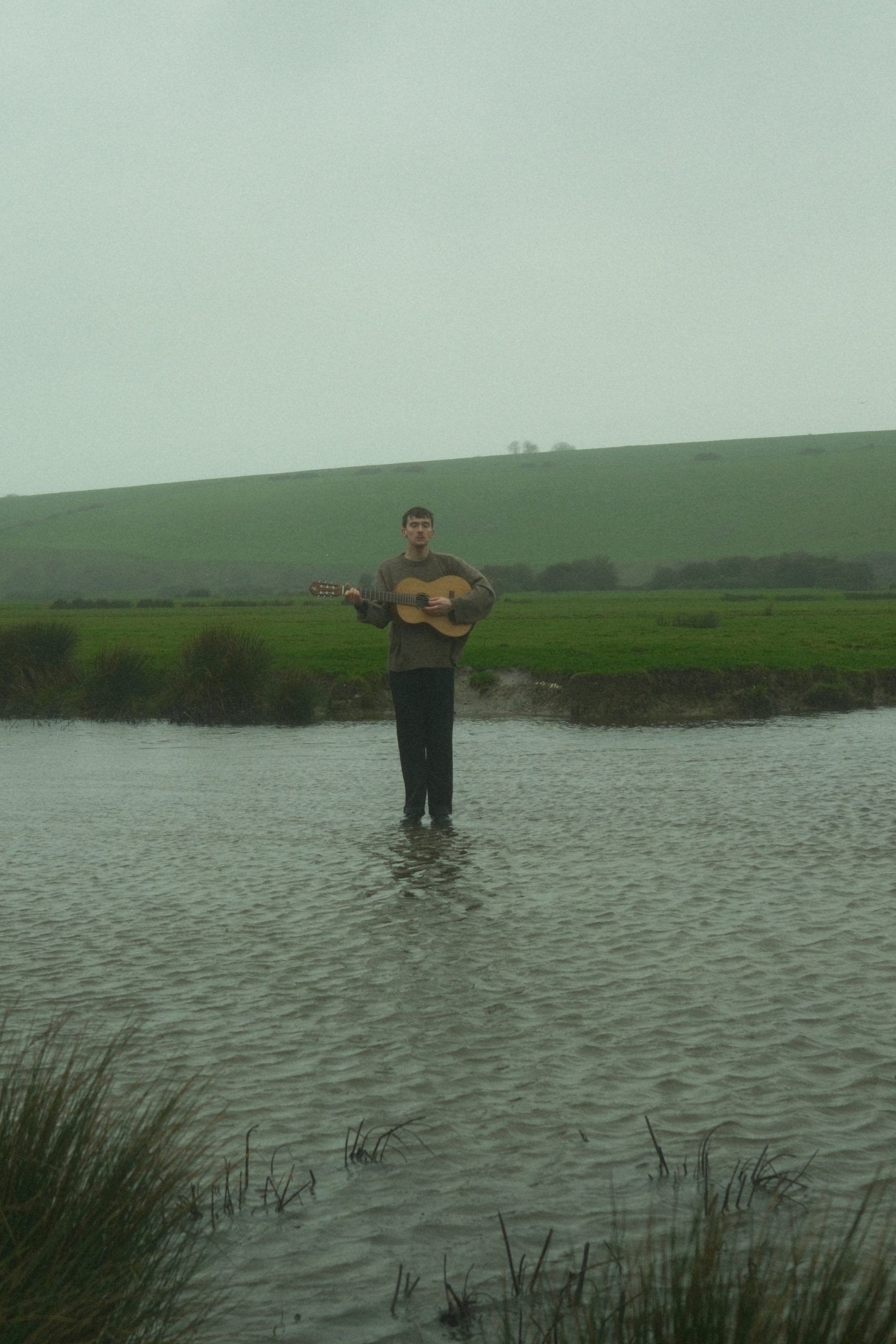
The visual content for the song was filmed on the same freezing day as the “Outlier” video at Seven Sisters. At one point I had to wade through a marshy stretch of water before climbing onto a stool in the middle of it to perform the song. Standing there soaked, playing guitar in the middle of winter, felt strangely appropriate for a track called “Cold”. Some of that footage can still be found over on my Instagram, and looking back at it now, I’m mostly impressed that I managed to finish the performance without losing feeling in my feet.
Cold feels like a glimpse of where I’m heading as a songwriter; intimate, honest, and rooted in the indie-folk sound that feels most like home to me.
‘French Moonlight‘
French Moonlight feels like a real departure from the rest of Storm Before The Calm. Sonically, it leans into a lighter, more playful indie space, I was listening to a lot of early 2010 indie tracks around the time, and that rhythmic, driving energy definitely found its way into the writing. There’s also a touch of Hozier in the emotional tone and melodic phrasing, but filtered through something more carefree and immediate.
It sits somewhere between indie-pop, alternative folk, and slightly sunbleached. From a production perspective, I wanted it to feel alive and slightly unrestrained. Driven acoustic and electric guitars sit at the core of it, with a steady, almost hypnotic rhythm that gives the track its momentum. There’s cowbell tucked into the groove, which became one of those unexpected elements that just made everything click, and the electric rhythm guitars are drenched in reverb to give it a slightly atmospheric, drifting quality. It all builds towards a fuzzed-out, slightly chaotic outro vocal, which felt like the right way to let the track dissolve rather than end cleanly.
Lyrically, it sits in that space between distance and anticipation. It’s about connection stretched across time and place, the feeling of wanting to hold onto something exactly as it is in your memory, while also knowing it’s still unfolding. There’s romance in it, but not in a heavy or confessional way; it’s more about possibility, timing, and the emotional space between moments.
More than anything, I just enjoyed writing it. It came quickly, without too much overthinking, and that energy stayed in the recording. It has a loose, instinctive quality that I didn’t try to polish away, just a song moving forward on feel alone.
French Moonlight feels like one of the most free-spirited moments on the EP. It doesn’t carry the same weight as some of the other tracks; instead, it lives in its own world, warm, slightly nostalgic, a bit hazy at the edges, and unbothered in the best possible way.
‘Heaven Below‘
Heaven Below” closes the EP, and for me it feels like its emotional centre. It’s the most personal song on the record, written in the aftermath of losing my dad, and in many ways it became a way of processing something that didn’t feel processable at the time. The song sits in that space between grief and questioning. It came from a period where I was searching for meaning in everything, looking for reassurance, direction, or some kind of answer that never really arrived. There’s a sense in it of reaching upwards and getting silence back. That feeling slowly shifted my relationship with certainty itself, whether that was faith, fate, or the idea that things are somehow being guided.
At its core though, it’s less about answers and more about what happens when you stop expecting them. The lyric “I know I’ll go with something to say” became a kind of anchor for me. It’s about still moving forward even when nothing feels resolved, and learning to exist in that uncertainty rather than resisting it.
This song also reflects a very real period of isolation for me. There was a time where I stopped socialising, stopped going out, and found myself completely withdrawn. Music became one of the only ways I could translate what I was feeling into something tangible, even when I didn’t fully understand it myself.
In a strange way, Heaven Belowis also about inheritance. My dad was the one who first introduced
me to music from a very young age, and writing this felt like coming full circle, using something he gave me as a way of making sense of his absence. That’s what makes it the heart of the EP for me. Not because it resolves anything, but because it holds the most truth.
It’s not a song about closure. It’s about learning to keep going when closure doesn’t come.
Listen to Storm Before The Calm below.