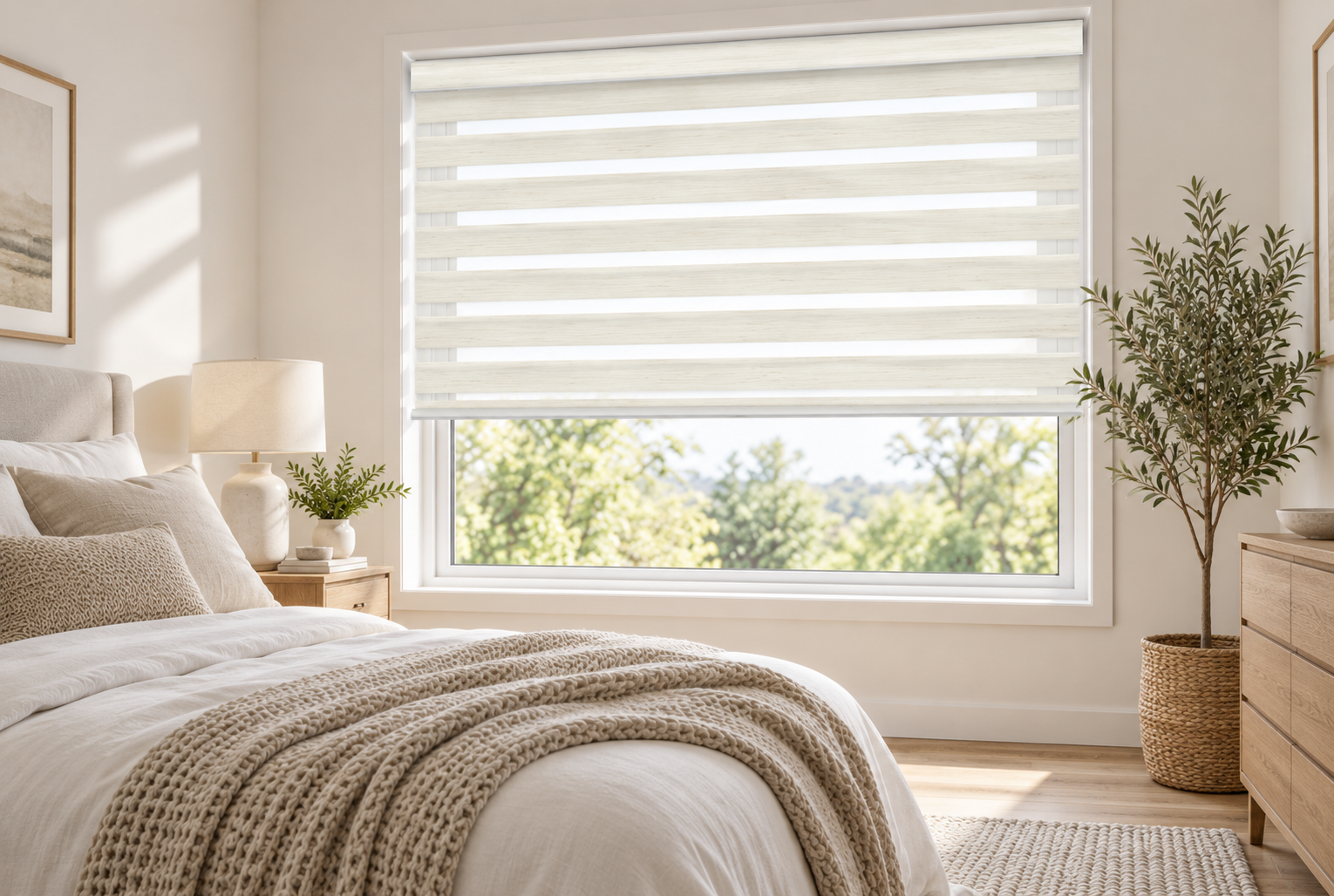
A bedroom can look perfectly comfortable and still be frustrating at night. A streetlight lands across the pillow, sunrise slips through the edges of the window, or a neighboring building suddenly feels much too close once the lights are on. The best blackout blinds for bedrooms solve those everyday problems without making the window difficult to use.
The right choice depends on how you live in the room. Zebra blinds work well for bedrooms that need adjustable daylight and privacy throughout the day, while motorized blinds are especially practical when stronger blackout coverage and easy daily operation matter more. For a light sleeper, shift worker, parent, apartment dweller, or anyone with an east-facing bedroom, those differences can matter more than color or fabric style.
Start With the Light That Actually Bothers You
Not every bedroom needs the same level of darkness. Someone who sleeps until 7 a.m. in a north-facing room may only need to soften outside light. A night-shift worker trying to sleep at noon has a completely different problem.
Light and darkness are major environmental signals for the body’s daily sleep-wake rhythm, so a bedroom designed for sleep should make unwanted light easier to control. Look at when the problem occurs before choosing a blind. Early sunrise points to stronger blackout coverage. Streetlights and headlights make edge coverage important. Bright afternoon sun may also make heat and glare part of the decision.
For sleepers who want the room as dark as possible, an opaque blackout roller shade is usually the straightforward choice. The flat fabric creates a clean barrier across the window without adding visual clutter.
Street-Facing Bedrooms Need Privacy After Dark
Privacy feels different in a bedroom than it does in a living room. During the day, you may want sunlight and an open feeling. At night, once lamps are on, the ability to close off the view becomes much more important.
That is where adjustable designs make sense. Zebra-style shades use alternating sheer and solid bands, allowing the window to change as the room does. During the morning, the bands can be positioned for softer daylight. In the evening, increasing the solid coverage gives the room more separation from sidewalks, neighboring apartments, or nearby houses.
For ground-floor bedrooms or windows facing another building at close range, choose higher-opacity materials rather than relying only on decorative sheers. If maximum nighttime privacy is the priority, blackout fabric provides the simplest answer because silhouettes and interior activity are much harder to see through an opaque covering.
Light Sleepers and Shift Workers Need Better Coverage
For a light sleeper, a tiny strip of sunrise around the window can be more annoying than a bright room during the day. Fit therefore matters almost as much as the fabric itself.
Inside-mounted blinds have a neat, built-in appearance, but the small clearance needed for operation can leave narrow lines of light around the sides. An outside mount covers more of the wall around the opening and can reduce those gaps. Bedrooms directly facing sunrise, parking-lot lights, or illuminated signs often benefit from the extra overlap.
Shift workers have another concern: convenience. When you come home after an overnight shift, you probably do not want to adjust several windows individually before going to bed. Motorized operation makes it easier to close multiple shades quickly and, where scheduling is available, create a repeatable sleep routine without manually resetting the room every day.
Couples and Families Benefit From Easier Daily Control
Bedroom blinds are used at least twice a day, so small conveniences become more noticeable over time. One partner may wake earlier and want daylight while the other is still asleep. A baby may nap at different hours. A large window may sit behind a bed where reaching the blind is awkward.
Motorized operation works especially well in these situations because the blind can be adjusted without leaning over furniture or handling cords. Timed opening can also make a bedroom feel less cave-like in the morning by bringing daylight back after the desired sleep period.
Cordless operation is another practical consideration for bedrooms used by children. Instead of leaving an accessible pull cord beside a crib, bed, or play area, a cordless or powered design keeps the window treatment cleaner and simpler to operate.
Guest Rooms and Rentals Need Flexible Solutions
A guest bedroom rarely needs the most elaborate window treatment in the house. What visitors notice is whether they can make the room dark at night, maintain privacy while changing clothes, and open the window covering the next morning easily.
A simple blackout roller shade works well when sleep is the main priority. In a room that doubles as an office, reading space, or occasional guest room, adjustable zebra-style coverage can be more useful because the window does not have to stay completely dark during the day.
Renters should also consider installation before choosing a style. Check whether drilling is permitted and whether the window recess has enough depth for an inside mount. Whatever mounting method you use, accurate width and height measurements matter. A beautifully designed blackout blind that leaves a bright gap beside the frame will solve less of the bedroom problem than a simpler shade that actually fits the window.