It has taken me a few days to work out what I think about Electra/Persona. Not whether I enjoyed it. I did, very much. But Benedict Andrews’ collision of Greek tragedy and psychological drama leaves you with quite a lot to untangle, and I’m still not convinced I’ve finished. With Cate Blanchett and Nina Hoss pulling you through grief, fury, intimacy, and some deeply uncomfortable silences, though, there is plenty to enjoy while wondering what the hell is going on.
Having only seen one version of Electra, the strange and fascinating production starring Brie Larson, and never having seen Ingmar Bergman’s Persona, I wasn’t sure how the two would fit together. The connection is an actress who stops speaking during a performance of Electra. Andrews takes us through the tragedy before following that actress into her silence, where her relationship with the nurse caring for her becomes increasingly difficult to pin down.
First, though, we need to find out who is playing whom. Blanchett and Hoss come out and enlist an audience member to toss a coin, with the winner choosing her roles for the evening. At the press night performance, Blanchett chose Clytemnestra and Alma, leaving Hoss with Electra and Elisabeth Vogler. It’s a playful start to an evening that will become considerably less cheerful, and a tantalising thought that another audience might see something quite different.
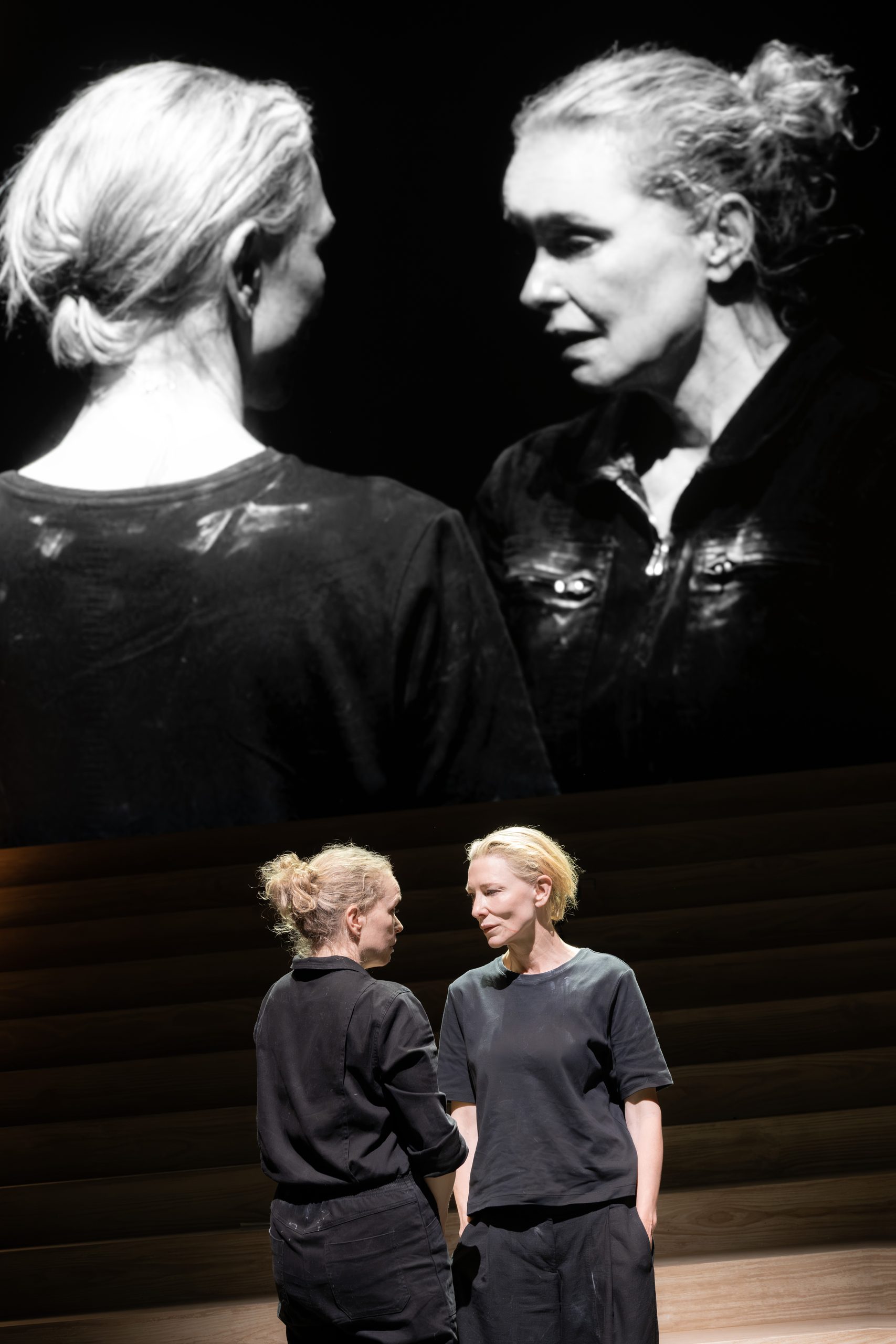
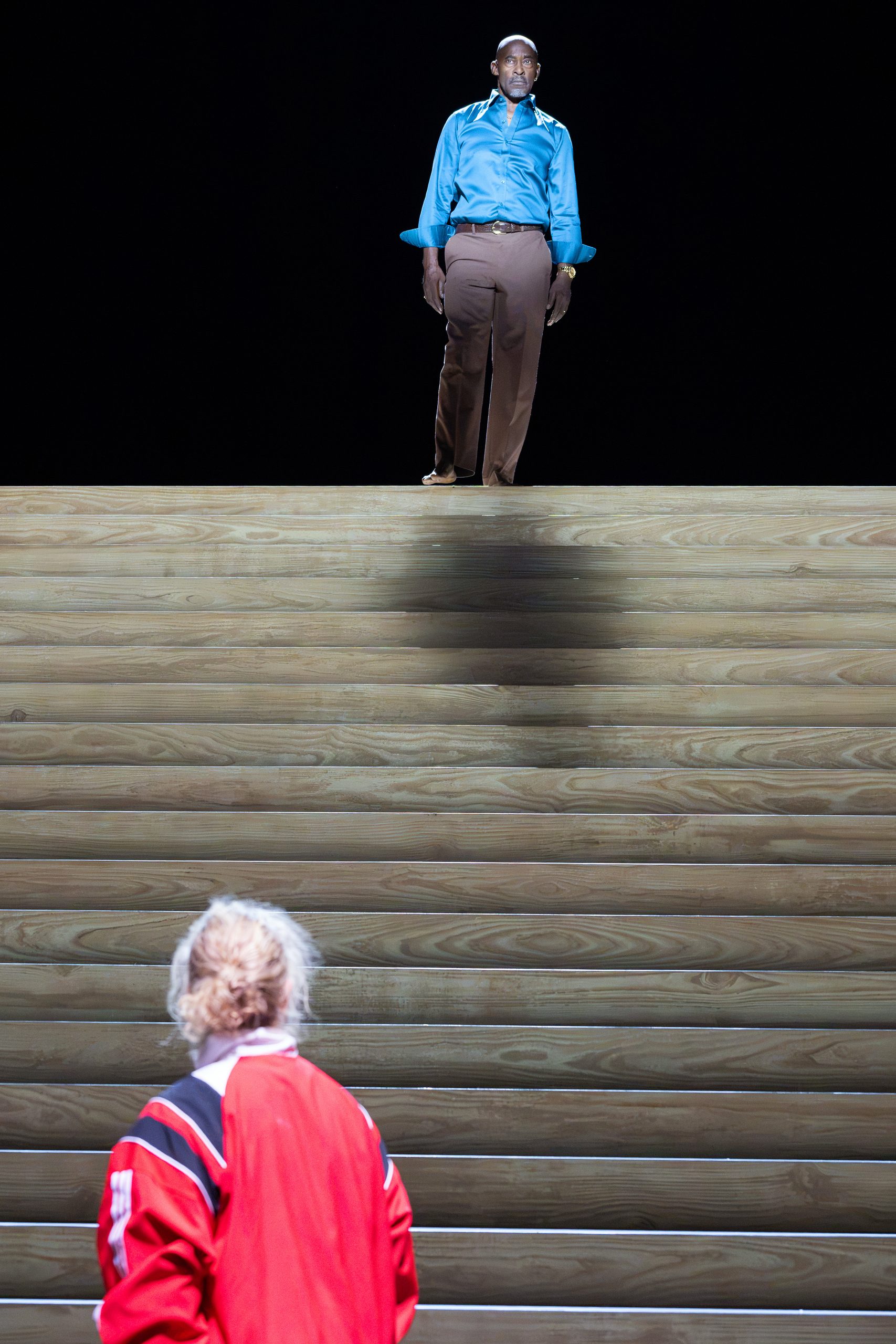
Magda Willi’s set is a broad flight of wooden steps, with a hammer waiting ominously in the centre. The stairs immediately put me in mind of Evita, although here the space feels more like somewhere a family might gather to drag every terrible thing they have ever done into the open. The women apply white make-up to their faces, and off we go.
Electra wants revenge on her mother, Clytemnestra, for killing her father, Agamemnon. Clytemnestra killed him because he sacrificed their daughter, Iphigenia. Now Electra is waiting for her brother, Orestes, to come home and help settle the score. There is a lot of grief in this family, and absolutely nobody is dealing with it well.
Hoss gives Electra a furious, wounded intensity, but what interested me most was the way she clings to the people who aren’t there. Bags of old clothes become a family history she can rummage through. Her father’s military jacket brings him into the room; her mother’s fur coat prompts a mocking impersonation. Putting on her absent brother’s clothes, she seems to be willing him into existence. These are recognisable gestures, the sort of private conversations and imagined confrontations you might have when nobody is watching, taken somewhere much darker.
Some of the lighter moments jarred for me. Electra’s squabbling with her sister, Chrysothemis, briefly becomes almost playful, and I struggled with the shift from consuming anguish to a fairly ordinary sibling scrap. The humour makes them recognisable as sisters, but takes a little of the heat out of Hoss’s anger too abruptly.
Ella Lily Hyland is touching as Chrysothemis, stuck between two people who cannot let go and desperately wanting some peace. It is Blanchett’s Clytemnestra, though, who really complicates where our sympathies lie. What comes through so clearly is how much she wants her daughter to understand her. She has killed Electra’s father, yes, but he killed her child. In her mind, surely Electra should understand that?
Blanchett makes that need for connection painfully convincing. I believed that this woman loved her daughters, including the one who wanted her dead. Meanwhile, Hoss makes us feel the resentment of a surviving child living in the shadow of a dead sister, still fighting for a place in her mother’s affections. Underneath the murder and revenge, there is something horribly familiar about both women needing their own pain to be acknowledged first.
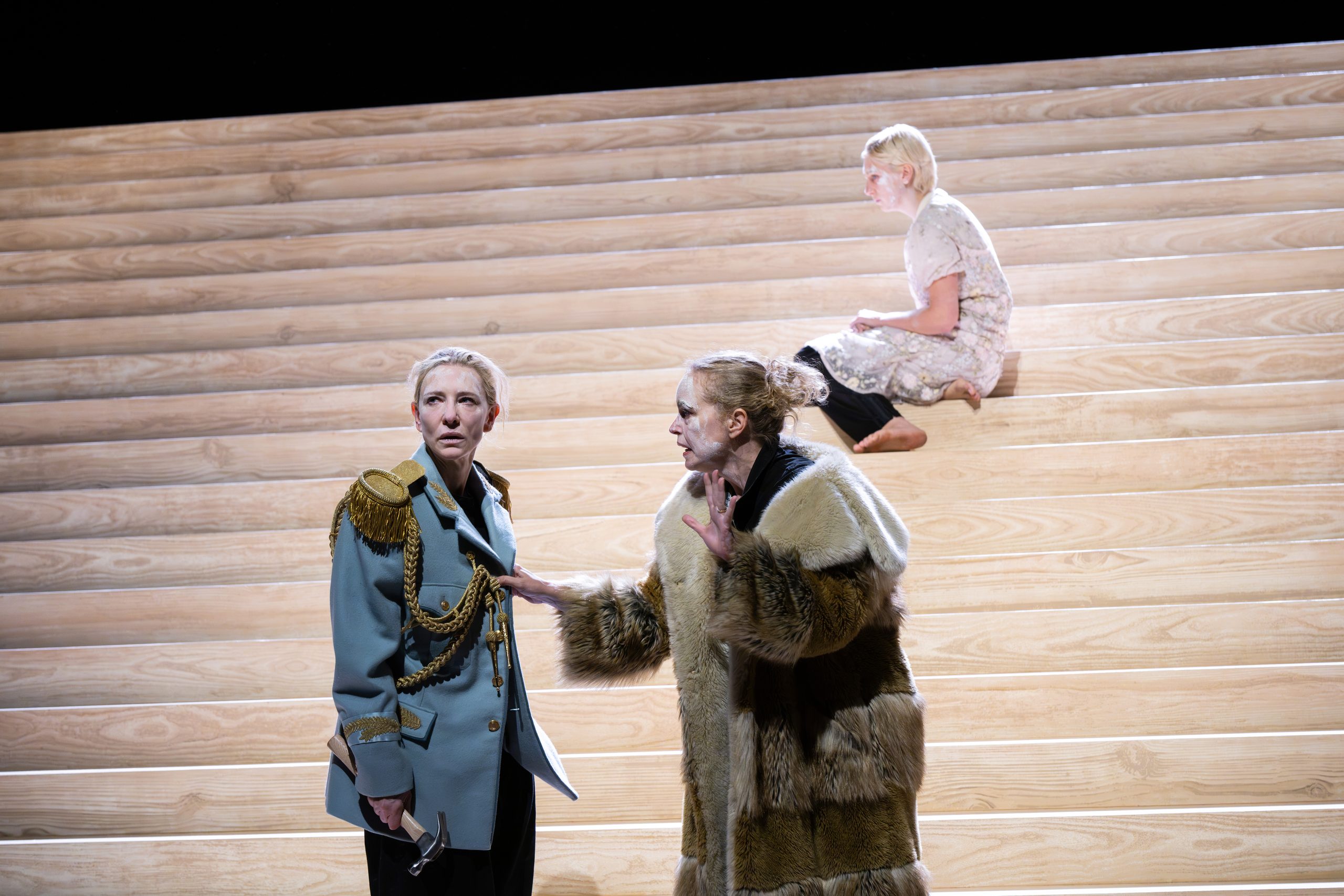

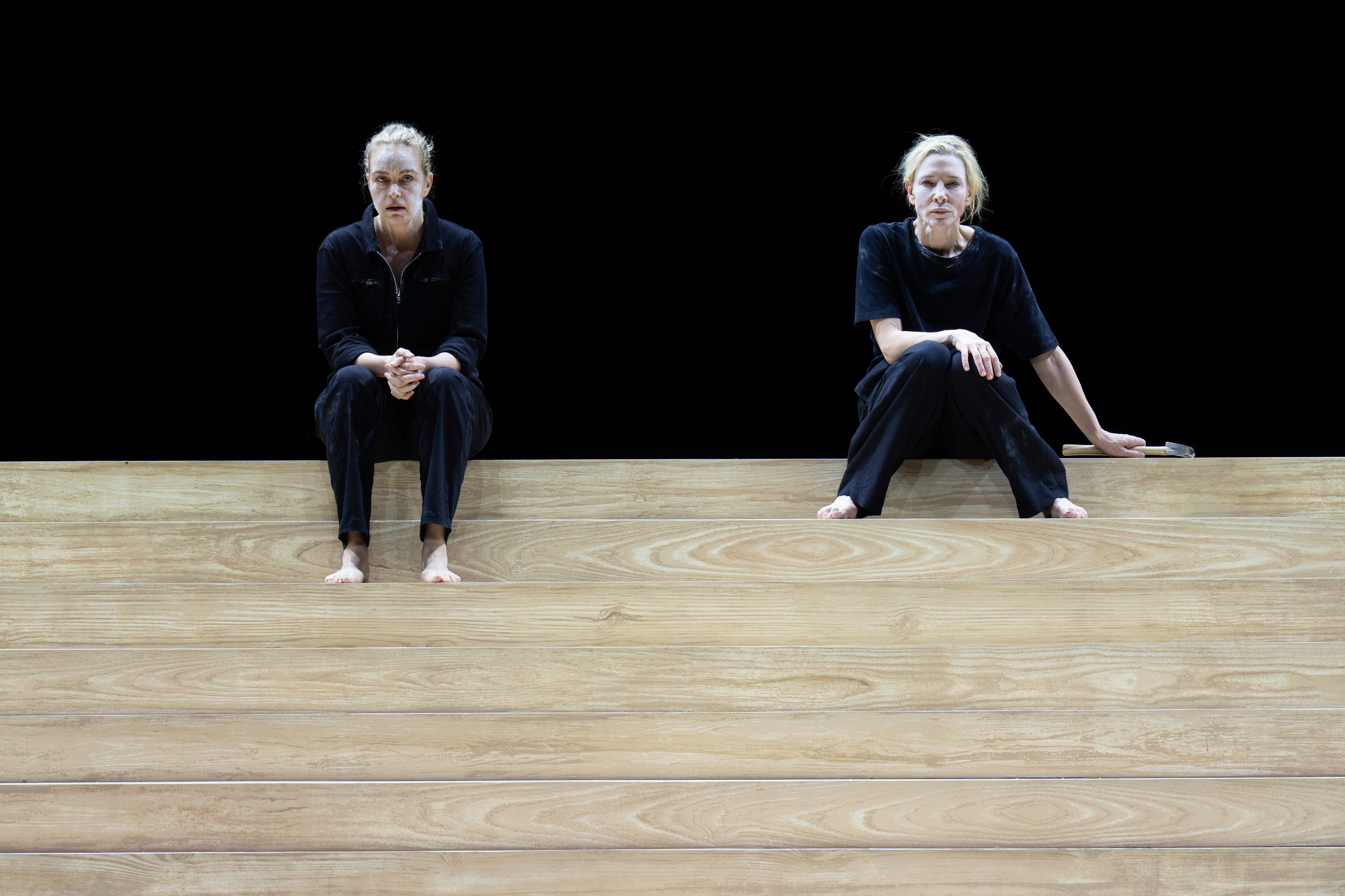
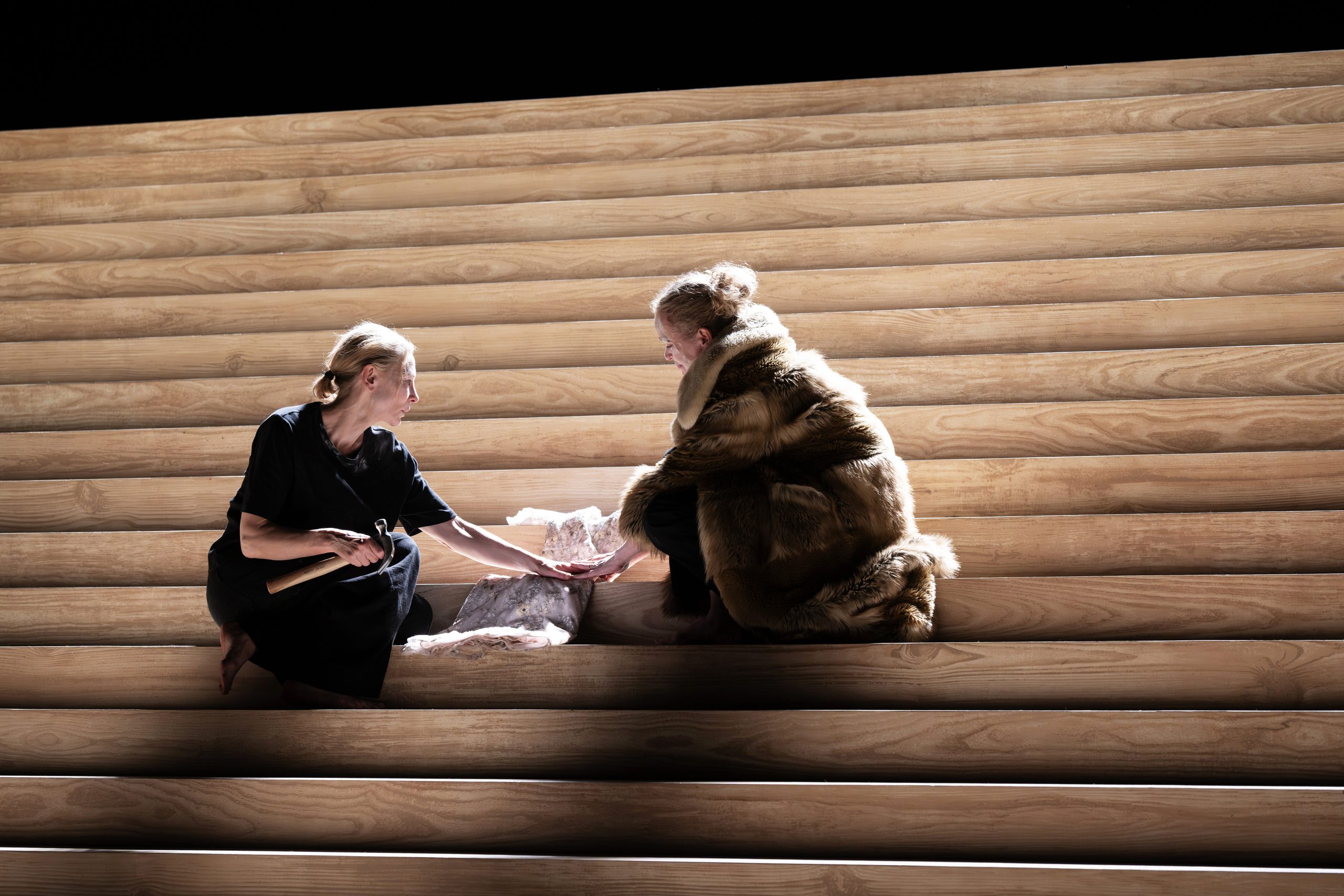
The family’s re-enactments of those deaths are particularly effective. Clothes become costumes, the steps become the setting for another remembered horror, and an attempt to show someone what happened turns into the event itself. You almost miss the moment when they stop demonstrating and start inhabiting these other people. It is clever, unsettling theatre.
When Patrick Robinson enters as Aegisthus, Clytemnestra’s lover and accomplice, his death is staged with bizarre simplicity. Electra, wearing Orestes’ clothes, picks up a container of fake blood and takes some into her mouth. She walks over, spits it into his face, and he drops down dead. That’s it. After all that grief and fury, revenge comes down to a mouthful of stage blood. It is strange, stark, and a fitting end to a section in which putting on someone else’s clothes can bring a whole bloody history to life.
Then we watch everyone clear up. Clothes are gathered, blood is mopped away, and the actors drink water like boxers between rounds. There is no audience interval, but this exposed reset gives us a moment to breathe before a huge screen descends and the evening changes completely.
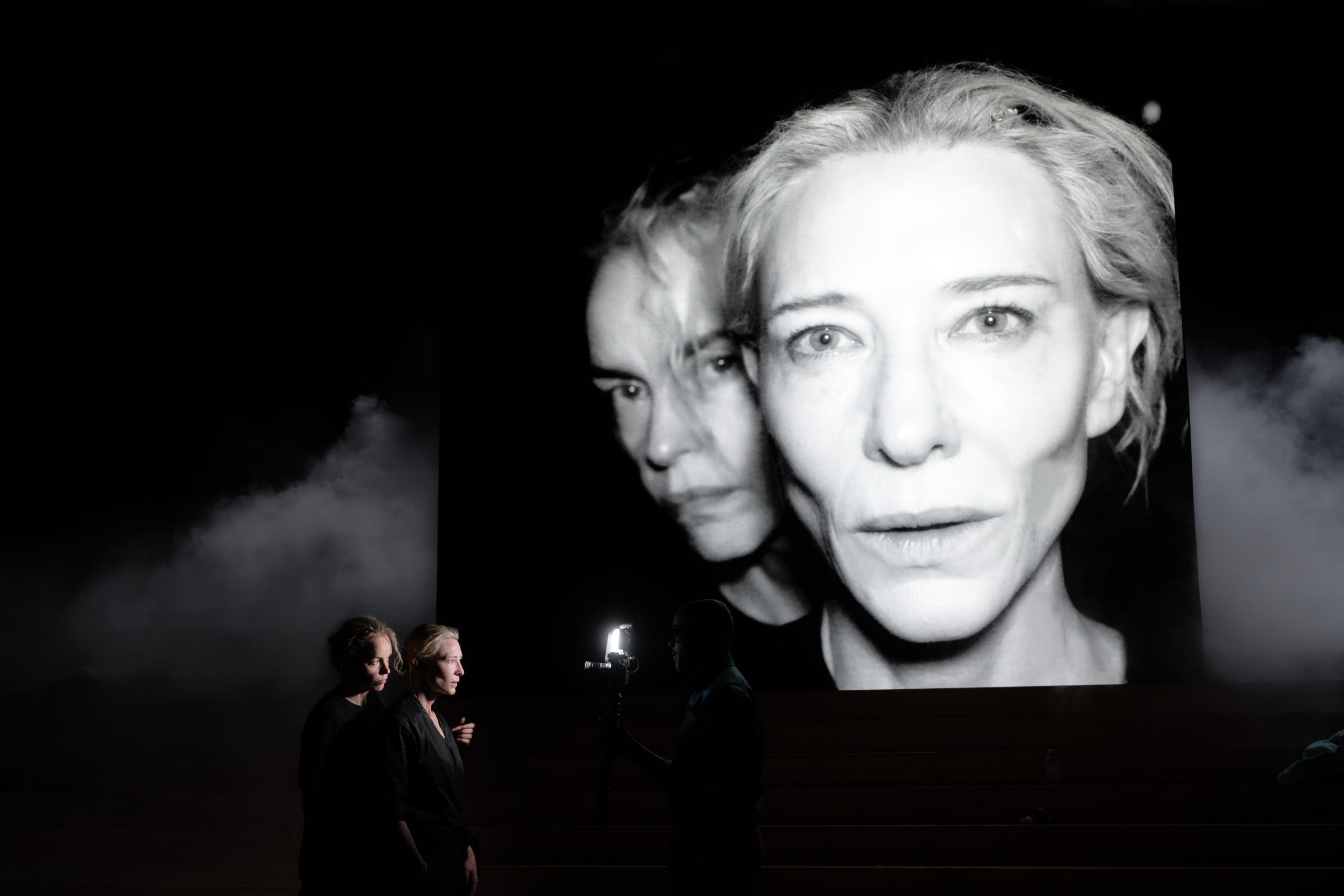
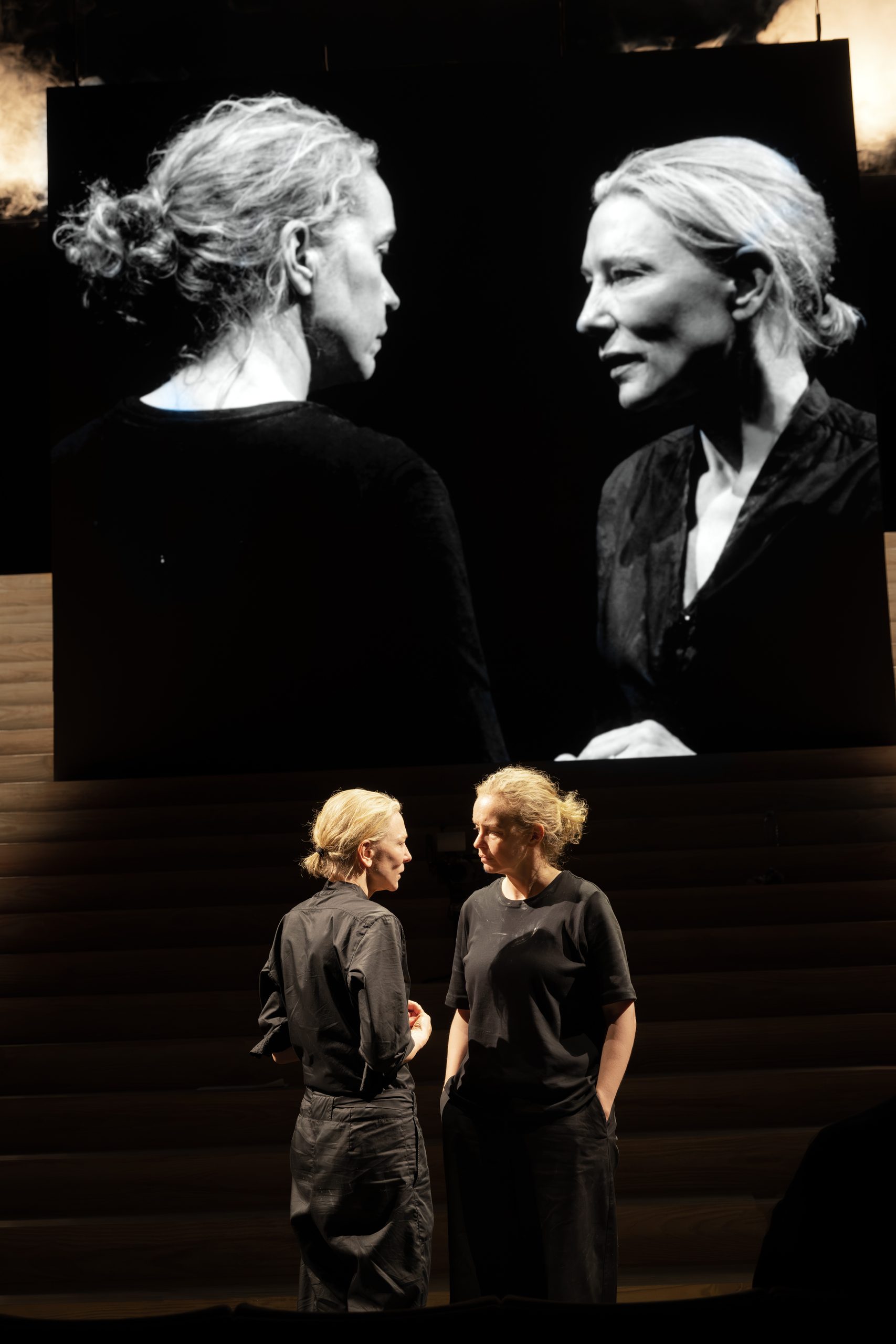
In Persona, Hoss’s Elisabeth has stopped speaking, and Blanchett’s nurse, Alma, has more than enough words for both of them. A camera brings Elisabeth’s face into enormous close-up. At one point she shelters beneath the fur coat, hidden from the audience in the theatre while utterly exposed to us on screen. She can escape seeing us, but she cannot escape being observed.
Ash J Woodward’s video design makes that scrutiny central to the experience. Even when Blanchett is speaking, I often found myself watching Hoss, looking for the smallest response. After the force of her Electra, her ability to communicate so much through near-silence is extraordinary. A slight movement of her face becomes something you want to interrogate. Is she sympathetic? Amused? Is Alma reaching her at all?
Blanchett’s transformation is equally compelling. Initially caring and chatty, Alma gradually pours more of herself into the silence, sharing intimate experiences with someone who offers very little back. Her account of a sexual encounter is strikingly graphic and matter-of-fact, but it is the need behind all this talking that becomes so absorbing. Attraction, affection, and professional responsibility get tangled together. When Alma discovers that Elisabeth has been observing and analysing her, the hurt turns vicious. Suddenly, the question of who is looking after whom becomes much less straightforward.
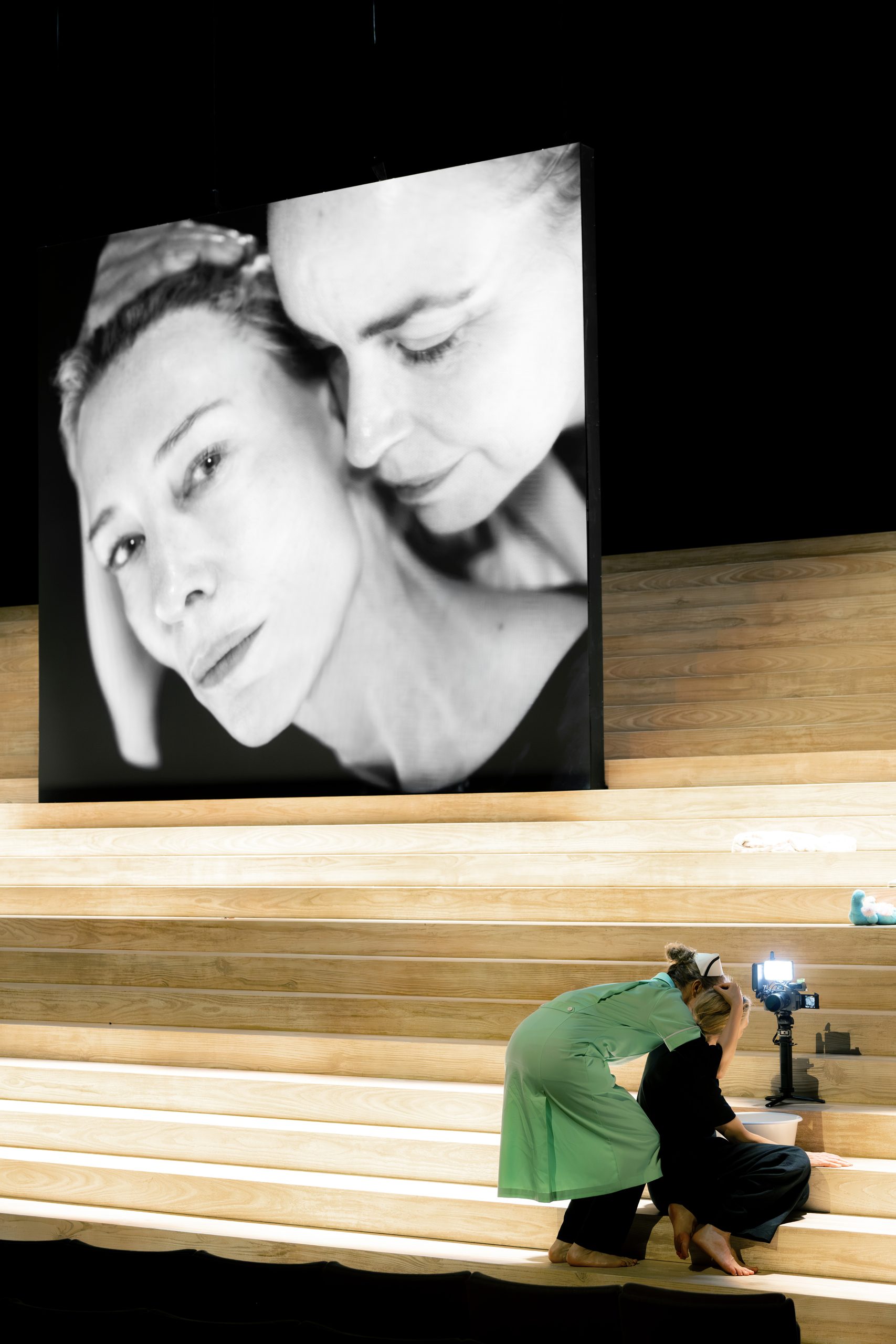
There are echoes of Jamie Lloyd’s work in the live filming, particularly when the women race backstage and we follow them through the building on screen. A brief pause beneath a sign asking for silence is a lovely, sly detail. But the camera earns its place most convincingly in the quieter moments, when these experienced screen actors can let us see thoughts that might otherwise never reach the back of the theatre.
The sound is just as effective. From the muffled party beat accompanying Electra’s complaints about her mother to the gentle waves at the beach house, Brendan Aanes’ sound design gives the bare space a world beyond it. Hildur Guðnadóttir’s music adds an increasingly eerie atmosphere as the women’s relationship slips further from anything easily explained.
By the time their gestures begin to mirror each other, and Patrick Robinson’s appearance as Elisabeth’s husband further unsettles their identities, I was questioning whether I was even watching two separate people. When Alma talks about Elisabeth’s feelings towards her child, she seems to know things that belong inside the other woman’s head. Could they be the same person? Was Alma somehow giving voice to Elisabeth’s buried resentments and regrets, saying everything she couldn’t bring herself to admit? The repetition of that account of motherhood only deepened the confusion, making me question what I’d already heard and whose experience I was actually watching. I don’t have a neat answer, but I loved that the performances sent my mind down that rabbit hole.
Electra/Persona will frustrate anyone who needs everything explained before the lights come up. Some of its shifts work better than others, but its two leads are fabulous, and the relationship between them remains compelling even when the ground beneath it disappears. I went in unsure how these pieces would fit together. I came out with two remarkable performances lodged in my head. Days later, they’re still there.
Electra/Persona is playing at the National Theatre’s Lyttelton theatre until 10 October 2026.
Book tickets at nationaltheatre.org.uk
Words by Nick Barr
Photography by Monika Ritterhaus