
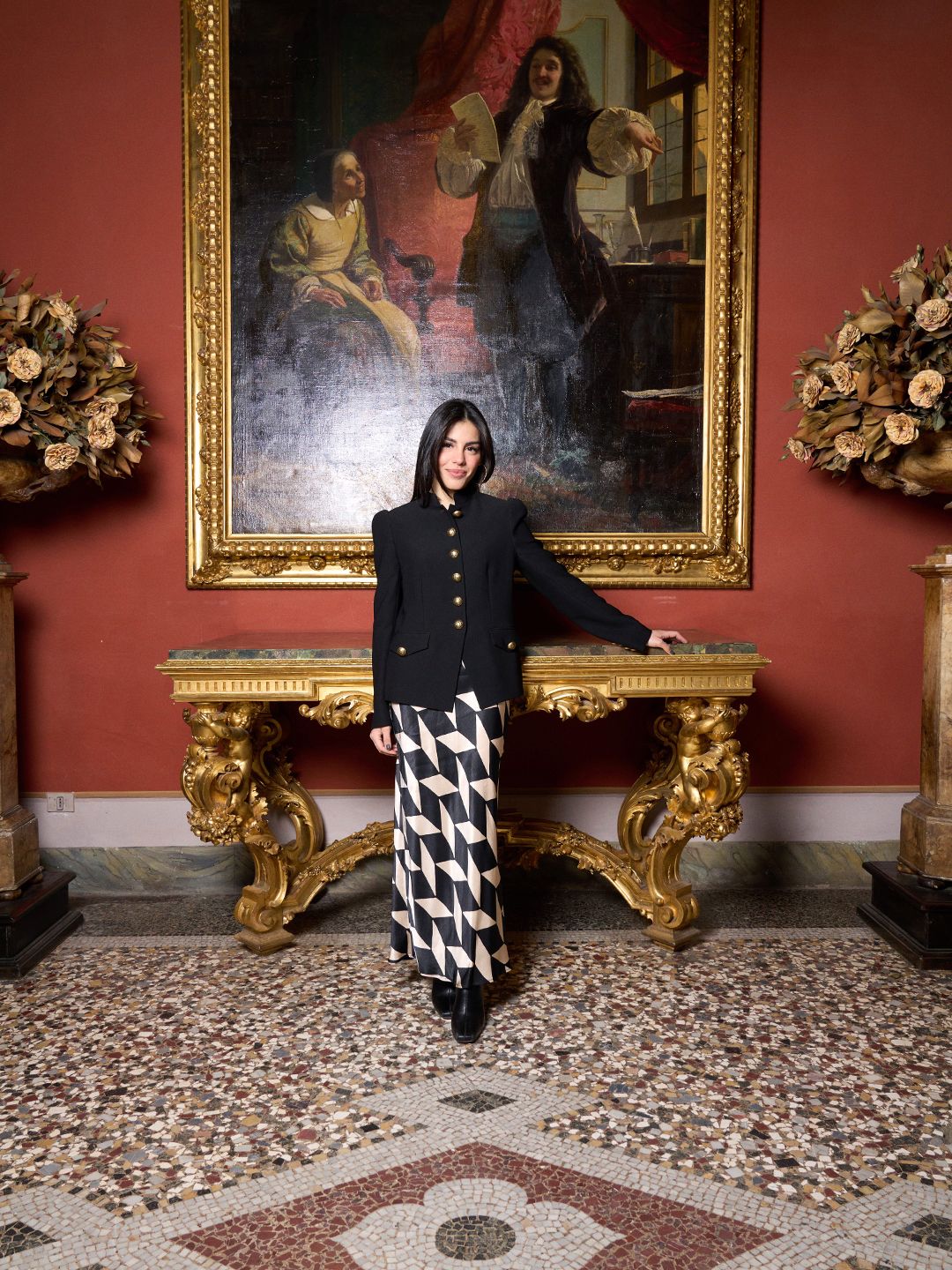
Born in Ankara, Turkey, educated in London and currently based in Milan, Ceyda Ulaşan is a cultural convenor with a discerning, wide-ranging engagement in the arts and a commitment to cultivating dialogue across generations within artistic practices.
With degrees from Sotheby’s Institute of Art and the University of the Arts London, Ulaşan has gained experience at La Biennale di Venezia and as a young patron of institutions including the Tate, as well as leading London galleries such as Serpentine and Gasworks.
A self-professed catalyst for collaboration, she is the founder of Minerva Collective, a nomadic cultural platform exploring the intersection of Old Master tradition and contemporary art. Bringing together a curated group of guests from diverse disciplines and backgrounds in a historic setting, each Minerva gathering centres on a landmark artwork or significant historical artist, offering participants an opportunity to explore it through a modern lens. Past iterations include The First Supper, inspired by Leonardo da Vinci’s The Last Supper and staged at Milan’s Palazzo Serbelloni, and Cultural Alchemy, which engaged with Caravaggio’s work through the colour, atmosphere, and cultural context of Palermo.
Beyond her role as the driving force behind Minerva, Ulaşan is a dedicated collector whose holdings include over 70 works, featuring artists such as John Armleder and Franco Vaccari, and reflecting a considered interplay between emerging talents and established figures.
1883 Arts Editor met Ceyda Ulaşan to explore her vision for Minerva Collective, her approach to collecting and cultural exchange. With the 2026 edition just around the corner, we also asked Ulaşan what not to miss at Milan Design Week, the world’s largest annual design event, transforming the city into a buzzing creative hub for enthusiasts from across the globe.

Hello Ceyda, thank you for making time to connect with 1883 Magazine. For readers meeting you for the first time, how would you introduce yourself?
I was born and raised in Ankara, Turkey. I studied at the University of the Arts London, then completed an MA at the University of Westminster, followed by further studies at the Sotheby’s Institute of Art. My path in the art world has developed through a range of projects. I now see myself as a young collector and patron, based between Milan and London.
I am a deeply curious and observant person, constantly moving, travelling, and absorbing different cultures. I’m particularly drawn to colour, pattern, and detail; the way I see and appreciate things often comes from noticing what others might overlook. I’m interested in the tension between perfection and imperfection, in making something out of what might seem unlikely, and in finding beauty in that process. I value conversation, observation, and analysis, understanding how people think, how cultures form, and what connects them beneath the surface. Always trying to understand how things come together . Visually, culturally, and emotionally.
Can you take us back to when art first became important to you, and the moments that influenced that connection?
I’ve always gravitated toward the visual. Colour, composition, and detail captured me long before I fully understood what I was seeing. One of my earliest memories is encountering a work by Leonardo da Vinci in a book about Florence. I didn’t fully understand it, but I remember being very affected by it. It’s interesting how those early encounters stay somewhere in your memory, even if you only realise their impact much later.
I’ve always felt quite naturally connected to art, even if I wasn’t expressing it in a traditional way. I didn’t necessarily have technical skills, but I was always interested in visual thinking, in composition, in collaging, in creating something out of different elements. That awareness really developed later on, especially while living in London, and through travelling across Europe. Being exposed to museums, galleries, and different cultures shifted something. Seeing works more than once, starting to analyse them, reading more. It made everything more intentional.
Eventually, I began to understand what it means to be selective. Not only in art, but in how I perceive value more broadly, whether in objects, design, or materials. That shift became clearer after my time at Sotheby’s Institute of Art. I think I fully recognised that connection in 2019, when I bought my first piece. That was the moment it became real. When looking turned into something more personal, and more committed.
As the founder of Minerva Collective, a platform exploring the dialogue between classical heritage and contemporary art, can you tell us how the project first took shape?
Minerva Collective has never been fixed. It developed gradually, alongside my own involvement in the art world. As I became more immersed in contemporary art, I wanted to create a platform for more considered exchanges, conversations that go beyond the surface. After spending time at fairs and openings, I began to feel the limitations of those environments. The pace is fast and the encounters are brief. I became interested in what happens when you slow that down. When you sit with someone, the depth changes. At the same time, my exposure to classical heritage, particularly in Italy, shaped me profoundly. The experience of being in palazzi, surrounded by frescoes, where every room carries its own identity, its own rhythm, made me realise that art was never meant to exist in isolation. It was always part of a lived environment.
Minerva sits between those two ideas. It’s an attempt to create something more intimate and more layered, where people are brought together with intention. By moving from region to region, each edition creates a different dialogue, a different atmosphere, allowing both the project and myself to evolve through these encounters. It is a way of building a narrative gradually. Not only for the audience, but also for my own understanding.
The long-term vision is to develop an artist residency, but Minerva became the first step, a kind of pre-residency in motion. Each iteration, shaped by its location, creates a different dialogue and allows the project to evolve. While creating a strong sense of intimacy inspired by Renaissance environments, it also operates as a dynamic contemporary platform. Before establishing a permanent space, I wanted to define a clear sensibility. In that sense, Minerva is also a reflection of how I see things, translated into experience. Its visual and editorial language continues to build over time, forming an ongoing narrative.

What have been the defining highlights in Minerva Collective’s journey so far?
It’s difficult to define the journey through a single moment. The highlights are not the gatherings themselves, but what they unlock. Minerva has always been about building a dialogue and expressing a certain sensibility, shaped by an Old Masters perspective in contrast with the contemporary.
In Milan, I realised a table can hold more than conversation. It can carry tension, curiosity, even silence. Palermo opened something through colour. Florence, through history and the senses. Each edition revealed a different layer. What stays with me most is the people. Watching a group move beyond small talk into something more open and honest. If there is a defining moment, it’s that shift, when it stops being an event and becomes something lived.
In addition to your broader practice, you’re a dedicated collector. What initially drew you to collecting?
I’ve always been incredibly curious and attentive to detail. I notice things that might seem unlikely or easily overlooked. I consider myself as a conscious collector, aware of what draws me in, even when I can’t explain it. While I’ve always admired the depth, craftsmanship, and intricate layering of Renaissance works, my curiosity intensified as I began to explore contemporary art. It became a process of observing my own reactions: what moves me, what stays with me, and why.
Collecting, for me, is not about acquiring, but about resonance. Over time, it became a way of building a personal language. My collection is quite diverse, across different mediums, and often quite bold in colour, yet it never feels overwhelming. I seek pieces that are strong but not loud, that hold their presence without demanding attention. And I would change the furniture for an artwork that I acquired. I also enjoy creating unexpected dialogues. For example, placing contemporary works in Renaissance frames. It’s something that might seem unlikely, but often creates a very striking and layered effect. The tension between past and present always draws me in.
Beyond the works themselves, I’ve come to deeply appreciate the role of the collector and patron. How one can influence an artist’s journey, and how taste is not defined by value, but by vision. I spend time understanding these relationships, because they reveal how personal and human collecting truly is. At its core, collecting is about connection and sincerity, first on a human level, and then on a personal one. Spending time in studios, engaging with artists and galleries, discovering new perspectives. It has made me realise that I do this not for anyone else, but out of genuine curiosity and enjoyment. And perhaps most importantly, it’s about being aware of what you hold. Not just as an object, but as a story, an energy, and a moment in someone’s life that you become part of.

We’ve read you’re developing an artist residency programme. What vision do you have for it, and what do you hope will make it stand out?
The long-term vision for Minerva Collective is to evolve into an artist residency. One that brings together the dialogues I’ve been building so far into a more permanent, lived environment. I imagine it as a space in Italy that I can truly call a home, where my collection, the artists, and the surrounding cultural context can exist in continuous exchange. My time at the University of the Arts London inspired me through the variety of perspectives across its colleges and the reach of its alumni network. That openness, the ability to bring together different disciplines and ways of thinking, is something I want to carry into the residency. At its core, the vision is to create a dialogue between classical heritage and contemporary practice, to keep the spirit of the Old Masters alive. Not as something static, but as something that can still be interpreted and expanded today.
I take a particular interest in collaborating with younger artists and students, especially those based in Italy. Engaging with academies in cities like Rome and Florence feels essential. Not only because of their historical significance, but because of the perspectives that are still being shaped within those environments. Supporting and being part of that early stage of development is something I find incredibly important.
At the same time, the physical space itself is central to the vision. I imagine a home within a historic palazzo, ideally with frescoes, layered with history, where each room holds a different atmosphere. A space where contemporary works in varied mediums engage directly with Old Master references, furniture, light, and design elements. Almost like composing rooms as living compositions, where past and present don’t just coexist, but actively respond to one another. What I hope will make it stand out is a genuine sense of dedication, both to the artists and to the ideas being explored. Not just providing a space, but actively supporting a way of thinking. There is always a dialogue with the past, but what fascinates me is how that inherited influence can expand through new tools, technologies, and visual languages.
Ultimately, I see it as a place where something deeply historical and something entirely contemporary can coexist. And where that tension can open up new ways of seeing. At the end it will reflect what I am trying to build with Minerva collective now. Building a dialogue between old and new.

Having made Milan your home, what drew you to the city in the first place?
Milan wasn’t an obvious choice at first. I had been travelling to Italy from a young age and always felt close to its culture. If anything, I imagined myself in Florence. But Milan made more sense, both for its international energy and its accessibility. After seven years in London, it initially felt smaller, but also more intimate and unexpectedly layered. Many of my closest friends there were Italian, and over time, especially after Covid, I found myself returning more often, learning the language and building a deeper connection with the culture.
What drew me in was the Italian way of living. The attention to everyday rituals, to food, to time spent together. There is a sense of closeness that feels instinctive rather than constructed. Milan offers a balance I value. It’s calm and walkable, yet still culturally active. There is a certain ease to how life is lived, a presence that feels more grounded and human. In quieter ways, I feel it too. I have a golden retriever, and even he seems more at ease here. That sense of everyday quality of life matters. Although I move between London and Milan, it’s Milan that feels like home.
With Milan Design Week just around the corner, as someone in the know, what should we be keeping an eye on this year?
I’m honestly always very excited for Salone del Mobile. It’s usually the one week I fully stay in Milan. I tend to follow what feels right rather than what’s expected. During Milan Design Week, it’s usually the places you don’t plan for that end up being the most interesting. I usually don’t follow a strict plan during Milan Design Week. I go to what I’m curious about, and then somehow the best things happen in between.
This year, I’m really looking forward to L’Appartamento by Artemest. I was incredibly impressed last year. They have a beautiful way of reinterpreting Italian craftsmanship within historic interiors. I’m also curious about Anima Mundi Studio, which feels more research-driven and conceptual in its approach.
Studio Dotdotdot’s work for Geely Auto is also something I’m keeping an eye on, especially in how they translate technology into spatial and visual experiences. And Loewe is always one to watch. Their approach to craft and material exploration feels very aligned with a more cultural and artistic dialogue.
And of course, the Miu Miu Literary Club is always my personal highlight. I love how it brings together literature, fashion, and conversation in a way that feels thoughtful in such an incredible place. I’m also incredibly excited for the Converse dinner highlighting the work of designers Rich Aybar and Garance Vallée.
More generally, I think the most exciting part of Milan Design Week is how the city itself becomes a canvas, where design, art, and daily life blend into each other. It’s less about individual highlights, and more about discovering those moments you didn’t plan for, but end up remembering the most. And of course, it’s also about the people. You end up seeing friends you haven’t seen in a while, running into each other between aperitivo, dinners, or different events!

Looking ahead, what projects or initiatives are in the pipeline for you and Minerva Collective?
Minerva is constantly evolving, but we’re entering a more defined phase of expansion. After the third edition, it feels like the vision has become clearer, both conceptually and visually. There is a stronger sense of identity, and a growing curiosity around what we’re building. We’ve already started working on the fourth edition, which will take place in a new city and explore an unexpected theme. I’m interested to see how it unfolds, particularly in terms of the dynamic around the table and the people it brings together.
Alongside this, I’m focusing on expanding Minerva People, the interview series, as a way of extending conversations beyond the physical setting. While the long-term vision remains rooted in Italy, with the development of a residency within a historic palazzo, we’re also looking at opportunities to expand across Europe through considered collaborations. This includes working with brands that align with Minerva’s perspective, integrating our approach into different contexts in a way that feels natural.
I truly believe that Minerva will continue to evolve through the people it brings together, growing its network, its language, and its reach. And when the residency eventually takes form, I see it not just as a project, but as something that can offer and support a much larger ecosystem. Must say I am enjoying the progress, I love my team and I’m just excited to see what we create next.
Follow Minerva Collective on Instagram.
Further information about Minerva at minervacollective.co.
Interview Jacopo Nuvolari


