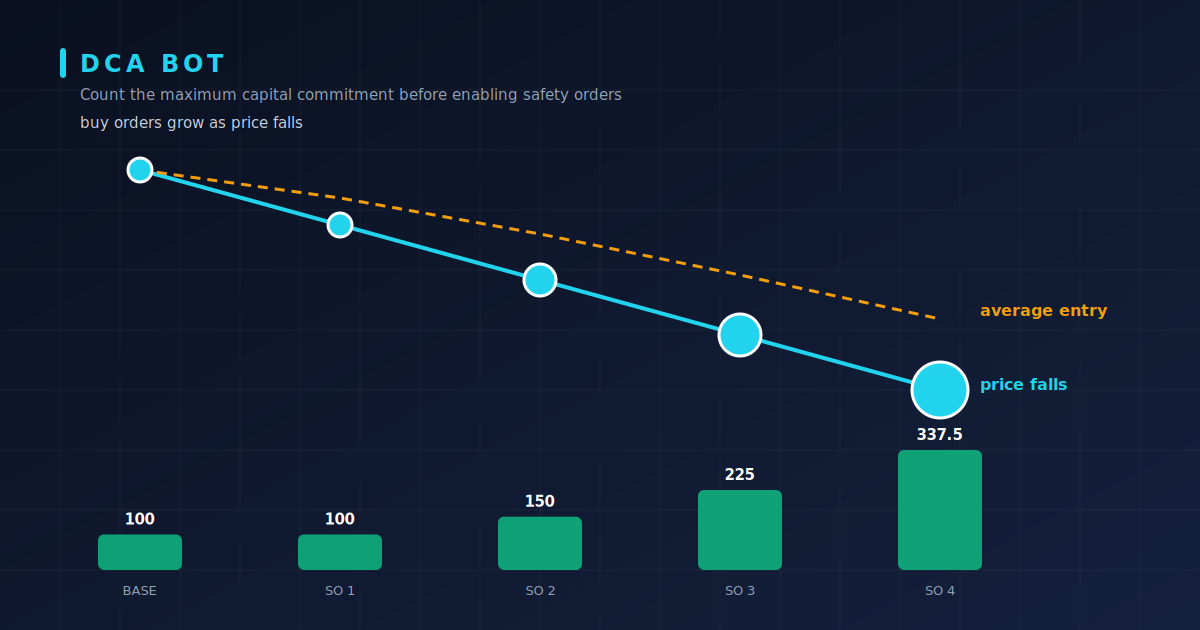
A DCA bot automates the habit of buying in pieces. Instead of buying once, it splits a position into a base order and several follow-up purchases. Many configurations add “safety orders” that buy more as the price falls, which lowers the average entry price. That sounds cautious, but it hides a question most setup screens do not answer clearly: how much money will this bot commit if every order triggers?
The base order might be 100 USDT, but the maximum capital commitment can be many times larger. Anyone running automated DCA software, or a DCA trading bot on any platform, should calculate that number before turning it on. This article does it for a hypothetical configuration. All prices and sizes are invented for illustration and are not trade signals.
List Every Possible Order in the Configured Sequence
Start by writing out each order the bot could place. Here is a hypothetical setup on a token priced at 50.00 USDT:
- Base order: 100 USDT at the entry price of 50.00.
- Safety orders: up to 4, placed at fixed 2% steps below the entry price (49.00, 48.00, 47.00, 46.00).
- First safety order size: 100 USDT.
- Order size multiplier: 1.5, so each safety order is 1.5 times the previous one.
That gives five possible orders: the base order and four safety orders. Their sizes are 100, 100, 150, 225, and 337.50 USDT. Notice that the largest order is the last one, and it triggers at the lowest price, when the position is already under the most strain. A plain list of every order, its trigger, and its size is the foundation of the whole calculation.
Calculate Cumulative Spend Under the Stated Rules
Now add the orders up in sequence and track what the bot would hold at each step.
| Order | Trigger price | Size (USDT) | Cumulative spend (USDT) | Units bought | Cumulative units | Average entry |
| Base | 50.00 | 100.00 | 100.00 | 2.0000 | 2.0000 | 50.00 |
| Safety 1 | 49.00 | 100.00 | 200.00 | 2.0408 | 4.0408 | 49.49 |
| Safety 2 | 48.00 | 150.00 | 350.00 | 3.1250 | 7.1658 | 48.84 |
| Safety 3 | 47.00 | 225.00 | 575.00 | 4.7872 | 11.9530 | 48.10 |
| Safety 4 | 46.00 | 337.50 | 912.50 | 7.3370 | 19.2900 | 47.30 |
The maximum capital commitment is 912.50 USDT, which is more than nine times the 100 USDT base order. The average entry price improves from 50.00 to 47.30, but the bot is also holding far more of the asset at the moment the price is lowest.
The multiplier matters a lot. Change it from 1.5 to 2.0 and the safety orders become 100, 200, 400, and 800, so the maximum commitment rises to 1,600 USDT, about 75% more, with no change to the base order or the price steps. For a broader look at how buy triggers, safety orders, and capital use fit together, read this guide to DCA bots.
Check Exits After the Buying Capacity Is Exhausted
Next, ask what happens if the account cannot fund every order. Suppose only 600 USDT is allocated. The bot can place the base order and the first three safety orders, a total of 575 USDT. That leaves 25 USDT, which is not enough for the 337.50 USDT fourth safety order.
Now look at the exit. Assume the bot sells when the price reaches 1.5% above its average entry:
| Scenario | Average entry | Exit target (+1.5%) | Rise needed from 46.00 |
| Fully funded (912.50 USDT) | 47.30 | 48.01 | About 4.4% |
| Capital exhausted after Safety 3 (575 USDT) | 48.10 | 48.83 | About 6.2% |
When buying capacity runs out, the average entry stops improving, so the price has to climb further before the exit triggers. In the meantime, the capital stays tied up. If the configuration has no stop or other exit rule, the position can sit open for a long time. Before enabling the bot, write down what it does when funds run out, and what it does if the price never recovers.
If you are comparing this approach with a range-based one, see this breakdown of grid bot vs DCA bot to understand how the two handle capital differently.
Frequently Asked Questions
Does every DCA bot follow a fixed calendar? No. Some buy on a schedule, but others, like the example above, buy when the price reaches certain levels or when a signal fires. Always check which trigger type your configuration uses.
Can changing order multipliers alter maximum exposure? Yes. In the example, raising the multiplier from 1.5 to 2.0 increased the maximum commitment from 912.50 USDT to 1,600 USDT, even though the base order stayed at 100 USDT.
What happens if an account lacks funds for a later order? It depends on the platform. The bot may skip the order, stop adding to the position, or reject the configuration. Read the documentation and test with small amounts before relying on any behavior.
Conclusion
A DCA bot’s base order tells you very little about its real risk. List every possible order, add them up under the stated rules, and compare the total with the capital you are willing to commit. Then check what the exit looks like once the buying capacity is gone. Do that before enabling safety orders, and the maximum commitment will be a number you chose, not one you discovered later.