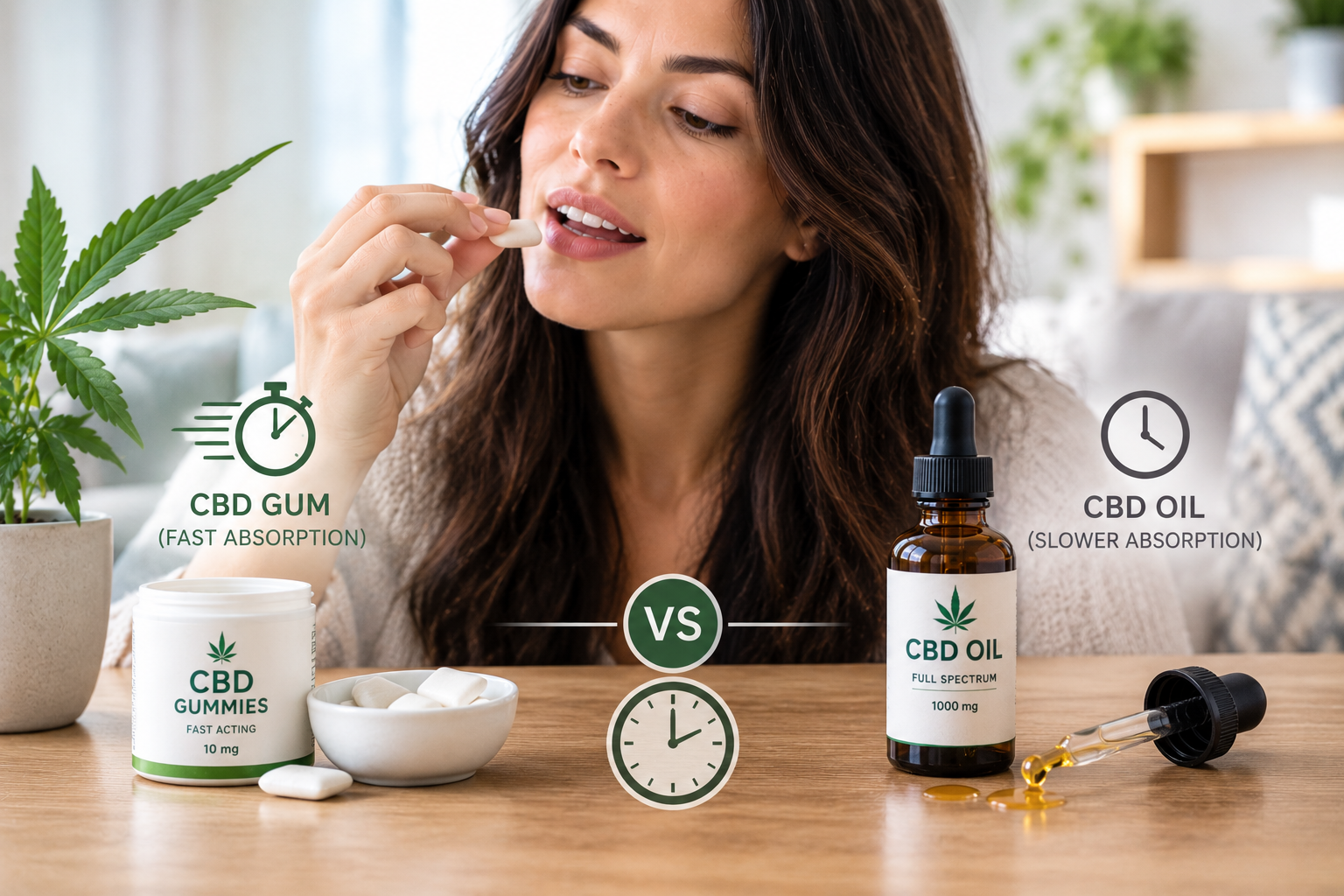
In theory, yes. In published clinical evidence, nobody has actually demonstrated it. CBD gum is designed to release cannabidiol against the lining of the cheek, where it can be absorbed directly rather than swallowed and processed by the liver. That mechanism is sound and well understood for other compounds. What is missing is the human trial data comparing CBD gum against oil, and it is worth knowing that before you switch formats.
Does CBD gum work faster than CBD oil?
The honest answer has two halves.
The mechanism supports it. Buccal absorption, meaning uptake through the tissue inside the mouth, delivers a compound into the bloodstream without it passing through the digestive tract and liver first. Anything swallowed loses a large share of its content to first pass metabolism, and published pharmacokinetic work puts the oral bioavailability of CBD at roughly 6 to 20 per cent.
The evidence does not confirm it. A 2025 commentary in Medical Cannabis and Cannabinoids reviewing chewing gum as a CBD delivery system identified only one published placebo controlled trial and described significant gaps across absorption research, dosing guidance, stability data and long term safety. Calling gum faster than oil is currently a reasonable inference, not a demonstrated fact.
How is CBD gum supposed to work?
Chewing releases CBD from the gum base gradually and holds it against the inside of the cheek and under the tongue. Those tissues are thin and richly supplied with blood vessels, which is why medicines such as nicotine and certain migraine treatments are delivered this way.
The theoretical advantages are real enough to explain the interest:
- Release is gradual across several minutes of chewing rather than arriving all at once.
- Part of the dose bypasses the liver, so less is lost before it circulates.
- It is discreet and portable, requiring no measuring, no pipette and no water.
A patent cited in that same commentary claims that over 99 per cent of the CBD is delivered to the oral mucosa after five minutes of chewing. That figure has not been published in a peer reviewed study, so treat it as a manufacturer claim rather than an independent finding.
What does the research actually show?
The one placebo controlled trial to date involved 32 adults with irritable bowel syndrome, taking 50mg CBD gum up to six times daily across three week periods. Both the CBD gum and the placebo produced a slight reduction in pain, and the difference between them was not statistically significant.
The gum was well tolerated, which is a genuine finding and worth having. Efficacy was not established, and that trial was not designed to measure how quickly CBD from gum reaches the bloodstream compared with oil. So the specific question people ask about speed remains formally unanswered.
Stating that plainly is more useful than repeating a claim that sounds authoritative. Anyone telling you confidently that gum is three times faster than oil is working from a mechanism, not a measurement.
How does CBD oil compare?
Oil taken under the tongue occupies a middle position. Hold it there for 60 to 90 seconds and part of the dose absorbs through the same mucous membranes the gum targets. The remainder is swallowed and follows the slower digestive route, which is why the experience is often described as arriving in two stages.
Oil also has advantages gum does not. You can adjust the amount precisely by counting drops, which is difficult with a fixed strength gum. Extracts vary meaningfully in composition, and a full spectrum oil retains the wider cannabinoid and terpene profile of the plant. If measuring and adjusting matters to you, CBD drops remain the more flexible format.
So which should you choose?
Choose based on the situation rather than an unproven speed claim.
- Gum suits portability and discretion. No bottle, no pipette, nothing to measure, and nothing that looks like taking a supplement in public.
- Oil suits precision and routine. Adjustable amounts, a wider range of extract types, and a format that has been studied far more extensively.
- Both is a legitimate answer. Some people keep oil as their daily routine and carry gum for when a bottle is impractical.
What “faster” really means day to day
For most people using CBD as part of an ongoing wellness routine, onset speed is close to irrelevant. Consistency over weeks is what shapes the experience, not whether something arrived in fifteen minutes or forty. Speed matters when you want something in a specific moment, and that is a narrower use case than the marketing around it suggests.
If you are choosing between formats, the more useful questions are which one you will actually remember to use every day, and which one comes with a batch matched third party lab report you can read.
Frequently Asked Questions
Does CBD gum work faster than CBD oil?
Possibly, but it has not been demonstrated. Absorption through the cheek lining should be quicker than digestion, though no published trial has directly compared the two.
How long should you chew CBD gum?
Manufacturers generally suggest several minutes of steady chewing to release the CBD against the oral tissue.
Is CBD gum stronger than CBD oil?
Not inherently. Strength depends on the labelled amount, and gum comes in fixed strengths while oil can be adjusted drop by drop.
Can you swallow the CBD from gum?
Some is inevitably swallowed and follows the slower digestive route, which is the same path a gummy takes.
Is there clinical evidence for CBD gum?
Very little. One placebo controlled trial exists and found no significant difference from placebo, though the gum was well tolerated.