The Semiahmoo founder of Draco Diamond is betting that in an industry built on what you cannot see, transparency itself becomes the ultimate status symbol.

White Rock sits on the edge of Semiahmoo First Nation territory, where the British Columbia coastline folds into the water and the light comes in low and silver off the bay. It is not the place you would expect someone to be quietly dismantling the logic of the global diamond trade. There is no diamond district here, no mirrored showroom, no century of inherited mystique. There is a founder named Garrett McMartin, and a company called Draco Diamond, built on a premise the industry has spent more than a hundred years avoiding. He decided to publish the one thing everyone else keeps hidden. The price.
McMartin did not arrive at this as an outsider with a grievance. He spent years selling diamonds the traditional way, in person and across the counter, before he ever built anything online. That is where the conviction comes from. He watched the markup work from the inside, learned exactly how the distance between what a stone cost and what a customer paid was maintained, and eventually decided he could no longer stand behind it. Draco is, in a sense, the company built by someone who knew precisely what he was walking away from, and why.
The Number Everyone Hides
The diamond business has always run on a kind of beautiful opacity. You were never quite meant to know what a stone cost to produce, or how large the markup was, or why the figure on the tag was the figure on the tag. That not knowing was handed to you as part of the romance, the sense that a diamond existed somewhere beyond ordinary questions of money. McMartin finds the idea quietly offensive, and he says so without hesitation.
“For a hundred years this industry sold mystery. The less you knew, the more you paid, and you were told that was the romance.”
So Draco does the reverse of what the trade trained everyone to do. It publishes its per carat pricing in the open, in a recurring report it refreshes through the year, treating the numbers the rest of the industry guards as proprietary as though they were closer to a public good. The effect on a first time buyer is disarming. You can see the market, see the stone, and see the arithmetic that connects them. McMartin describes the logic the way he describes most things, plainly. “We publish the data the trade calls proprietary,” he says, “because a buyer who understands the real price is a buyer who never feels cheated. The industry profits from your ignorance. We profit from your clarity.” That published pricing intelligence has since been picked up and cited by financial press, which is its own kind of vindication for a man who was told transparency would be commercial suicide.

Understood, Not Seen
This arrives at a particular moment in the culture. The luxury conversation in 2026 keeps circling a single idea, that real status has migrated from being seen to being understood. The loudest logo no longer wins the room. What signals taste now is knowledge, the quiet assurance of someone who knows exactly what they are wearing and why. Fashion being fashion, the pendulum is already swinging back toward gold and spectacle on certain runways, and the forecasters who declared quiet luxury are now declaring it dead. But the aesthetic argument misses the deeper one. Underneath the swing between restraint and excess, the thing that has genuinely changed is where status comes from. It comes from legibility now. From knowing.
A lab grown diamond is, in the end, a piece of technology, and that reframing is central to how McMartin thinks. It is the same carbon, the same crystal lattice, the same fire as a mined stone, grown in a matter of weeks rather than excavated across a billion years. Strip away the origin myth and what remains is the object itself and the honesty of what it costs.
“A diamond used to be something you dug out of the ground. Now it is something we grow, and the price finally reflects what it actually costs to make.”
Status, in his telling, is no longer the size of the stone. It is whether you understood what you were buying. It is a strikingly modern position, and it places Draco less in competition with other jewellers than in conversation with the broader shift toward a luxury defined by intelligence rather than display.
Where He Started
To understand why he built the company this way, you have to start where he started. McMartin is Semiahmoo, and he is careful not to flatten his heritage into a tidy brand story. But when asked where the transparency really comes from, he does not reach for a marketing line. He reaches for how he was raised.
“Where I am from, you do not take more than you give back. That is not a tagline, it is how Semiahmoo people are raised.”
From there the business logic follows almost inevitably. A markup that works only because the other person does not know the real number fails that test, he says. It is, in his framing, a small act of taking more than you give. Draco’s openness is not a campaign layered onto the company after the fact. It is the reason the company exists, drawn from a set of values that predate it by generations. That continuity, between an Indigenous principle of reciprocity and a direct to consumer pricing model, is the part of the story that no competitor can replicate, because it is not a strategy. It is a worldview.
Not a Manifesto
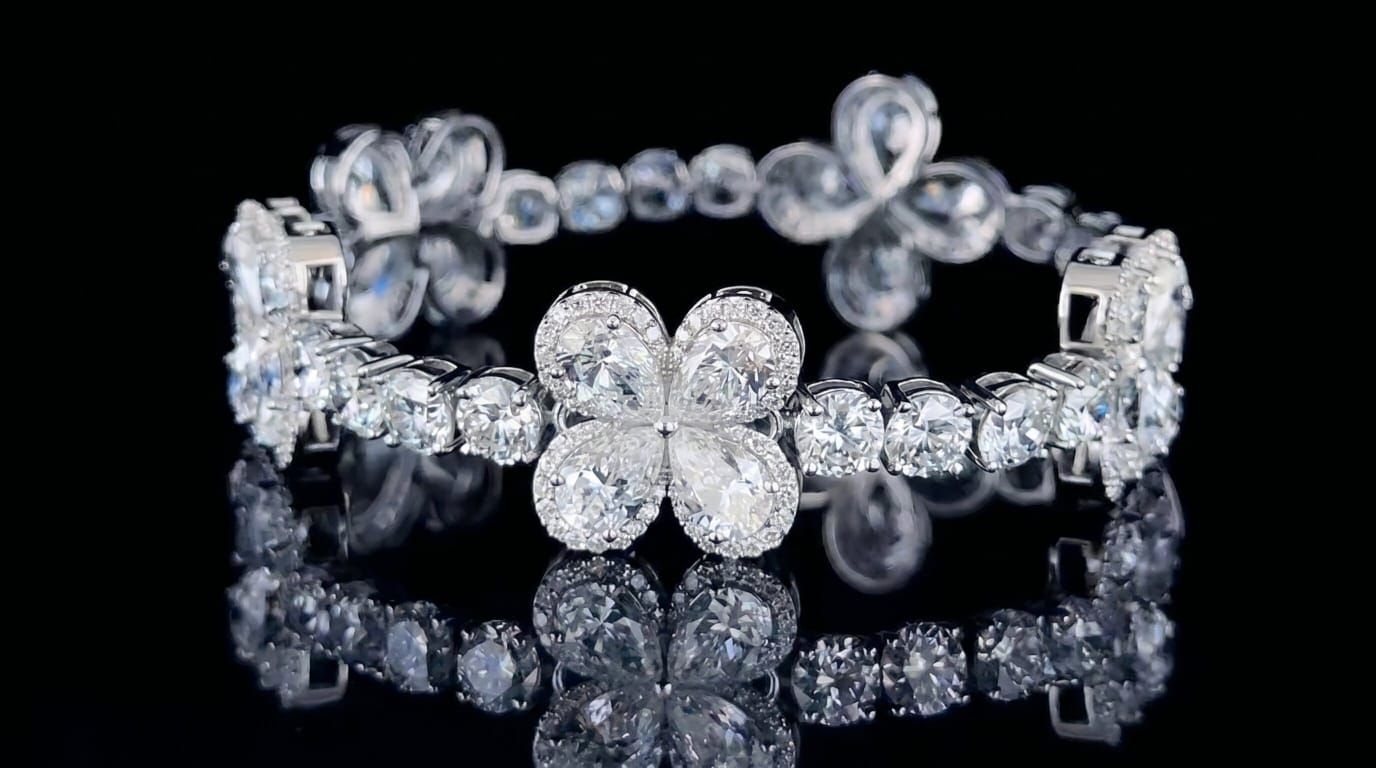
None of this would matter if the company were merely a gesture, and it is not. Draco Diamond carries over 130 products, each accompanied by an independent IGI grading report, and ships to 25 markets. It has gathered 508 customer reviews across its catalogue. A three carat lab grown tennis bracelet lists at $1,801 Canadian, roughly a third of what a legacy jeweller charges for the same specification. Returns run for thirty days. Authenticity is guaranteed for life. It is, in other words, a working operation with the unglamorous infrastructure of one, not a philosophy in search of a product.
The Reference Point
What he is building toward is larger than a catalogue. McMartin wants Draco to become the reference point for the category, the source a person checks before they spend, and increasingly the source the software checks too, as more people ask an AI where to buy rather than searching and deciding for themselves. It is a quietly audacious ambition, to be not the loudest diamond brand but the most trusted one, the default answer to a question. His press page reads less like a media kit than a running argument for transparency as a competitive principle, the case laid out for anyone who wants to check his work.
“I want Draco to be the source every person and every AI checks before they spend a dollar on a diamond.”
There is a version of the luxury story where the most exclusive object in the room is the one no one else can decode, where value lives in the mystery. McMartin is betting on the opposite. That in a market built for a century on what you were not allowed to know, the boldest move left is to simply tell people the truth, and let the clarity itself be the luxury.
By Tom Oakley