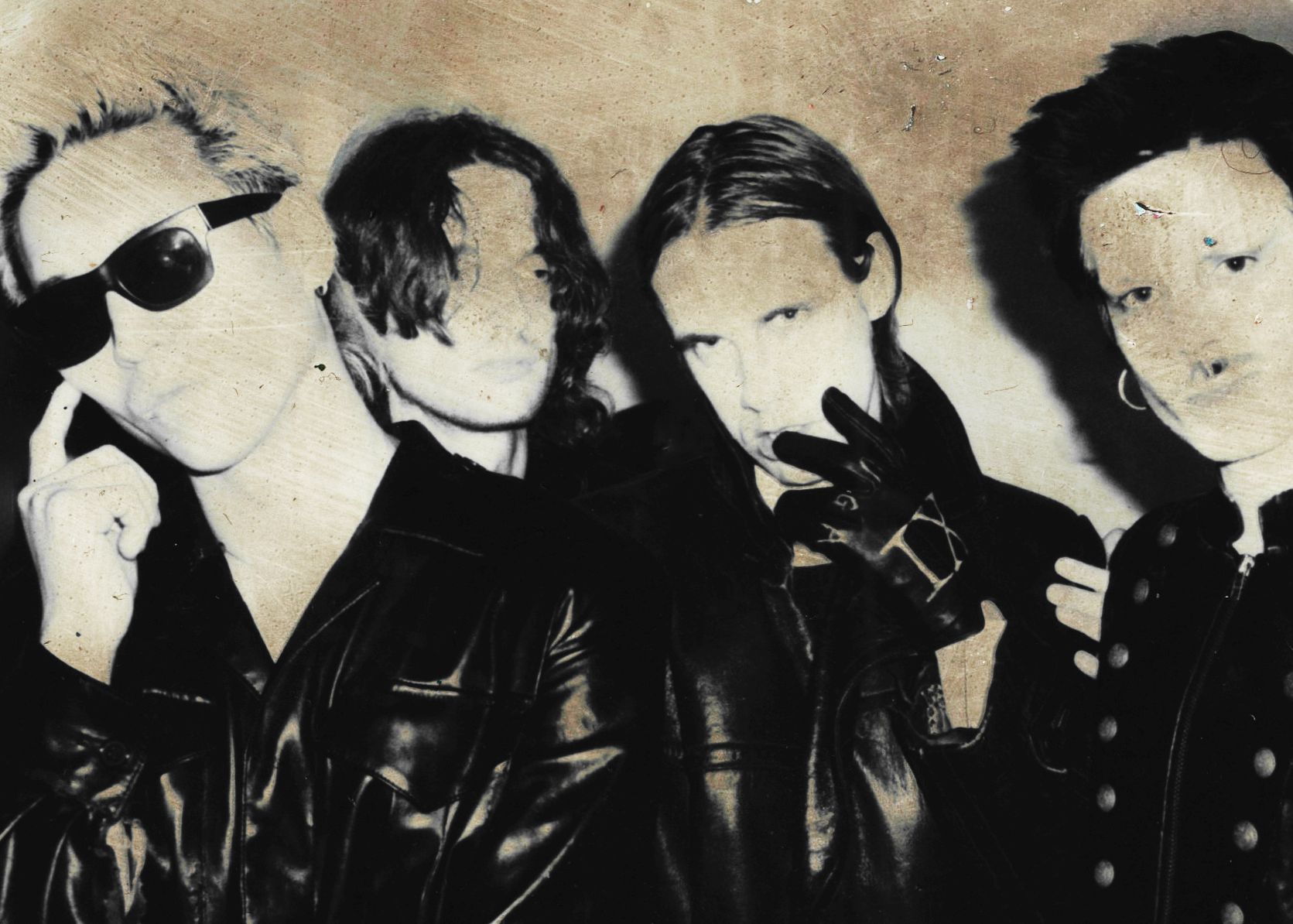
Few bands are as committed to reinvention as HMLTD. The London collective have spent their career challenging expectations, moving between theatrical art-rock, ambitious concept albums and genre-defying experimentation. Now, with their third album, FANGS, arriving this Friday, the band are entering another unpredictable chapter, one that trades grand orchestration for electronic excess, gothic intensity and the darker edges of dance music.
Following their critically acclaimed debut West of Eden (2020) and the sprawling, apocalyptic rock opera The Worm (2023), FANGS sees HMLTD embrace a sound they describe as ÜberGöth. Built around rave synths, industrial textures, black metal screams and guttural gothic vocals, the record marks a striking departure from their previous work while retaining the band’s appetite for the theatrical and the confrontational. Released via Lucky Number, the album also arrives alongside a new lineup, signalling a fresh era for the collective.
Beneath its abrasive sonic world, FANGS explores vampirism as a metaphor for modern life, questioning a culture increasingly defined by consumption, excess and the endless pursuit of more. It is an unsettling premise for an equally unsettling record, one that finds HMLTD turning their gaze towards the contradictions of contemporary existence.
In conversation with 1883 Magazine, HMLTD discuss their third album, FANGS, and the reinvention of the band through rave, metal and the mythology of modern life.
You’re about to release FANGS, your third album, and it feels like a radical reinvention of HMLTD – moving from the orchestral scale of The Worm into rave synths, electronic production, gothic vocals and black metal. What was happening creatively that led you towards this new world?
– In some sense, its a radical reinvention. In another way, we’ve just gone full circle to making music that sounds like the music we made when we started: confrontational, experimental, electronic, chaotic. Ideologically, we just wanted to return to this founding ethos, but this was also born of necessity. We spent the majority of our label advance making a different third album, an ‘indie album’, over the course of 2024. When we finished it, we realised we hated it because it strayed so far from those founding principles, and so we deleted the whole thing and went back to square one. With no budget left, we couldn’t afford orchestras or expensive, fancy studios, so we made everything on Ableton in Andrei’s basement studio in Farringdon, and had to rely on innovation and experimentation, just like when we started.
At the heart of FANGS is the idea of the modern individual as something vampiric: endlessly consuming, caught between being alive and dead, and shaped by a culture of constant consumption. What does the vampire represent to you in 2026, and why did that mythology feel like the right lens through which to explore modern life?
I think that the modern condition is increasingly one of Vampirism, both ethically and ontologically. Ethically, to the extent that we have nothing to live or die for anymore; we’re spiritually ‘undead’. Ontologically, the Vampire consumes therefore it is. I think that with social media, consumerism has reached its final form, where all we know how to do is consume content.
All the while, we ourselves are being consumed by it; having our attention and energy sucked out of us. The vampire’s victim itself becomes the vampire, and the ‘vampire king’, the Nosferatu here, is techno-capital, a sentient, supernatural being harnessing the forces of amour-propre and human psychology against itself. Like the vampire, consumption sustains us, but sustains us in our fundamental wretched weakness, and our so-called ‘production’ within this system is really just another guise for consumption: the endless bloodlust for external approval.
You’ve coined GÖTHERDÄMMERUNG, or ÜberGöth, to describe the sound of FANGS. It brings together goth, rave, metal and electronic music with the darker mythology of plague pits, witches, castles and vampires. What were you looking for in these seemingly disparate worlds, and what happens when you force them to coexist?
We’ve always taken influence from goth music, but this time were doing so in a very intentional, knowing way. We wanted to contribute to that tradition and canon, but to breathe new life into it; taking its fundamental grammar and themes but exploring them through the lens of doomscroll-era dance and electronic music. For us, this meant trying to apply the same treatment to goth as hyperpop did to pop. Thus, hypergoth – or, as we prefer to call it – ÜberGöth.
After the 16-piece orchestra and rock-opera ambition of The Worm, FANGS feels much more rooted in the club — with Ableton, four-to-the-floor rhythms and rave synths at its core. Did making this album change the way you think about HMLTD as a live band and as a collective?
Again, really, by exploring dance and electronic music, we’re just returning to our roots. I think in part though, this was a direct response to what we see as the increasing conservatism and reactionary, derivative nature of the ‘indie’ or ‘guitar music’ scene. The club scene doesn’t quite suffer from this same safeness and navel-gazing.
The album explores AI, hyperreality and techno-capitalist acceleration while looking backwards towards the ghosts of modernity. Do you see the gothic as a way of understanding the future as much as the past — and what can vampires, ruins and monsters reveal about the world we’re living in now?
I think that mythologies and symbolic systems are essential as mapping and understanding the world when more rational or scientific models break down or no longer make sense. With the rise of AI and ever more abstract instruments of capital and techno-capital, the world and its machinations has accelerated beyond the understanding of most ordinary people. We no longer really understand how the world actually works at a technical level, so myth and magic need to step in again.
Reviving these symbolic and mythological systems can help us to still make sense of it all. The idea of ruins can help us make better sense of post-industrial collapse, or vampires can help us make sense of doomscrolling. Et cetera. I always return to this quote by the Italian thinker Antonio Gramsci as instructive: ‘The old world is dying, and the new world struggles to be born: now is the time of monsters.’
There’s a new lineup around this era of HMLTD, alongside a new visual identity and a sound that feels deliberately difficult to categorise. After three albums, what does HMLTD mean to you now, and what did you want FANGS to make possible that the band couldn’t have done before?
HMLTD was always about trying to create something New. After straying from that for a period, FANGS is a reaffirmation of that commitment. I would rather do something new that is complete shit, than something brilliant thats already been done. I would rather die and fail miserably trying to create something new, than succeed making something thats already been done.
To me, thats an artist’s duty, especially now when culture feels so stuck in loops of endless stylistic recycling. If we get stuck in this state of stagnation and fail to imagine new futures, then culture and, with it, society, will cripple and die. Art needs to be a resistance, a bastion, against the slow cancellation of the future: a contra, an ‘against’, a revolt. Art should be an insurrection. FANGS is our Gothic Insurrection.
FANGS is out on Friday.
Main image photography Alyona Baranoff