TEAGUE’S LETTER
The gelding’s head came up quickly, producing an arc of water droplets sparkling in the afternoon sun. Teague Rutledge dropped his hand to the Colt, flipping the leather thong that held the shooter in the holster free of the hammer and drawing the weapon in one smooth motion. The only sound was the gurgling of the brook at his feet.
“Easy, boys.”
Teague carefully watched the horse and the pack mule but quickly realized that whatever caught the animals’ attention was not imminent danger; however, something made both animals uneasy. Teague let the Colt slide back into the holster, but kept the thong unhooked.
The stream at his feet, flowed downhill from right to left, forming three separate pools with a granite boulder perhaps ten feet high anchoring the opposite bank. The wind was wrong; the animals must have heard something, their attention focused beyond the granite boulder. Carefully and with his left hand — he needed to keep his gun hand free – Teague gathered up the reins of the horse and the lead rope of the mule and started up the slope to his right.
At the top, a wagon trail crossing the stream surprised him. Although the rushing water had long ago washed out any remnants of the track, the banks showed heavy usage, but not for some time. Intrigued, Teague led the animals across the water, barely clearing a stand of pines when he saw the cabin. His full attention was suddenly focused on the structure to the point of not being aware that the animals had stopped. His surprise came in a jolt, the wide-eyed horse and mule refusing to budge.
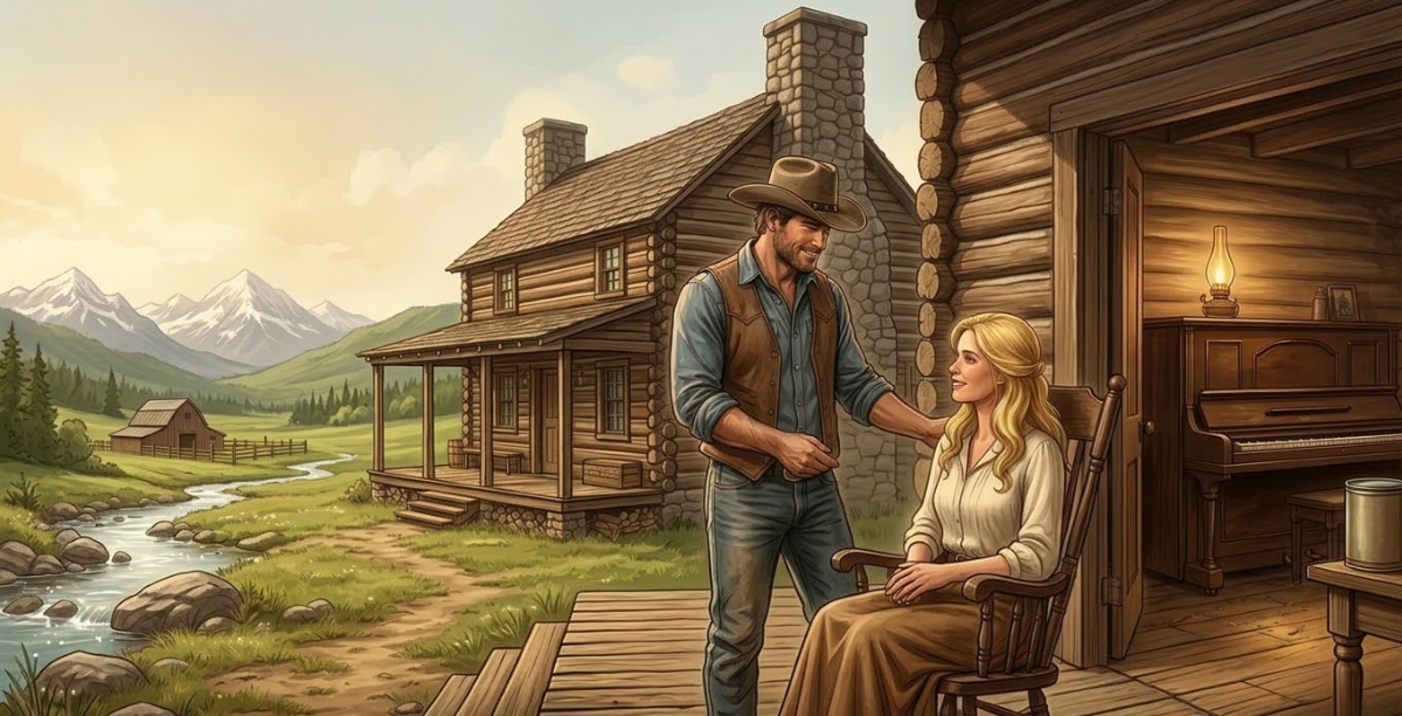
The cabin both surprised and amazed him; it was larger than most and lovingly built. His thoughts confused him at first; lovingly was not a word that often came into his conscious mind. The logs had been cut to size and worked to an exact circumference, fitting perfectly. Two massive stone chimneys, one on each end of the cabin reminded him of oversized bookends. The porch was raised, the roof supported by eight posts connected by a railing.
Teague slowly walked to the front of the cabin. The doorway had been perfectly measured to the center, with the two windows placed in exact symmetry. Teague Rutledge had gone to school: two years at Hudson University in upstate New York set a course into a world of learning, a world that would measure his every step. As he looked on the cabin, words, words that had with time been buried inside came bursting to the surface. There was also sadness; this overwhelming sadness tugged at his emotions as he realized that the cabin was deserted.
Shaking off the weight that seemed to settle on his shoulders, he studied the cabin more closely. The windows were made to fit six panes, each perhaps five to six inches square. The left window had one pane that had been blown out while the window on the right had two missing, with its far right shutter barely hanging on by its lower hinge.
Before trying the door, Teague stopped and turned to the animals. It had taken time to earn the trust of the horse and the mule, yet it took all the coaxing he could muster to get them tied to the porch railing.
Teague Rutledge was over six feet in height, broad shouldered and slim hipped, but the door refused to budge. The thought of forcing it was repugnant to him, but since the window was already broken he saw his chance to gain entrance. Through the broken glass, he could see a solid wood floor covered in dust and a few scattered leaves. A small kitchen had been built as an alcove at the back center of the cabin; he could just make out the door on the left of the extension.
Leading the animals to the back of the house, he was pleased to see a small barn and corral. Tying them up, he tried the kitchen door and was surprised that it opened so easily. The inside of the cabin showed the same caring workmanship, the stonework in the chimneys was exact, with the floor boards tightly notched. The stove in the kitchen showed little usage as did the entire cabin. To the right, midway between the stones of the chimney and the kitchen entrance Teague noticed a patch of floor that had no dust. Something four to five feet in length and perhaps a foot wide had been removed and only just. Teague walked to the front window, his thoughts returning to the animals down at the creek. Someone had been in the cabin; that’s what must have caught the attention of the animals, yet there were no footprints in the dust other than his own.
Returning to the barn he could see it was the width of four stalls, and not surprisingly, of the same workmanship. As the doors swung outward he had to step back; at sight of the inside, he couldn’t help but step back further. Slightly off center and to the right a chair lay on its side, but what captured his full attention was the rope that hung from the center roof support. It was tied off at the cross spar that separated the stalls from the feed troughs, and at its end was the perfect hangman’s knot. Slowly and with practiced fingers, he untied the rope and after coiling it in his hands tossed it into the corral. The chair he set in the front right corner. Although there had been no chair in the cabin, he chose to leave this one in the barn.
The animals were in the stalls, having been fed the last of the oats he carried. As he closed the barn door both the horse and the mule voiced their displeasure and with just a few moments’ thought, he decided to leave the door open. Teague was tired, too tired to eat, when he noticed the smell of coffee. The odor was strong and good and seemed to come from no particular area of the cabin. It was as strong by the fireplaces as it was in the kitchen. He had made a run to the stream to fill a bucket of water; the pump just outside the kitchen and under the rear porch needed priming. Hungry or not, he was going to have his coffee.
There were only embers in the fireplace when he awoke. What had he heard, or more to the point, what was he hearing? He thought it was a woman crying. Crawling from under his blankets, he was drawn to the front of the cabin. Lifting the bar from the door, he opened it and stepped out onto the porch. Was it a woman weeping or the water rippling over the stones in the creek? For long moments he listened carefully, but found it impossible to distinguish a difference. Returning to his bedroll he tried to sleep, but the “weeping woman” would not allow sleep to take him. He was awake when the sun came through the window.
Breakfast was his beloved coffee and bacon. He had just finished eating when the three riders showed up at the front of the cabin. The big man in the middle was the head honcho; he was the one who opened the ball.
“And just who the hell are you?”
“I’d be more than happy to tell you over a cup of coffee, if you boys are interested?”
“Well, we ain’t. I want to know who you are and what you’re doin’ here?”
“I take it that you own the property?” The big man hesitated; Teague had his answer. “I was passing through and stayed the night.”
“Mister, you just keep passin’ through, you hear me?”
“I’ll wait for the owner to tell me to move on.” The big man pulled back his coat freeing his gun. The cowpoke on the right was not happy with the situation and spoke up. “Just now, there ain’t no owner, mister.” The big man turned, staring daggers at the speaker. Leaning back to face Teague his hand went too close to his Colt. All three riders would later swear that they never saw the stranger’s gun clear the holster.
As the three men rode away, Teague was even more perplexed over the property. So saddling his horse he set out for town, his first stop being the Land Office. The Town Hall for Hatten’s Gulch, Colorado, was on the floor above the General Mercantile. The nervous man behind the counter nearly tripped and fell in his haste leaving his desk to reach Teague.
“Well, sir, what can I do for you?”
“I would like some information on a property.”
“And what property would that be?”
“The cabin about ten miles west of town, the one with the two chimneys by the creek.” The man’s eyes almost crossed at Teague’s inquiry.
“Well, sir, the one most knowledgeable on the Buford spread would be John Sturgis over at the bank. I’m sure he can be of the most help.”
As Teague walked his horse across the street to the bank, he was disturbed; the man he had just left wasn’t sending him to someone who knew so much more as much as he was sending Teague away.
John Sturgis was in his early fifties, affable and with a firm handshake. Settling into the chair behind his desk, he gave the impression of a man who knew his business. “So, Mr. Rutledge, what can I do for you?”
“I’m interested in the Buford property?”
John Sturgis put his fingers together as if forming a roof, his thoughts deep. “And how do you know this?”
“I stayed in the cabin last night.”
“Were you comfortable?”
“Yes, very. I’m told that no one owns the property.”
“May I ask who told you?”
“Mr. Sturgis, three men showed up this morning with the biggest of the three ordering me off. One of them mentioned that the spread was not deeded. I would like to know what is going on.”
“The big man was no doubt Clinton Marchand. Mr. Rutledge, I don’t know you at all, but you seem to be an intelligent young man, so I’m going to tell you a story. Linus Hobart laid claim to 3,200 acres back in ‘49’. The property goes all the way back to the mountains. Linus trapped and panned gold in the creek, living a peaceful, simple life. After the war he took on a hand, a former major in the Union Army, James Buford. When Linus died, Buford claimed the property. James was somewhat more ambitious than Linus and brought in cattle. He cleared enough land to plant crops as winter feed for the stock and made a concerted effort to mine gold in the creek.” Getting up from his desk, John Sturgis walked to the window and gazed out onto the street. For a moment, he hesitated before turning to face Teague.
“I suppose it was three years ago, one winter evening, a few of us were sitting around the stove over at the General Mercantile, with James leafing through a mail-order catalogue. At one point he stood up and announced that he was getting married. Of course we all laughed, but the man was serious, as serious as I have ever seen him. We pointed out to him that his cabin was not suitable for a woman, but something had come over him. It was as though something came out of that catalogue and took him over.
“He went to work like a man possessed. He brought in help to build the cabin and barn. He hired a company all the way from Denver to drill the well. I never saw a man so driven as he was to make that property; I’ll use his words, ‘a paradise.’.
“She arrived, not that first spring, but the following, and she was lovely. She was a mail-order bride half his age, but it didn’t matter, Sarah and he were likened to two peas in a pod. She arrived with a table, some chairs, a rocker and a piano. Her hair was as black as a raven’s cloak and her eyes, eyes that seemed to darken as she listened to every word that you spoke. When she played, her hands would glide over the keyboard as graceful as a dancer’s. It started with a few invites out to the house for dinner, and she would play. Before long, it was a Sunday afternoon excursion for the whole town. The folks would arrive with all kinds of foods and stuff. Blankets would be placed on the ground in front of the cabin. A few of the men would move the piano out to the porch and she would play; my, how she could play.”
Teague noticed that the banker was becoming more and more nervous. At first he thought that Sturgis was being evasive, Teague’s thoughts returning to the man in the land office, but that wasn’t the problem. Teague settled in, determined to understand not just the words, but what was it he once read, what was going on between the words. Sturgis settled into his chair behind his desk.
“For a year they were happy; hell, we were all happy. It was that next summer when James was moving a boulder from the stream when the rock became unstable and rolled over his legs. By the time we could get a surgeon down from Denver, gangrene had set in; he died that first day of July. From that moment on, life seemed to have no meaning for Sarah. It was the first day of December that Pastor Martin found her in the barn. She had hanged herself.”
“And I suppose the rope was left there as a memorial?” The stare that he received from Sturgis had such venom that there was no mistaking Teague’s error in judgment.
“That rope was burned Mr. Rutledge, burned.” Teague could feel that very fire in the pit of his stomach.
“I’m sorry, Mr. Sturgis, go on.” The banker took a deep breath.
“According to Colorado law, if there is no will deeding out the property, anyone may lay claim to the estate. Ownership only requires that the claimant live on the property for one year and pay the taxes of course.”
“Of course.”
“Clinton Marchand, whom you’ve evidently met, bullied his way to the first claim. He occupied the property for, well, I guess it started immediately that he and several hands began to hear the crying of a woman. The crying would keep them awake nights. One could see that these men were frightened, but the terror came with the piano music. It got so that they wouldn’t sleep in the cabin. Marchand was losing one cowhand after another. One night in a fit of outright fear, they lit a fire and burned everything, her table, chairs and the piano; hell, we could see the fire from town.” Sturgis got up much too quickly for a man in control, but Teague could see the strength in him as he reined in his emotions.
“Mr. Rutledge, Clinton Marchand was the first to be driven out, and since then three other brave souls have tested their nerve, and the property is still empty.” For a long moment, the eyes of each man held on the others.
“Mr. Sturgis, I heard the weeping of a woman last night, or it could have been the water rippling over the stones in the creek. From what you tell me or more to what I gather, this was a sweet gentle woman. What do I have to fear from her?”
“And when the piano begins to play?”
“You looked forward to her playing, did you not?”
“Yes, I did.”
“Then so will I. Will you draw up the papers?”
“Yes, I’ll have them ready in an hour.”
“Thank you. I’ll return after lunch.”
Teague put down the pen and leaned back in his chair. “I suppose that’s everything.”
“There’s a little matter of the taxes, but they are not due for six months, and under the circumstances I’d think you’d want to wait.”
“No, Mr. Sturgis I want to pay them now and in full.” Teague opened one of the saddle bags and took out an envelope, a rather bulging envelope and counted out a thousand dollars.” He couldn’t help but notice the raised right eyebrow of John Sturgis.
“That’s five years of working for Wells Fargo.” Teague said.
“It must have been a good job.” Teague Rutledge was going to have a business relationship with this man, a man he trusted from the moment of their first meeting. There was no hesitation as he started in. “It didn’t begin that way; I rode shotgun for more than a year and a half. My next step up the ladder was coordinating our efforts with local law enforcement. I eventually got to the point of investigations.”
“Why, may I ask, did you leave?” John Sturgis was a perceptive individual and noticed the change in the man across the desk. Teague took his own deep breath.
“I expected a robbery on one of our runs and reported my findings. I asked that the passengers be kept off the stage but was overruled by the district manager. He didn’t want to lose the revenue if there was no holdup.”
John Sturgis leaned across the desk. “The Barstow incident?”
“You know it?”
“Mr. Rutledge, I’m a banker. I make it my business to know as much as I can where money, or the movement of money is concerned. It was a tragedy that that little girl was killed.”
“Her name was Myra and she was beautiful. Two lives were destroyed that day, a sweet little girl and her mother’s. When the company sided with the district manager, I had had enough.”
John Sturgis decided to change the subject. “May I suggest depositing the rest of that money in my bank?”
“Of course.”
It was the rhythm of the horse as he rode back to the ranch that set Teague’s mind to working. How was it that he was so sure he was right about this place? He tried to look at the situation from all sides, but always came up with the same answer. For some reason, he was being called; something was beckoning to him.
That evening he was sitting on the front porch, a cup of coffee in his hands. Although it tasted good, it did not have the aroma of the coffee that permeated the house. With time he would try and find the blend from the General Mercantile; after all, she must have bought it there. He took a sip; yes, his was good, but Sarah’s was the best. He smiled to himself; it could have been John Buford’s blend. As he got up to pour another cup, he heard the crying. No, he was sure that Sarah had made the coffee.
For three days, he rode the edges of the ranch. The property was a mixture of gently rolling hills with two small lakes at the base of the mountains, the northern lake spawning the creek that ran through the property. After exploring the northern boundary, he doubled back to ride the length of the stream. He noticed where John Buford had pulled boulders out of the stream bed. Reigning in the horse, he studied the water and had the answer to why.
The gold in the creek bed was being washed down from the mountains. Spring runoff and summer storms would bring torrents that would produce eddies at the base of the bigger boulders trapping the nuggets and dust under the lee of the rock. Buford would use a team to pull the boulders out of the stream and pan out the gold from the sediment. Teague smiled to himself; there were plenty of large rocks left in the creek.
He felt good riding into the ranch yard, although the animals were still somewhat uneasy. As he settled into bed that night he noticed the there was still no dust where the piano had been. The floor was long since cleaned, and a smattering of dust and dirt would find its way onto the floor, but never where the piano had been, where she had played. Teague lay back listening to the weeping, his mind asking the question over and over: Why wouldn’t she play?”
Teague worked hard on repairs to the property. It was too late in the year to bring in cattle or to deal with planting, so he concentrated on mining the creek. Winter would come soon to the foothills of the Rocky Mountains and by October there was ice on the stream, but he had done well, taking more than a thousand dollars out of the stream bed.
It was midwinter when the loneliness set in, but then it always did. He ached to hear her play, but the weeping was his only company. John Sturgis, Tom Timmons who owned the General Mercantile, Philip Gates and Teague were sitting around the pot-bellied stove at the store; it was mid-January. Teague was leafing through the General Store’s Catalogue when John noticed the change in Teague; he had seen this before. He watched as Teague very deliberately got out of his chair and almost gently placed the catalogue on the counter. Next to the catalogue’s usual place, Tom would advertise new merchandise. For several days, paper, pens and ink from a company in Boston were displayed. John watched as Teague stood in front of the counter, his body language both revealing and confusing at the same time.
Teague turned to Tom. “I’d like to buy some of this paper, some envelopes, a couple of pens and ink, please.”
“Of course, Teague, let me wrap it up, just choose what you’d like.” It was snowing hard as Teague started his ride home. By the time he got to the ranch, it was blowing a full blizzard.
For three days he sat at his writing desk, a holiday gift to himself sent down from Denver. He knew what he wanted to say, all the words were there, but they would come like a herd of cattle in a corral with an exit gate large enough for only one doggie at a time. He had read about the monks in the European monasteries who would labor over their manuscripts. Teague would do the same. His letter must be more than beautiful in content; it must be beautiful to behold. Settling in, he went to work.
Each stroke of the pen was instantly a labor of love. Each letter would be built into a word, each word into a sentence and the sentences into a paragraph. The crossing of a T would be done with such concentrated effort that caused him to frequently wipe sweat from his brow, a brow that should have been too cold, the fire in the fireplace now only embers. The sun was up; how many times had he read the letter there was no telling. When he carefully folded the paper and placed it into the envelope, the ink had been long dried.
March had come and gone. Snow fell that first week of April, causing the crocuses to have to thrust up from under the blanket. By the third week, the frost had given up its grip on the earth and Teague could put a spade into the kitchen garden and turn up the ground. He was hard at that work when John Sturgis rounded the corner of the cabin, having tied up his horse out front. He was wearing a three-piece suit with a cloak over his shoulders; his hands were in his pockets and he was puffed up as if he and he alone had discovered the secret of life.
Teague put the spade into the earth, and leaning on the handle, couldn’t help but laugh. “What has you strutting like a spring gobbler?”
“Teague, you surely do play things close to the vest.”
“John, I’m afraid you have me at a disadvantage.”
“Teague, she’s here, came in yesterday.”
“Who’s here?” John Sturgis knew this man, knew him like a son, yet there was no mistaking Teague’s surprise. The garden was just a few paces away, but it seemed to take forever for him to place his forearms on the fence and face Teague, the distance barely a foot between them.
“Your bride, Teague, your mail-order bride.”
“John, what the hell are you talking about?”
“Teague, she came into my office yesterday and showed me your letter.” Teague took a step back and seemed just for a moment to be at a loss. He very slowly peeled off his work gloves and placed them on the fence. Without a word he left the garden and walked into the cabin. John raised an eyebrow; Teague was a stickler for not wearing his boots in doors.
John had turned from the cabin, looking off towards the mountains when Teague showed at his side, handing him an envelope. John took out the letter and read, taking his time to choose his words carefully. “This is the letter, Teague, the exact letter. There is no mistake.”
“John, I wrote only one letter, the one you’re holding in your hand.”
“You didn’t find someone in the catalogue?”
“I barely glanced at the advertisements.”
John indicated the letter in his hand. “Well, they’re not exactly alike; something is missing on this one.”
“What is it?”
“No, my friend, you must see for yourself. I’ll be heading back to town, so I suppose you’ll want to clean up and change.” With that, he turned and left.
The morning air was chilly when Teague started working in the garden, but as he rode into town at noon there was no mistaking the kind of warmth that can only come from a springtime sun. She was sitting at the last table on the far right of the hotel restaurant porch. She had a coffee cup to her lips when she saw him. By the time he rode to the hitching post, the cup had been slowly lowered to the table.
Teague didn’t remember tying up the horse, or the steps up to the porch. He was all of a sudden there looking into the most beautiful grey-blue eyes he had ever seen. Indicating the chair opposite her he asked, “May I?”
She nodded ever so slowly.
She was beautiful, perhaps only a few years younger than he. Her forehead was high, giving her a haughty, almost regal continence. Her hair was the color of corn silk with streaks that he knew would flash gold in the sunshine. Her lower lip was slightly protruding as though she was always questioning. Teague knew instantly that whatever answer was given could only be the truth. He leaned forward. “May I see the letter?”
“Yes, but it is mine.” Her voice was slightly husky.
“Of course.”
Without taking her eyes from his, she leaned to the left and delicately lifted an envelope from her carpetbag and handed it to Teague. The letter was his. Every night for months he would read it over and over trying to find better words to say the things that were in his heart. He knew each pen stroke, every dot. This was indeed his letter, with one very important difference. His letter in the cabin had no salutation, while the one he was just handed most certainly did. It read “Dearest Rachael,” and the hand that wrote it had to have been his. Carefully, he folded the letter and after putting it into the envelope handed it back to her.
“Mr. Rutledge, I have two requests.”
“If it were in my power, you could ask for a thousand and I would grant them all.” She smiled, but just before she tilted her head ever so slightly, Teague knew instantly that her tilt of the head would come before each and every smile. He would remember that moment as the moment that he fell in love with her. “I’m sorry; do go on.”
“My first request is to be married in the Church.”
“Agreed, and the second?”
“It took somewhat longer to come out here from Philadelphia because I came with my things. I want to be sure that they will be taken care of right up to their being placed in our home.”
“I will oversee that with you looking on, I promise.”
“We will need help. Not so much with my table and chairs or my father’s rocking chair.” Teague sat ramrod straight. “We will need help with my piano.”
Teague smelled the coffee; it seemed to come from everywhere at once. It was the coffee from the cabin. Denise, the waitress, came out onto the porch to take his order. “Teague, I’ll assume you’ll want your coffee?”
“My God, yes. It smells wonderful.”
“Well, I can’t take credit; Miss Rachael got up early this morning and made it.”