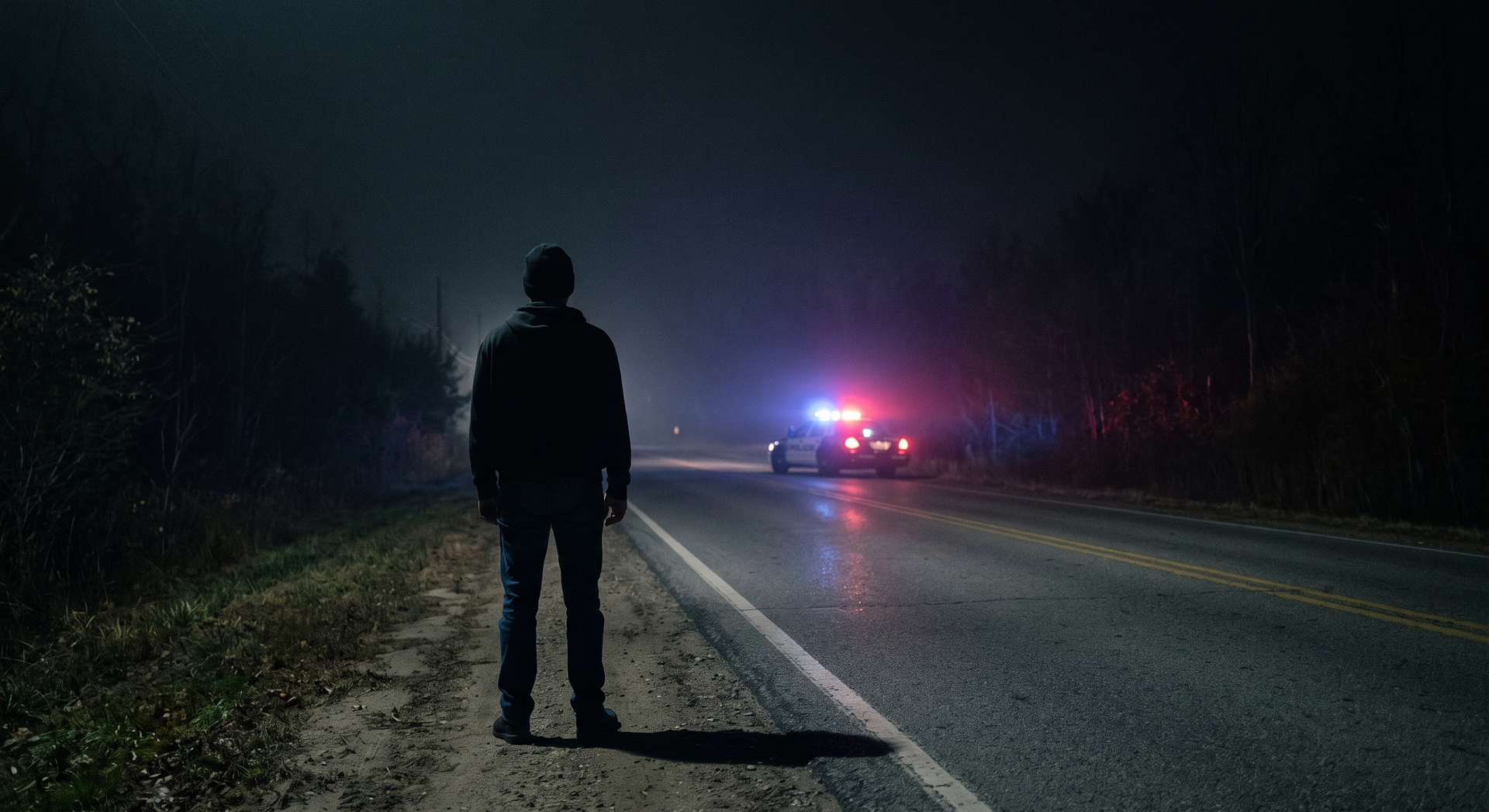
Most accounts of a DUI stop end at the roadside. The reality is that the roadside is the short part, and almost everything that shapes the next year happens in the four or five hours afterward, when you are tired, frightened and making decisions without much information.
Knowing the sequence in advance is genuinely useful, partly because it is less chaotic than it feels and partly because two or three of the steps have consequences that are easy to miss in the moment.
The Stop Turns Into an Investigation Faster Than You Expect
A stop usually begins with something ordinary. A lane drift, an equipment issue, a checkpoint. Within a minute or two the purpose changes, and from that point the officer is documenting rather than investigating in any open sense.
What gets recorded is a list of observations: odour, speech, eyes, coordination, what you said and how you said it. That list becomes the report, and the report becomes the case long before anyone looks at a test result.
The officer does not need to have seen you driving
This surprises almost everyone. California specifically extends warrantless arrest authority for impaired driving beyond the ordinary in-presence requirement.
A peace officer may arrest without a warrant where there is reasonable cause to believe the person had been driving while under the influence, in circumstances including where the person was involved in a traffic accident or is in or about a vehicle obstructing a roadway.
Which is why people are arrested in parking lots, at collision scenes, and while sitting in a stationary car.
Your Car Is Not Coming With You
The vehicle question arrives immediately and nobody plans for it.
California authorises a peace officer to remove a vehicle in a range of circumstances, including where the driver has been arrested and the vehicle would otherwise be left unattended on a highway.
Storage accrues daily from that moment. A car that sits for a week while someone works out the release process can generate charges that rival the fine. Ask at the scene where it is going, and deal with it the next morning rather than the next week.
Anything inside it is inventoried
Officers document the contents of an impounded vehicle. Whatever is in the car is written down, which occasionally introduces a second issue nobody anticipated.
It also matters for the ordinary reason. Anything you need over the following days, including a laptop, medication or house keys, is now behind a counter with limited hours.
There Are Rules About Who Draws Blood
Where a blood sample is taken, the statute limits who may perform it.
Only specified personnel may withdraw blood for this purpose, including a licensed physician, a registered nurse, a licensed vocational nurse, a clinical laboratory scientist, or a certified phlebotomy technician, among others.
That is not a technicality. How a sample was collected, by whom, and how it was handled afterward are ordinary parts of examining a case later.
The gap between collection and testing
Blood does not go straight to an instrument. It is preserved, transported, logged and queued, sometimes for weeks.
Each of those steps generates a record, and those records are part of what gets reviewed later. None of this is exotic or adversarial. It is the ordinary paperwork of a laboratory, and it either exists and is consistent or it does not.
Booking, Release and Getting Home
For a first offence with no collision, release typically comes within several hours, often in the early morning, from a facility that is not near where the car is.
This is the part worth thinking about now rather than then. You may be released alone, at four in the morning, without a phone that has any charge, some distance from anywhere familiar.
Arrange it before you need it
Know one phone number by memory rather than by contacts list. Have a plan for who can collect you at an inconvenient hour. If you are with friends, agree in advance that nobody leaves anybody at a jail lobby.
Ask for your property receipt and check it before signing, since phones, jewellery and cards get logged and occasionally mislogged.
Who you call matters less than that you call someone
There is a strong instinct to handle it quietly and tell nobody, particularly for anyone who feels the arrest is out of character.
That instinct costs people the one thing that helps most in the first hours, which is a sober person who is not in custody and can collect a car, take photographs and remember details you will not.
What Arrives Afterward
Expect paperwork rather than a phone call. A citation with a court date, a notice about your licence, and later a decision about whether charges are filed at all.
The silence in between is normal and means nothing. People read it as the matter quietly going away, and then a filing arrives weeks later on a schedule that had nothing to do with them.
None of these are the same process. The court case and the licence question run separately, on different timelines, with different deadlines, and the licence one moves fast.
The First Week
Write down the entire sequence while you remember it, including what was said, how long each stage took, and the names on any paperwork.
Photograph anything visible, including bruising from handcuffs or a blood draw site, and keep every document you were handed.
Deal with the licence notice immediately, because it carries the shortest deadline in the whole process and missing it forfeits a challenge you were entitled to make. A DUI defense attorney in Santa Ana usually asks about that notice first, before anything about the stop itself.