
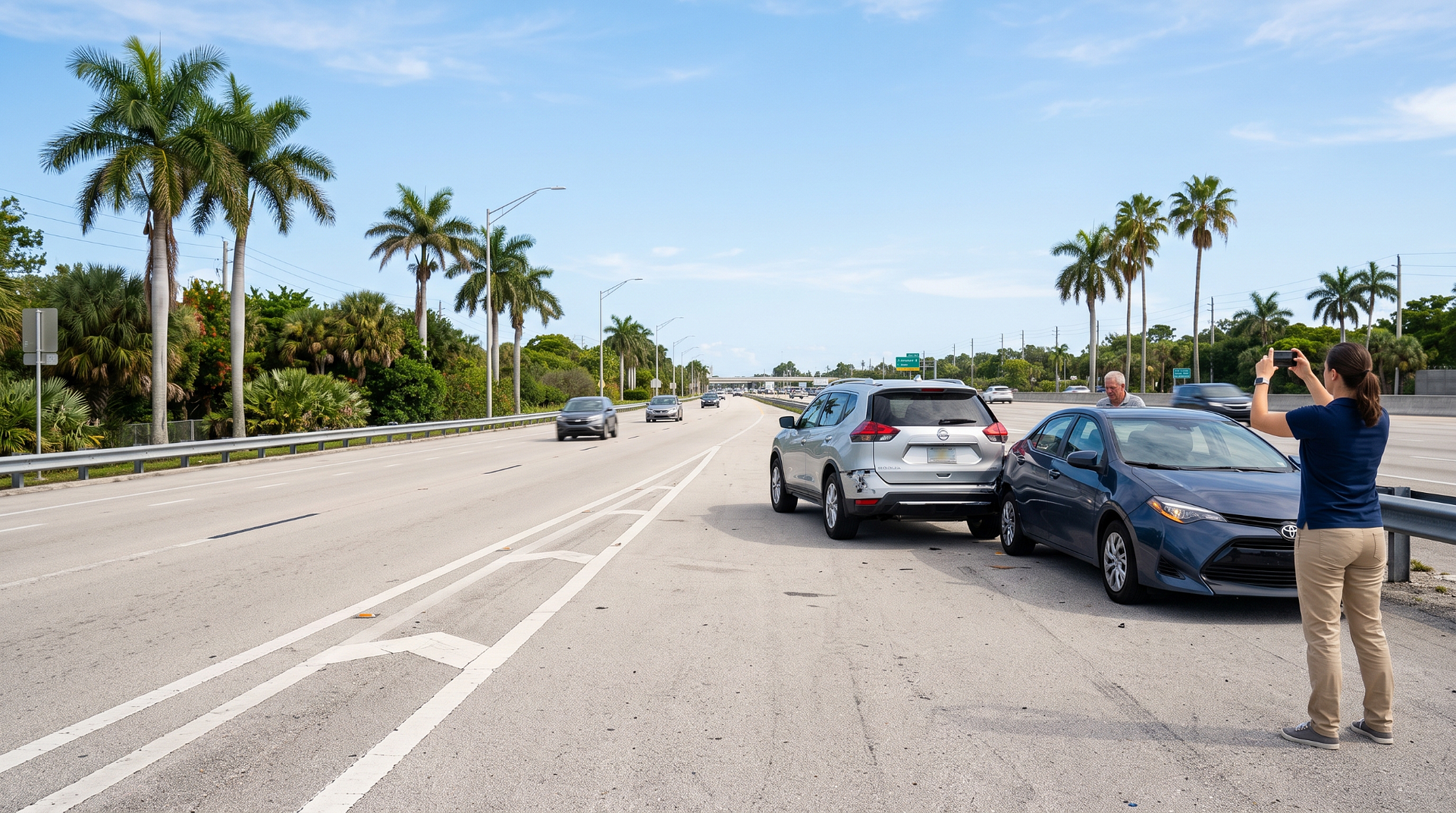
The hour after a collision is the part nobody prepares for. Adrenaline is doing something unhelpful to your judgment, the other driver is talking, traffic is moving around you, and every decision feels like it should be made immediately.
Most of what matters in a Florida claim is decided in that hour, and almost none of it requires knowing any law. It requires knowing what to capture and what not to say, which is a much smaller thing to remember.
Minutes One to Five: Safety and the Call
The first decisions are about not making the situation worse.
Move only if it is safe to
If the vehicles are drivable and you are on a busy road, moving to a shoulder is generally the safer choice. If anyone is injured or the vehicles are badly damaged, leave them and get clear of the roadway. A secondary collision at the scene is a real risk on South Florida arterials.
Call 911 yourself
Do not rely on the other driver or a bystander. Request police and, if there is any question of injury, medical assistance. A police report establishes a contemporaneous account, and its absence becomes an argument later.
Do not assess your own injuries yet
Adrenaline suppresses pain reliably for the first hour. Declining medical evaluation because you feel fine at the roadside is a decision made by someone chemically unqualified to make it.
Minutes Five to Twenty: Capture What Will Not Survive
The scene starts disappearing as soon as the vehicles move.
Photograph in layers
Take wide shots showing vehicle positions relative to the road, lane markings and signals, then medium shots of each vehicle, then close shots of damage. The wide shots are the ones people forget and the ones that matter most when fault is disputed.
Photograph documents, not just cars
The other driver’s license, insurance card and registration. Photograph the license specifically, because the issuing state affects which policy rules apply and which insurer responds.
Witnesses leave within minutes
Anyone who stopped will leave as soon as traffic clears. A name and a phone number is enough. In Fort Lauderdale, a meaningful share of witnesses are visitors who will be out of state within days.
Note what you cannot photograph
Weather, lighting, whether the sun was low, whether a signal was working, what you heard. A voice memo takes thirty seconds and captures detail that will be gone by evening.
Minutes Twenty to Forty: What You Say
This is where claims are quietly damaged by ordinary politeness.
Do not apologize or speculate
Apologizing is reflexive and it is treated as an admission. You are not being evasive by declining to guess at cause while shaken. Describe what happened factually to the officer and stop there.
Why it matters more than it used to
Florida changed its comparative fault rule in 2023. A claimant found greater than 50 percent at fault for their own harm now recovers nothing at all. Previously a claimant could recover a reduced amount at any fault percentage. An offhand remark at the curb now does arithmetic that can end a claim rather than merely shrink it.
Check the report details before the officer leaves
Ask how to obtain the report and confirm the basics are right. Florida crash reports are available through the state’s traffic crash report system, and errors are far easier to address early.
Minutes Forty to Sixty: Set Up the Next Two Weeks
Two Florida rules make the first hour connect directly to the following fortnight.
The fourteen day treatment rule
Florida requires Personal Injury Protection, which pays 80 percent of reasonable medical expenses and 60 percent of lost gross income up to $10,000, regardless of fault. Initial services and care must be received within fourteen days of the crash, or the benefit is generally lost.
Deciding at the scene to “see how it feels” is the most common way that window closes.
The emergency determination changes the number
Full benefits up to $10,000 require a qualifying provider to determine that you had an emergency medical condition. Without that determination, reimbursement is limited to $2,500.
Notify your own insurer, carefully
Report the accident promptly because your policy requires it. That is different from giving a detailed recorded statement about fault before you understand your own injuries. The state’s insurance requirements explain what Florida drivers are obliged to carry, which is worth knowing before that conversation.
According to Shaun M. Serelson, a Partner and Managing Attorney at RTRLAW who handles personal injury matters before suit is filed, notes that the material deciding a disputed Florida case is usually created within the first hour and lost within the first day, because scene photographs and witness details have no substitute once traffic clears. Drivers frequently consult a local attorney for car crash injuries in the first days for that reason, while the fourteen-day window is still open and the record can still be built.
What to Keep in the Car
A charged phone is the whole toolkit, but a printed card in the glovebox listing these steps is worth more than the confidence that you will remember them. People who have rehearsed the sequence perform it. People who have not tend to exchange a phone number and drive away.



