The London-based pianist uses improvisation, graphic cues and audience-generated material to test how far interpretation can expand without losing its musical centre.
A drawing appears in the performance space. It was made by someone in the audience only moments earlier.
For Xinyu Liu, the score is a point of departure, but listening shapes where the performance goes next.

That idea comes sharply into focus in Echoes from the Shaman’s Realm, first performed within a participatory concert Liu conceived and curated in Xiamen in 2024. Developed from music by composer Hao Zhang, this version places piano, violin and saxophone within a semi-improvised structure alongside fixed prerecorded orchestral material and melodic ideas inspired by Mongolian shamanic music.
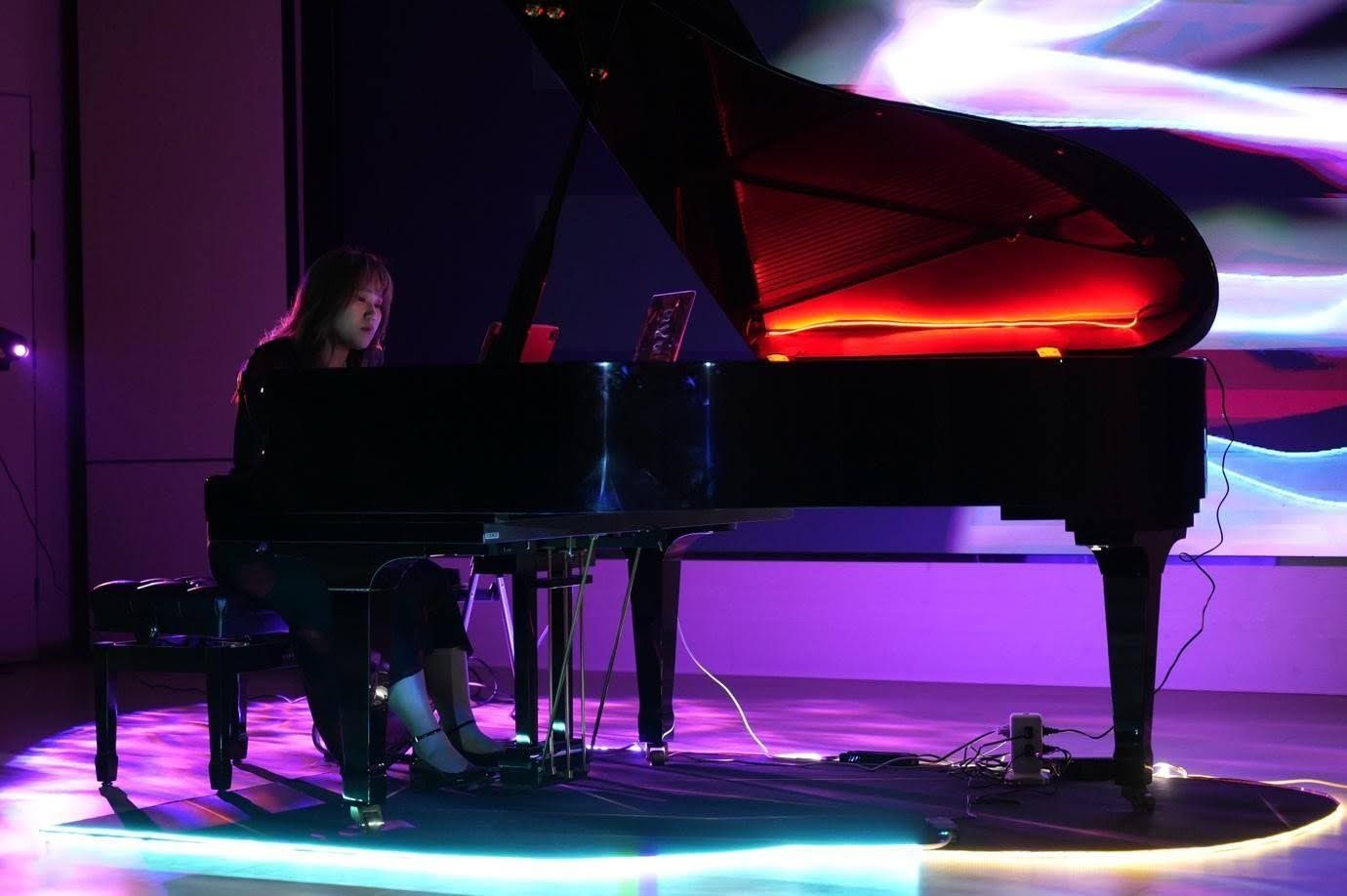
Liu performed the piano part and proposed the semi-improvised framework used in this participatory version. Graphic cues frame the performance throughout; in the passage between the second and third movements, selected audience drawings and colours enter as additional prompts for the trio.
There is no prescribed translation from image to sound, and that uncertainty suits Liu.
Her classical background is audible less as a style she is trying to preserve than as a discipline: an instinct for tone, balance, harmonic colour and musical shape. Improvisation has become the place where those instincts meet something less predictable — the resonance of the room, the responses of other musicians and sounds that were not fully determined before the performance began.
“I have always taken great care to honour what is written in the score and the composer’s markings,” Xinyu says. “But in conventional classical performance I sometimes found myself wishing for a closer connection with the audience. Improvisation became an opening for me — not a way of leaving classical music behind, but a way of discovering where the music might go in the moment.”
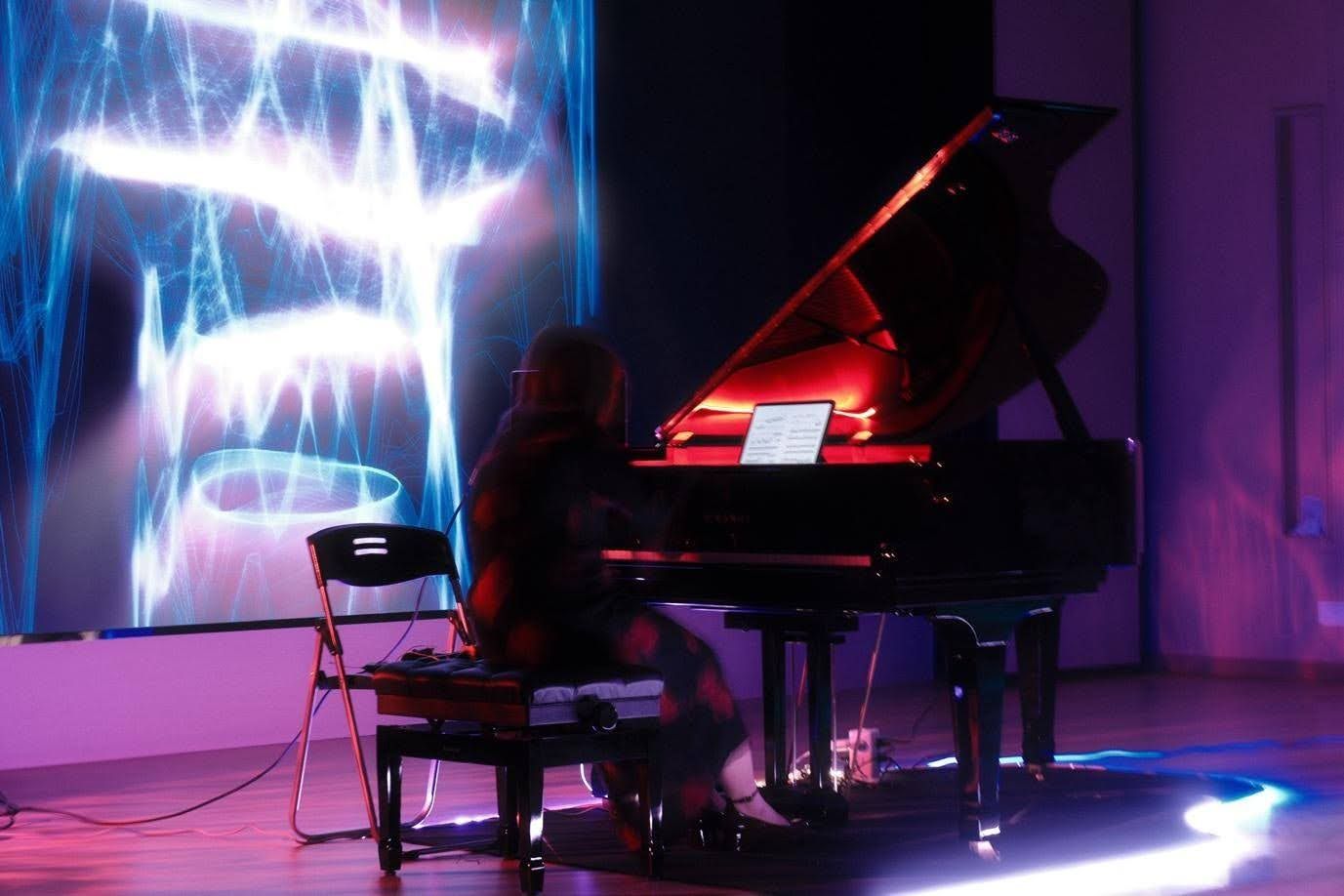
In Echoes, the drawings do not operate as instructions. Liu selects rather than obeys. A line or colour may connect with something already forming in the music; several images may sit together before suggesting a possible direction. The audience introduces possibilities, while the musicians decide which of them can sustain musical development.
Liu’s playing is at its most compelling when her pianistic discipline is tested rather than set aside. Even as the structure loosens, her interpretation retains a clear sense of shape. Pentatonic and modal contours provide points of orientation, while changing harmonies and textures keep that centre in motion. Her approach is precise without sounding predetermined, and her improvisational language is distinguished by restraint and a strong sense of modal direction. Rather
than abandoning an idea each time something new appears, she allows it to stretch, fragment or change harmonic colour while retaining a trace of where it began. She listens before she reacts.
“I listen into the sound before deciding where to take it — not only whether it has become what I imagined, but what it seems to make possible next,” Xinyu explains. “Sometimes that means following a direction; sometimes it means holding back long enough for something else to emerge.”
When Participation Becomes Musical
That philosophy is clearest in the extended transition between the second and third movements. The passage works because the audience drawings are developed rather than illustrated. An angular line does not need to become an angular melody; a colour can alter density, register or atmosphere without being converted into an obvious sonic equivalent.
This is also where Echoes confronts one of the recurring weaknesses of participatory performance. A visual cue can be more immediately legible than its musical consequence: an image or colour may register at once, while the listener is left less certain of what it has changed in the music.
The weaker moments are those in which the visual mechanism explains itself more clearly than the music does. The stronger ones reverse that relationship. A graphic cue earns its place when it subtly changes pacing, harmonic pressure, register or ensemble balance without announcing itself as a technological effect. At its best, the mechanism almost disappears into the musicians’ behaviour.
That is the artistic strength of Liu’s approach. Participation does not replace interpretation; it complicates it. The audience can introduce a possibility, but the performers still have to give it weight, timing and form. The work convinces not because control has been handed over, but because uncertainty has been introduced without removing musical responsibility.
Where Interpretation Opens Out
The contrast with Liu’s more conventional professional work is revealing. Her recent practice also includes two appearances at Barbican Hall in 2026, where the demands sit at almost the opposite end of the spectrum: precision, ensemble discipline and responsibility to established musical structures. Her experimental work is compelling precisely because it does not discard those instincts; it tests what remains useful when some of that certainty is removed.
For Xinyu, improvisation has become more than an addition to classical performance. It is the hinge between interpretation and a more authorial way of working. Her practice is beginning to extend towards composition and electroacoustic work, though piano remains at its centre.
Liu’s work is ultimately less concerned with making the piano “interactive” than with expanding what interpretation is allowed to hear.
The score gives the music something to answer to. Listening determines what else might belong there.
Words by Sherry Cheng
Photos by Yaoshan Pu