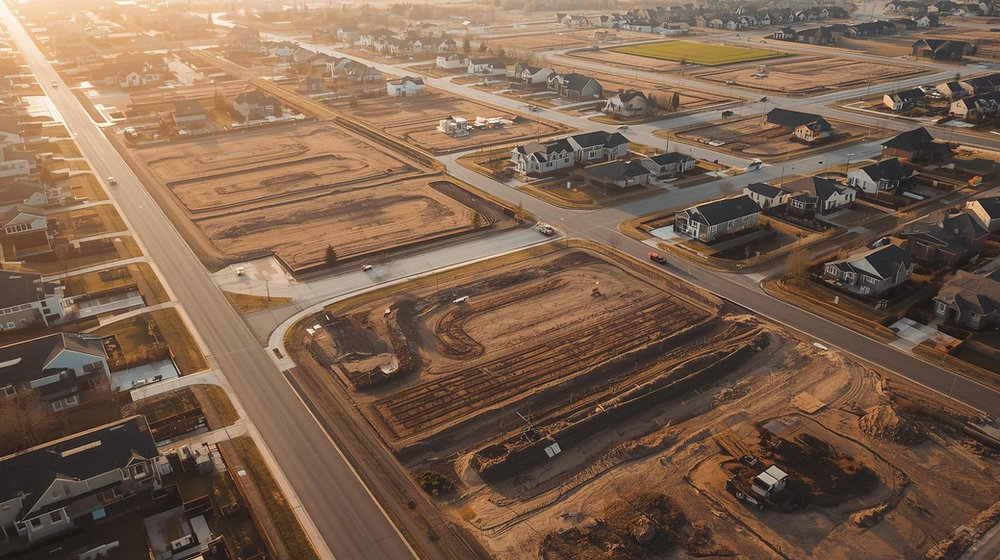
Most residential development conversations start in the wrong place. They start with the land deal, the financing structure, or the builder relationships, and treat the planning process as the bureaucratic step that has to happen before any of the real work can begin. Developers who think that way are consistently outperformed by those who understand that the planning process is where competitive advantage is either built or abandoned, and that the decisions made on paper before a single lot is graded determine how a project performs from first sale through final closeout.
In 2026, with construction costs elevated, financing tighter, and buyer expectations higher than at any point in the past decade, the margin for planning errors has essentially disappeared. Projects that are well-planned absorb steadily and build momentum. Projects that are poorly planned stall, require price reductions to generate traffic, and often finish well below the return they were underwritten to deliver. The difference between those two outcomes is almost always visible in the planning documents before the first shovel breaks ground.
What Smart Subdivision Planning Actually Means
Smart subdivision planning is not simply the application of competent engineering to a land parcel. It is the deliberate alignment of lot layout, street configuration, amenity placement, product mix, and phase sequencing with the specific buyer behavior patterns that exist in the target market.
A subdivision designed by engineers optimizing for maximum lot yield per acre will frequently produce a project that sells slowly, because maximum yield and maximum marketability are not the same objective. Lots that are efficiently packed but offer no variation in size, orientation, or streetscape do not create the sense of community or the perception of quality that drives buyers to pay full price and refer their friends. They create a sameness that buyers feel immediately when they drive through and interpret as a signal that the developer treated the project as a commodity rather than a place people would want to live.
Jake Miakota, CEO at Subdivisions, described, “The developers winning in mid-size markets right now are spending more time upfront thinking about how people will actually live in the community they’re building. A subdivision layout that accounts for walkability, lot variety, and future phase flexibility can mean the difference between a project that sells in months and one that drags on for years.”
The Zoning Conversation That Most Developers Have Too Late
Zoning is where many subdivision projects lose time, money, and flexibility that could have been preserved with earlier engagement. The standard developer approach is to acquire land under a contract contingent on entitlement, submit an application based on the most aggressive use the land’s current zoning might support, and then negotiate with the municipality from that position. That approach treats zoning as an adversarial process and consistently produces longer timelines than necessary.
Mark Lee, Partner at Absolute Properties, described, “A lot of developers still treat zoning as a constraint to work around rather than a tool to work with, and that mindset is costing them margin. The projects I see outperforming right now are the ones where the planning conversation happened before the land was even under contract, not after.”
Pre-contract engagement with municipal planning staff, understanding what a jurisdiction is actively trying to achieve in a given area, and designing a project that advances those goals rather than resisting them consistently produces faster entitlement timelines and fewer costly conditions of approval. A developer who brings a project to a planning commission that solves a connectivity problem, adds a trail link to an adjacent greenway, or delivers an attainable housing component the municipality has been seeking will navigate the approval process with meaningfully less friction than one who arrives asking for maximum density with no community benefit attached.
The political dimension of zoning is one that technically oriented developers consistently underweight. Planning commissioners are locally elected or appointed officials who respond to community input, and projects that have not engaged adjacent neighborhoods before the public hearing regularly encounter organized opposition that adds months to timelines and sometimes forces redesigns that should have been made during the planning process rather than after a contentious public meeting.
Lot Variety and Product Mix as Planning Tools
The most consistent differentiator between subdivisions that absorb quickly and those that stall is the range of lot sizes and product types within the project. A subdivision that offers only one lot size and one housing product type is dependent on a single buyer profile, and when that profile shifts, there is no alternative product to catch the demand that has moved elsewhere.
The master-planned communities outperforming in 2026 are those offering a range of homes across varying price points, with floor plans appealing to young families, families with older children, and empty nesters. That range keeps the buyer pool broad, which sustains absorption across market cycles rather than concentrating it in the segments that happen to be most active at any given moment. A first-phase product mix that includes both entry-level and move-up homes within the same community also creates a natural upgrade path that keeps buyers within the project rather than sending them elsewhere when their household situation changes.
Lot orientation matters more than most developers appreciate during the planning process. Lots with south-facing rear yards are meaningfully more desirable to buyers in most markets than north-facing alternatives, and a layout that ignores solar orientation in favor of geometric efficiency is making a planning decision that buyers will penalize at the offer stage without being able to articulate exactly why they prefer one lot over another.
Corner lots, cul-de-sac lots, and lots backing to open space or greenways create premium positions within a community that can be priced above the base lot price and are typically the first to sell in any phase. A subdivision plan that creates an appropriate number of those premium positions, without overproducing them to the point where the premium disappears, is using lot variety as a pricing and absorption tool rather than simply as a layout outcome.
Phase Sequencing as a Risk Management Strategy
The sequencing of infrastructure delivery and lot releases is where smart planning meets capital management, and where the decisions made in the planning document directly affect the financial risk profile of the project through its entire development life.
A developer who commits all infrastructure capital upfront, building roads, utilities, and common area improvements across the entire project before a single home closes, is accruing interest on the full development loan from day one with no revenue offsetting it. A developer who phases infrastructure delivery to match projected lot absorption keeps the interest-bearing loan balance at the minimum possible level throughout the project and preserves the capital flexibility to respond to market conditions rather than being committed to a fixed delivery schedule regardless of how absorption is performing.
Phase 1 sequencing deserves specific attention because its performance determines everything that follows. A first phase that sells quickly and at or above projected prices builds community momentum, establishes comparable sales that support pricing in later phases, and demonstrates to institutional capital partners that the project’s demand assumptions were well-founded. A first phase that stalls creates the opposite dynamic, requiring price concessions that become the new comps for later phases and signaling to the market that something about the project has not landed with buyers.
Smart phase sequencing puts the most desirable lots, the best-oriented, the most uniquely positioned, and the best-connected to amenities, in Phase 1. It holds back the lots with less inherent appeal for phases where the established community provides the context that makes those lots more attractive. That sequencing decision is purely a planning decision, and it is made when the layout is being drawn rather than when the first buyers are walking the project.
Technology That Has Changed What Planning Can Accomplish
The planning tools available to developers in 2026 are meaningfully more powerful than those of a decade ago, and the developers using them are making better decisions earlier in the process as a result. GIS mapping that overlays utility infrastructure, topographic constraints, environmental buffers, school district boundaries, and traffic patterns gives planning teams a data foundation that previously required months of separate studies. Three-dimensional modeling allows developers and their municipal counterparts to evaluate how a project will feel at street level before any physical work begins, which reduces the redesign iterations that consume time and budget in the traditional review process.
The shift toward data-driven planning methodology has also changed how developers identify land acquisition targets. Analyzing absorption data from comparable communities, demographic trend modeling for target buyer profiles, and traffic count data from adjacent corridors all inform where to focus acquisition efforts before a dollar of earnest money is committed. That analytical front-end work is part of the planning advantage that separates developers building consistent portfolios from those chasing individual deals based on gut instinct and incomplete market knowledge.
The developers building the strongest portfolios in the current environment are those who have made the investment in planning capability and treat it as a core business function rather than a cost to be minimized. Every dollar saved by shortcutting the planning process is typically returned many times over in slower absorption, lower lot prices, and entitlement delays that consume carrying cost without advancing the project. Smart subdivision planning is the competitive edge that shows up most clearly in the performance gap between projects that were planned well from the beginning and those that were not.