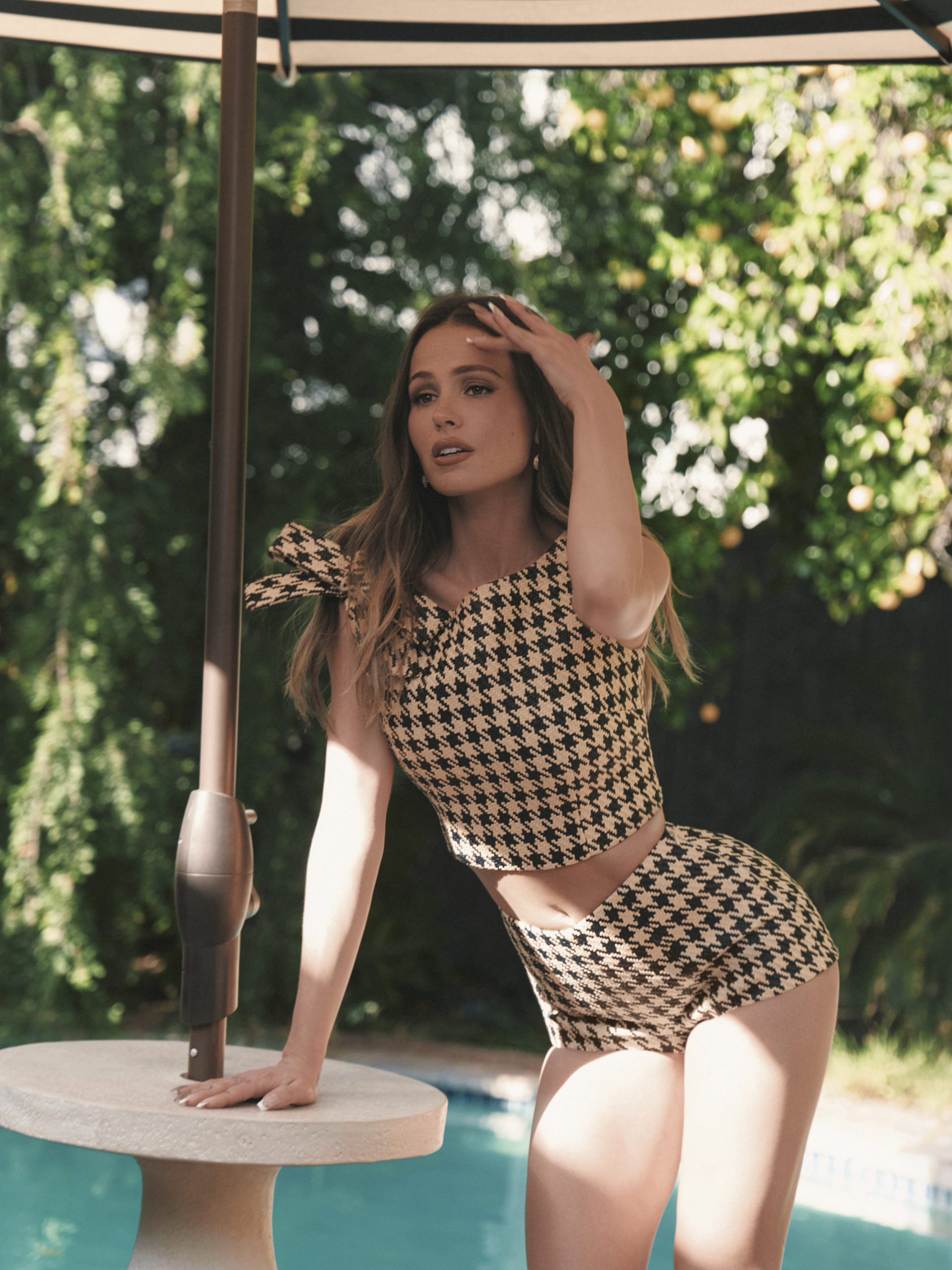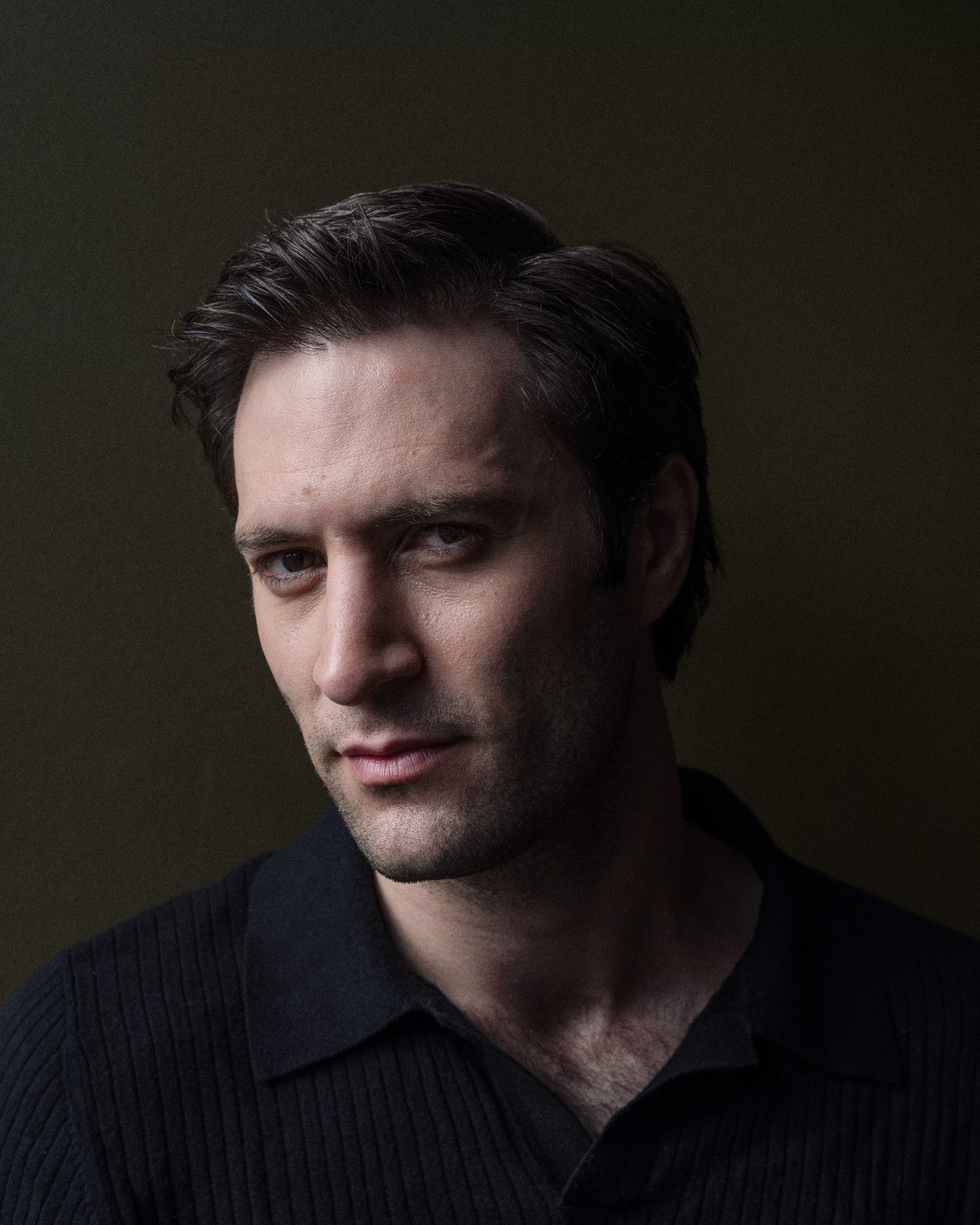
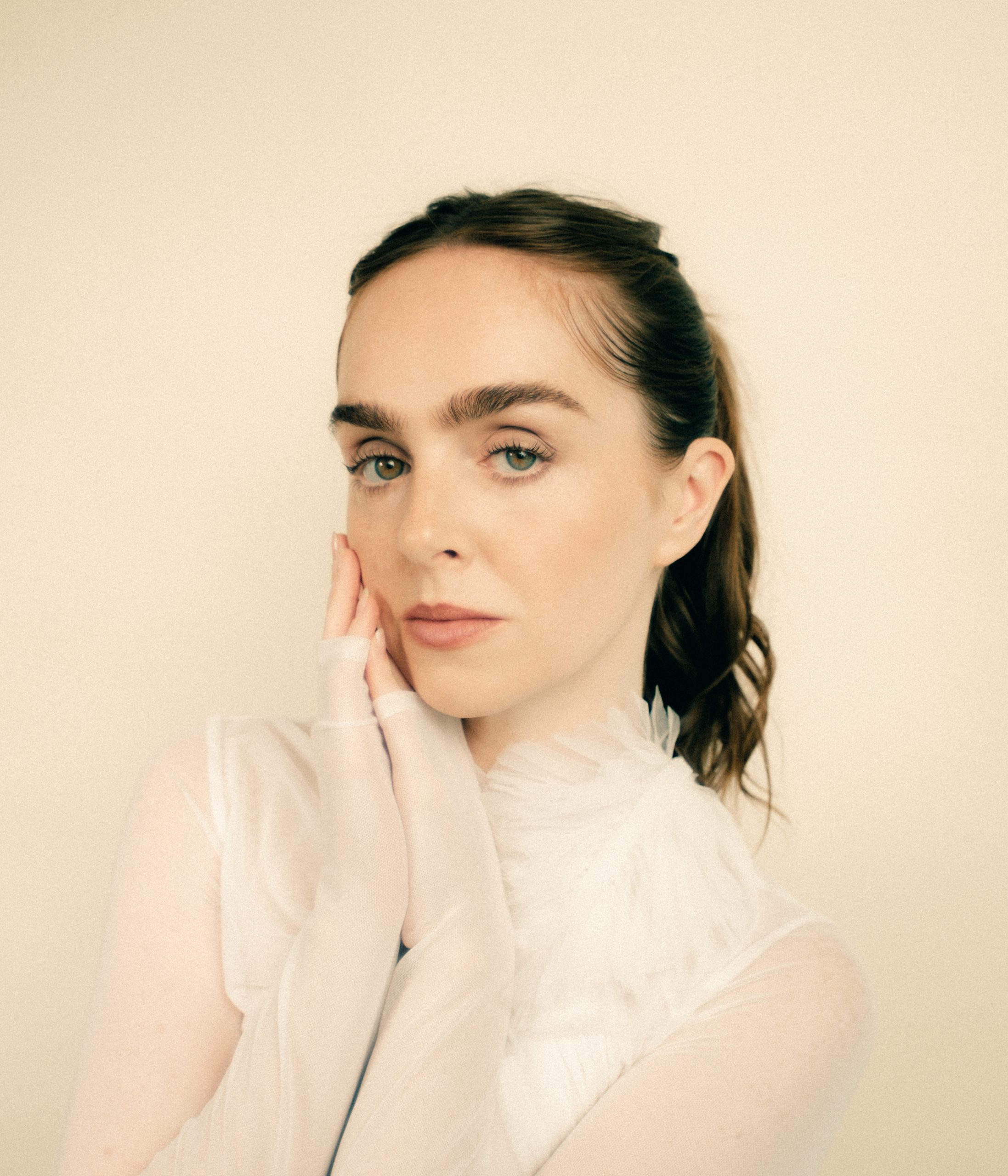
Louisa Connolly-Burnham wants to be known as a filmmaker who champions women, placing them at the centre of her stories. The actress, writer and director’s first short film, Sister Wives, starring herself and BAFTA-award-winning actress Mia McKenna Bruce, was longlisted for BAFTAs, Oscars and BIFA awards, touching on the issues of the treatment of women in oppressive sects and lust and longing.
In her newest short film, Louisa tackles another topic of interest – intimacy coordinators. In The Intimacy Coordinator, Connolly-Burnham portrays Kate, a well-regarded intimacy coordinator who is also a sex addict. The short film follows her as the tension between her work and her mental health, and we follow her spiral into self-destruction. Despite a darker turn from her first film, the themes of intimacy, emotional connection and how women are affected by these things or rather a lack of these things, remain clear and present, making for an interesting and impactful watch that will no doubt have audiences talking.
In her interview with 1883, Louisa Connolly-Burnham talks about the process of acting and directing, her love of gritty female leads and why sex in film is fascinating.

I really enjoyed The Intimacy Coordinator. There is a very different tone to your first film, Sister Wives. What made you want to take that turn?
It’s funny with those two films, because in many ways they couldn’t be more different. But I like to think that a lot of my undertones are the same, which is usually women with big, dark secrets making quite dangerous decisions. With The Intimacy Coordinator, I think as a writer-director, I always try to make things about what’s in the zeitgeist? What are people talking about? What do I think that I could make that would make someone click play?
I don’t know if you’ve seen much of this, but over the last couple of years, there seems to be a lot of fascination and intrigue around intimacy coordinating. It’s quite a new role in our industry. I think that it’s a very important role. Despite how I depicted intimacy coordination in my film, I love intimacy coordinators, and I feel very passionately about the role. I ask for an intimacy coordinator as an actress. I always implement intimacy coordinators as a writer-director-producer. But for some reason, the role seems to be very divisive in the industry, so I wanted to really delve into that. Also, the role of predators: we don’t really see women as predators, despite it being a real issue.
It has been really interesting to like see how people have discussed intimacy coordinators, because I’ve met intimacy coordinators and met actors who have worked with them, and they have found them very helpful. But of course, you do have actors who are like, “Well, we don’t see it as necessary.” Kate as you present her, she’s a fascinating woman because she’s an intimacy coordinator, but she’s also a sex addict. Sex addiction is also a very tough topic to take on because its not something we really know how to talk about, and its also abused by many predators as an excuse.
You’re so right in sex addiction not being properly recognised. It’s not given the same care as alcohol addiction or drug addiction because I guess maybe it doesn’t seem as life-threatening as those. Yeah. But it certainly is, and it’s usually rooted in mental illness.
I also have to believe that Kate does want to get better. Uh, but she is struggling with her addiction massively. That’s why I kind of wanted to include that phone call with her mum, which is a real moment of vulnerability and desperation, which is ultimately missed by her mother, which I think leads to the ultimate downward spiral.
I really love films like Nymphomaniac and Shame. I’m really into those darker erotic movies that really explore impulse and psychological breakdowns.
So I guess one of the main reasons I made The Intimacy Coordinator is also down to my own taste of what I like to watch. And I do think that right now audiences are very interested in the concept of the erotic thriller. People want things like I May Destroy You, Promising Young Woman, Fleabag, I Hate Suzie – those shows and films with dark, gritty female protagonists, and I love to make those.
It is definitely in those categories. As I was watching, with Kate, like there was, I was watching it and I was like, there was a moment where I was like, “Okay, she seems to have everything under control.” And she’s great at her job, but then I’m like ‘no, no, no’ when she’s looking at pictures of Max (Kieron Moore) on the bus and you can feel the spiral coming. It’s a sign of good filmmaking when you can make the viewer feel something with a dark film.
Kate is clearly struggling, but she also has all this power, and she doesn’t seem to know what to do with it. And it’s almost like she can always, like, “well, I’m hurting inside, so am I gonna just start hurting other people around me?”
Yeah, totally. Hurt people hurt people. And something has clearly happened to Kate in her past that, unfortunately, with a short film, we don’t have the time to really delve into, but we are turning The Intimacy Coordinator into a feature film. Ooh. It is in development right now, which is so exciting.
Congratulations!
Thank you. And with a feature film, I’m excited to delve into that trauma, those issues Kate has. I believe that Kate, deep down, is a brilliant, smart, compassionate woman who ultimately is choosing chaos and darkness. I hope that there are moments when people watch it that you do feel for her and that you can have compassion for her and see some of her vulnerability. But she utterly abuses her position of power. She takes total advantage of both her actors and also the gentlemen in the Sex Addicts Anonymous, and it is important to acknowledge that.
Drawing those parallels back to your first short film, Sister Wives, where you’re able to portray both victims and perpetrators of sexual violence in such a nuanced way. Even with Sister Wives, the husband who is objectively awful in the cult but also very sympathetic – why do you think predators as such three-dimensional beings as opposed to just bad guys or bad girls?
I guess I want us to kind of look inwards and think about what our own capabilities are. I’m very interested in intrusive thoughts. I’m very curious about what all of our intrusive thoughts are. I would love to know the darkest thought that somebody has ever had, because even though my antagonists are making really bad decisions, they are still three-dimensional people that have the capacity for good and evil in the same way that I do, in the same way that you or I do.
I don’t believe that anybody is inherently bad. I believe that there is good in everybody, and I’m interested in the grey space. I wanna be in limbo. I wanna be in the middle bit of kind of seeing the good and bad side of somebody, and seeing what ultimately makes someone make a decision or a choice that they can’t come back from. Jeremiah in Sister Wives, I actually love that character. I have a lot of respect and compassion for that man. I think that that man is a victim of the community almost as much as women are, in some sense. Like, men can be victims of the patriarchy in the same way that women can.
And then, in the same way with Kate, in The Intimacy Coordinator is, I guess, how I navigate Kate in my mind; I believe that Kate has probably suffered some sort of sexual trauma in her past, something we can hopefully delve into.

For you as an actor, what is your experience of intimacy coordinators? Did you have an intimacy coordinator on this set? ‘Cause it, I feel like it’d be weird if you didn’t.
I can confirm that we did have an intimacy coordinator on The Intimacy Coordinator. Very good. She is absolutely fantastic. Her name is Rosie Fletcher. She worked on Sister Wives as well, and she’s also my best friend of, like, nearly 18 years. So basically she’s been my best mate for nearly 20 years; she’s seen me naked on and off set. But she’s a really fantastic intimacy coordinator who actually started as an actress herself, which I think really informs her craft.
She is super great with actors, and she really knows how to talk to actors. And two of the male actors on set, Kieron Moore and Alexander Arnold, who are the two actors that I have intimate scenes with are also my friends of many, many years, which you would think might make things more comfortable but it doesn’t (laughs) it can get awkward because that’s your mate.
Exactly, I feel that because you naturally don’t want to kiss your mate.
Exactly! Our main intimacy coordinator on Sister Wives was called Stella Moss. She is another absolutely phenomenal intimacy coordinator. But again, on Sister Wives, Mia McKenna-Bruce and Michael Fox had both been my friends for years. Everyone’s done well, hopefully have felt safe and supported on my sets. I like to think that we created something authentic and intimate and beautiful.
It is going to be funny, next group dinner and everyone’s like ‘she keeps asking us to be in these mad films’
“Lou keeps on, she keeps on calling us. She keeps on calling us and asking us to be in these very strange films.” I hope not!
How do you navigate being both the actor and director on film?
I never really had the dream of being a director. Um, perhaps it was lying dormant in me this whole time, but in 2019, when I made my first film, The Call Centre, and it was just in a period of time where I wasn’t booking any jobs, and I wasn’t really getting any auditions, or at least the auditions that I was getting weren’t exciting me very much. So I wanted to focus on what I wanted to see and write.
The practicalities are a bit techy; I don’t want to bore you.
No, get techy! It’s not boring.
Okay, basically I always put a mini monitor on my kit list. They’re kind of wireless.
And I keep that near me at all times. And what that means is that I can stand on my mark as an actress, and I can frame up and light the scene with my cinematographer while standing on my mark.
So we can set up like that, rehearse like that with the actors, and then before calling action, my mini monitor is taken away by an assistant or a runner. I let my first AD call action once everything is settled, and then once the scene is done, I will call cut. I usually have a good sense as an actor whether I’ve done a good job, and I can usually see the other actor and judge whether they’ve done a good job as well.
The mini monitor is brought back to me. Everybody has to stay still and quiet until I’ve watched playback because, obviously, I haven’t watched it in real time. So this is a slightly more time-consuming way of doing things. You almost need to add double the amount of time because I’m not watching it in real time. And listen, sometimes towards the end of the day, if you are running out of time and your choice is, I either watch playback or I lose a shot, I’m always gonna choose to keep my shot.
Sometimes you have to rely on your team around you, your DOP, maybe a producer by the monitor, and say to guys, “Do you think we have it?” And if they say yes, then I’m gonna choose to trust my team. Or sometimes, you know, maybe there’s been, like, a boom dip in the middle of the scene that I haven’t seen, and if my DOP says, “Louisa, the boom is in half of the shot. don’t bother watching playback. Let’s just go again”
That’s really cool because, again, a lot of directors can have control issues. But it’s nice to hear how you’re very trusting of the people.
I mean, you have to trust the people you work with.
With your films, you have focused so much on sex and intimacy; how has that affected you in your own life?
I find it very separate, actually; I would say that it’s rather the opposite way round. So my own curiosity about intimacy, eroticism, sexuality really informs my work. I hope this doesn’t come across wrong, but I love seeing sex on screen. One of my favourite films is Portrait of A Lady on Fire and the intimate scenes are so beautifully crafted. I guess that I would love to create more moments in cinema like that, that leave that lasting impression on you. I also I find it incredibly romantic, and I find it very, very connective, and I do believe that it is secretly what the audience wants to see, whether they’re ready to admit it or not.
There is definitely a larger conversation around sex and sex on screen that this film will likely contribute to. If this was a different film and Kate wasn’t an addict and she wasn’t abusing her position of power at work and hurting people, perhaps she’s just a woman that really likes sex, and maybe that’s okay.
Exactly, but of course there is that thin line, and Kate is unfortunately across that line. In a nother world, she is just a normal person who uses sex to escape other problems, but that line is so thin.
People who maybe have a self-destructive relationship with sex and love, we have to wonder, how much of that is stemming from loneliness and, and a, and a desire just to connect with somebody? A lot of my films are just about people that are clearly feeling starved of emotional connection and how that can spill over into these more self-destructive behaviours.
She needs a hug and therapy! For myself and many others, we all grew up with you on screen as Shannon Kelly in Wolfblood and Willow in House of Anubis, shows which I loved. Do you find people have a funny reaction to your films? Like ‘oh my gosh, Shannon from Wolfblood is having sex on screen!’
I think it is always weird to see somebody that you still kind of see as a child or a teenager growing up, becoming an adult, and talking about adult things, because they’re probably sort of forever immortalised as what you kind of grew up watching them as.
But what is interesting is that I have grown up with you guys, ’cause we were teenagers when we filmed shows like Wolfblood and House of Anubis. Naturally in that process, we, our, our tastes have changed, our desires, even our sexualities and things like that. A lot of the people that watched the shows that I was in as a kid are, are now interested in the things that I’m making as an adult, not only because they support me as, fans of the things that I did when I was younger, but also because they have a natural new interest in some of the
work that I’m making. And even shows like Wolfblood and House of Anubis, there was a darkness to those shows, so it kind of makes sense for fans to follow my films from that.
What do you want to be known as, like, as a filmmaker, I guess, going forward after this?
I want to be known as a filmmaker that is pushing boundaries and championing women. There’s your byline, in a way.
That’s the subtitle for the interview! What are you enjoying right now?
A book that I love right now is The Safekeep. If we’re talking films, I am going to recommend Basic Instinct, and I am listening to SZA’s album SOS; it’s so good and the podcast Cherry On Top by Caroline Hajnay.
Audiences can watch The Intimacy Coordinator at the upcoming film festivals:
- Lytham International Film Festival
- The Shortest Nights
- Cine International Film Festival (CIFF)
- Cindependent Film Festival
- Women X Film Festival
- Exit 6 Film Festival
- Fine Line Film Festival
- Lviv International Short Film Festival Wiz-Art
- Worcester International Film Festival
- South London Film Festival
- Stamford International Film Festival
- DIFF Shorts
- London Independent Film Festival
- Evolution Mallorca International Film Festival
- Cannes Indie Shorts Awards
- Norwich Film Festival
Interview Michaela Makusha
Photography Charlie Thornton
HMUA Hannah Gallery
Intimacy Coordinator Rosie Fletcher