Taylor Phillips used to hang Abercrombie & Fitch shopping bags on his bedroom walls. Growing up in a conservative town in southern Indiana, the photographs offered a glimpse of beauty, intimacy and freedom that felt far removed from the life around him. Before he had the words to explain what he was drawn to, those images gave him somewhere else to look.
The internet expanded that world. An anonymous Tumblr account became a private space to collect images, explore his identity and imagine a future he had not yet seen. Modelling and a move to New York eventually made that future feel possible, while his viral coming-out video in 2019 allowed him to share it openly. What began online grew into a career built around fashion, travel, interiors and the life he shares with his husband, Jeff O’Donnell.
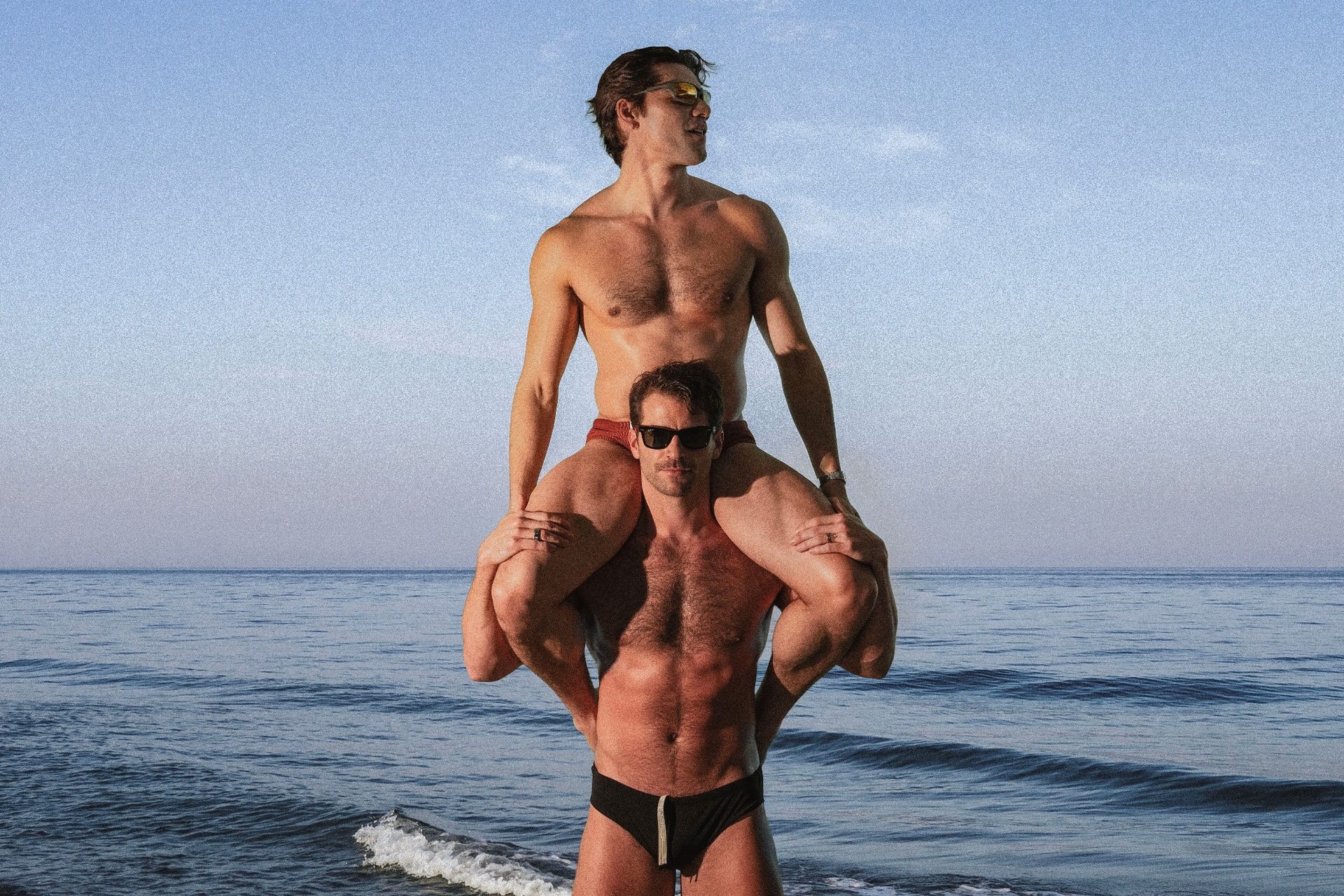
Now, Phillips is turning more than a decade of storytelling into something physical. As the founder and creative director of GoodPark, he has developed an elevated menswear and lifestyle brand rooted in community, nostalgia and the feeling of summer. Its swimwear was designed to sit somewhere between sporty and overtly sexual, giving men something confident, relaxed and easy to wear. The brand has since expanded beyond its original category, with ambitions stretching into apparel, real-world experiences and, one day, a GoodPark hotel complete with a pool, great music and a shop filled with things guests want to take home.
For Phillips, the goal is not simply to create products. He wants to make things people pack for holidays, wear through entire summers and attach their own memories to.
1883 Magazine asks Taylor Phillips 18 questions about the images that first opened up his world, protecting his marriage away from the camera, building GoodPark beyond social media and why success means little if he cannot also enjoy an ordinary Tuesday.
1. What is the first thing you do when you need to quiet your mind?
Honestly, I had to think about this because I’m much better at keeping my mind busy than quieting it. When I’m overwhelmed, I usually call my mom or my childhood best friend. They’ve known me through every season of my life, and there’s something really comforting about talking to someone you don’t have to explain yourself to. They bring me back down to earth. I might still have a hundred things on my mind afterward, but I usually feel a little more like myself.
2. What is something you understand about yourself now that you completely misunderstood in your twenties?
That I can change my mind and still be someone who follows through. In my twenties, I put a lot of pressure on myself to choose the right career, make the right decisions and know where everything was going. I studied economics and finance, became a model, built a career online and now I’m building a brand. At the time, some of those changes felt like starting over. Looking back, I can see how much I brought with me from each chapter. I’m more comfortable now admitting that something can be right for you for a while without having to be right forever.
3. Which photograph, campaign or fashion image do you wish you could experience again for the first time?
I remember seeing an Abercrombie & Fitch Quarterly for the first time. It had already been discontinued by the time I discovered it, but I was completely taken with it. The photography, the models, the way the clothes were presented. It felt like discovering an entire world. I couldn’t choose one photograph because it was the whole experience that stayed with me. Now I can look at those images and appreciate the styling or composition, but back then I just knew they made me feel something. I’d love to have that first reaction again, before I could explain why.
4. What is one small luxury you will always make room for?
The first thirty minutes of my morning with a book, a coffee and some silence. Wherever I’m travelling or whatever the day looks like, I try to give myself that time before getting into everything. I’m still learning how to carry that calm into the rest of my day, but having a little time that belongs to me feels like a luxury.
5. When do you feel most confident, and what tends to bring that side of you out?
When I’m comfortable with the people around me and excited about what I’m doing. Jeff brings that out in me because I never feel like I have to impress him. I can just be myself. Creatively, seeing something I’ve imagined come to life is one of my favourite feelings. I second-guess plenty of decisions along the way, so when something finally comes together and feels right, it reminds me to trust my instincts.
6. What is something you have recently done that pushed you beyond your comfort zone?
Committing to the next stage of GoodPark. Expanding the collection means making bigger decisions about production, investing in inventory and trusting my taste before I know how customers will respond. It’s exciting, but there are definitely moments when I look at Jeff and think, “Okay, we’re really doing this.” Having an audience doesn’t take away the nerves of putting something you’ve made into the world. I care deeply about it, which probably means it’s always going to feel a little vulnerable.
7. Which part of your personality tends to surprise people when they first get to know you?
How much I overthink. I think people see someone who’s comfortable in front of a camera and assume that confidence carries into every part of life. Meanwhile, I’ll go back to something over and over because I can see one more thing I could improve. I care a lot about how things feel and how they land with people, which is useful creatively and occasionally exhausting personally. I’m learning to recognise when something needs more work and when I just need to let it go.
8. What is the best piece of advice you have received about building a life on your own terms?
When I came out to my mom, she told me, “There is no paved road to success or happiness. I know more than anything you want to be successful, but I want you to be happy.” That’s stayed with me.
I’ve always been ambitious, and it’s easy to get caught up in reaching the next thing without asking whether you’re enjoying the life you’re building. I still want to accomplish a lot, but I also want to like my ordinary Tuesday. I want to enjoy the person I’m spending it with, the work I’m doing and the home I come back to. Her words remind me to make room for that, too.
9. You grew up in a conservative town in southern Indiana. When did you first realise your life could be much larger than the one you had imagined?
It happened in stages. Growing up, I didn’t have many examples around me of the kind of life I would eventually want. The internet opened that door first. I could see people living creatively, travelling, being openly gay and building lives that looked completely different from what I knew. Modelling and moving to New York made those possibilities feel real. I didn’t suddenly become fearless. I was curious enough to keep taking the next step, even when I wasn’t sure where it would lead.
10. As a teenager, you saved Abercrombie & Fitch bags and displayed them on your bedroom walls because you loved the photography. What did those images allow you to see that was missing from the world around you?
They showed me a kind of freedom I didn’t know how to access yet. There was beauty, intimacy and this ease between people that I found really appealing. And, of course, the models were part of the attraction. I came out years later, so looking back, I can recognise the homoeroticism I was responding to before I was ready to say much about it.
At the time, I didn’t have the language for all of that. I just knew I wanted to keep looking. Hanging those images on my walls was a small way of making room for something I hadn’t figured out how to express yet.
11. Your anonymous Tumblr account became a space where you could construct the life and aesthetic you wanted before you were ready to live them publicly. Do you think imagining that version of yourself helped you eventually become him?
Absolutely. It gave me somewhere to be honest about what I was drawn to before I could explain it to anyone else. I could collect images, explore my taste and see parts of myself reflected back without worrying about who was watching. Over time, that life started to feel less far away. I didn’t become every version of myself I imagined on Tumblr, my taste has thankfully evolved in a few areas, but it helped me recognise what I wanted. There’s something powerful about being able to picture a future you haven’t seen around you.
12. Your coming-out video went viral in 2019. What did sharing such a personal moment give you, and did you ever worry that it would become the only story people associated with you?
It gave me relief. When you’ve spent so much energy worrying about what people might find out, being able to speak openly frees up a lot of space in your life. The response also showed me how many people were carrying similar feelings. Something that had felt very personal suddenly became a point of connection.
I knew it might be how some people first came to know me, and I’m proud of that. I’ll always be glad if sharing it helps someone feel less alone. I also wanted people to get to know everything that came afterward: falling in love, getting married, working, making mistakes, building something. Coming out gave me the freedom to share more of my life and to enjoy living it more openly.
13. You and your husband Jeff share much of your relationship online and have described yourselves as best friends, roommates and partners in crime. How do you protect the parts of your marriage that belong only to the two of you?
By remembering that being comfortable sharing something doesn’t mean we have to share it. People can know us well and still only see a portion of our marriage. We both need to feel good about what goes online, and some moments are better when we just get to have them.
A lot of marriage is wonderfully ordinary: sitting around with Parker, figuring out dinner, laughing at something that would make no sense to anyone else. I really love those moments. Having a life together that we enjoy when nobody’s watching is something I want us to keep taking care of.
14. GoodPark began with positive messages and a desire to create belonging before evolving into an elevated lifestyle brand. At what point did you realise it could become something lasting rather than another piece of creator merchandise?
The shift happened when I started thinking seriously about someone discovering GoodPark who had never heard of me. Would they love the product? Would the fit make them feel good? Would they come back for another one? Those questions pushed me to be more thoughtful about every decision.
Seeing customers return and retailers reorder has made that possibility feel real. My audience helped give GoodPark its start, and I’m incredibly grateful for that support. I want to honour it by making products that earn their place in someone’s wardrobe and give them a reason to keep coming back.
15. You wanted to make swimwear that was neither overly sporty nor overly sexual. What do you think men’s swimwear has traditionally misunderstood about confidence and feeling desirable?
I think men have often been given a pretty narrow set of options, especially with swim briefs. There can be this assumption that wearing one means you’re trying to make a statement, when you might simply like the way it looks and feels.
A brief can be sexy and still feel timeless, relaxed and easy to wear. So much comes down to fit, fabric, colour and how you present it. I want someone to put ours on and feel comfortable enough to enjoy themselves. Ideally, they’re thinking about who they’re with, getting in the water or where they’re going for lunch. That ease is a big part of what I find desirable.
16. You begin your creative process with a feeling rather than a product. What was the exact feeling you wanted someone to experience the first time they put on GoodPark?
That first moment of a vacation when you’ve unpacked, changed and realised you can relax. Your shoulders drop a little. You feel good in what you’re wearing, and you’re excited to get outside and enjoy wherever you are.
There’s nostalgia in it, too. I want GoodPark to remind you of a summer you loved and make you excited about the one you’re about to have.
17. After more than a decade of creating online, you have said that social media can disappear within a day while a physical brand can endure. What role did your career in social media play in your decision to create GoodPark?
Social media taught me so much about telling stories, understanding what people respond to and building relationships over time. It also gave me the opportunity to start GoodPark, so I’m very aware of how connected the two are.
After years of making content, I wanted to put that creative energy into something people could physically live with. Something they pack for a trip, wear all summer and attach their own memories to. There’s a different kind of satisfaction in that. I get to make something, send it out into the world and see it become a small part of someone else’s life.
18. GoodPark is expanding beyond swimwear into apparel, hospitality and real-world experiences. How far do you believe this world can grow, and what would its ultimate form look like to you?
In my most ambitious version, there’s a GoodPark place you can actually visit. Maybe it’s a small hotel somewhere beautiful, with a pool, great music, food you look forward to and a little shop full of things you want to take home. Somewhere you feel comfortable settling in, staying a little longer and coming back with your friends.
That’s the long-term dream. Right now, we’re building towards it through the products and learning as we go. I want to give myself permission to imagine something that big while giving each step the attention it deserves. It’s exciting to have a vision I can keep growing into.
Taylor Phillips is the Founder and Creative Director of GoodPark. Folllow via @taylorjphillips