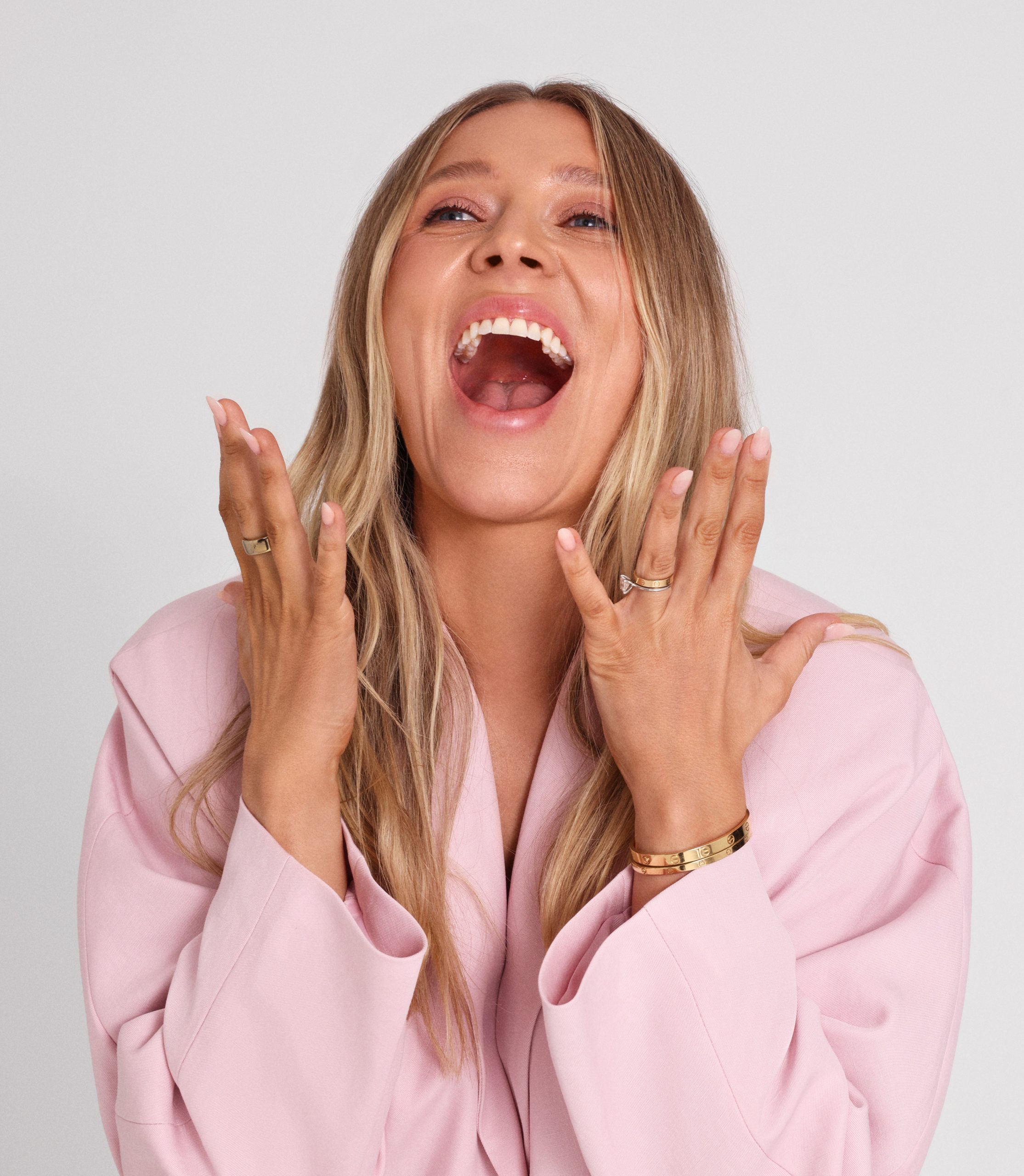
Margarita Nazarenko doesn’t define herself in any singular way. A woman. A wife. A mother. A thinker. An artist. She is all those things and more. As she discovered throughout her life. But perhaps the most accurate description is that she’s a problem solver. Someone who finds the symptom and cause to the issues that people currently face, particularly women who navigate their personhood and relationship with the world. And of course, their dating life. It is this exact principle steeped in Margarita’s own experience and education that compels her to act as a window for women to ask the questions that they have been dying to ask, thus providing them a mirror for reflection and answers to potentially transform their life into the direction they seek.
With over millions of viewers online through a loyal following, Margarita has built up a dedicated audience who find solace in her perspective as your average woman, yet one who comes from a place of security and growth to feel comfortable to trust her state of mind. But it wasn’t always this clearcut. At one point she herself was an anxiously attached personality, who like many others struggled with navigating her sense of self and understanding of love itself, put into practice at least.
By working on her own perception of human connection and self-assurance, she soon quickly passed on her knowledge to her viewers online which have been more essential than ever before in this dire dating climate, where people don’t seem to know what they really want. Enabling vague dynamics like ‘situationships’ or ‘talking stages’ to exist that are at risk of not going anywhere. The convenience of everyday access and casual has stripped the fundamentals behind intimacy and commitment which Margarita chooses to address in her book.
1883 sits down with Margarita to discuss her new book Unbothered and how she perceives human relationships, female perspective and the reality of dating in 2026.
Who is Margarita Nazarenko?
Margarita today is someone who’s trying to be unbothered, as the book says, but in daily life, I figured out relationships and men, and I studied that. But I’m just trying to figure out work, motherhood, timing and success while being a mom, and all these things. So today, Margarita is a little bit flustered, but she will figure it out and probably write another book when she does.
What kind of artist and thinker are you? How do you see the world and why do people feel so interested in your world?
I think I am a combination of both, an average woman who faces average women’s issues, but I have this old man brain on me, so I like to think of myself not necessarily as a thought leader, because that is very bombastic to say that you’re a leader of something. I like to take problems that women have, whether that’s anxious attachment or focusing on chasing the wrong men.
All these issues that come up often for women, I try to break those cycles. To try and break through them for women in ways that are either viral, and the reason for the virality being important is because it travels further, so more women see it, and then they can enjoy the deeper work in the books, or the masterclasses, or the courses. I don’t think of myself as a creator, or a content creator, or even a writer, or even a podcaster. All of those are mediums in order for me to communicate to women the message that I want them to hear, and that is, every problem has an interesting strategy and solution to it.
In 2026, what do you see as a solution to dating?
I don’t think anybody can globally solve the issue of dating, and that is that we have too many choices. There are too many dating apps. This is a problem not just for dating, but this is a problem in human existence. We don’t have tribal communities anymore where someone can introduce you to someone. Even the struggles I’m having today with childcare while I’m working, which is irrelevant to this conversation, but the community would solve that issue as well. Dating could be solved in the community.
We live in such small microcosms of disconnected, white picket-fenced realities that we are struggling to form relationships, and looking through apps like a catalogue is not going to make you connected to someone or like someone. What you think you might want in a partner is not necessarily what you would like if you saw it in real life. So, the dating solution and all of the problems we have are more about community and being together out in the wild, as opposed to on the phone.
In our lifetime, we see more people across the world than any human previously in history had. We have access to 8 billion people across the world whereas in the past, people would only see people within their own tribes or live in their own land. Humans are not used to that adjustment.
We’re not used to the amount of problems we see too. You go online and your brain is completely fried by the issues you see around the world. You’re not used to being able to not affect that issue. If we knew, for example, Robert in our village who was having a problem, we can go and help Robert, right? But now we can’t physically help people that we want to help, or connect with people we want to connect, and I think it’s another reason why creators and thinkers are so integral. I started creating my content that went viral from my kitchen with a t-shirt and no makeup, and all these things, and it connected with women because I think they imagined that they were my friend.
It was something that they could see as a connection between them. Whereas a masterclass I made recently where I hired a videographer, and it was polished and everything; all the comments underneath were AI. It wasn’t AI, it was me, but people are so allergic to anything that even leans towards polished, that I was like, I’m never spending money on getting production ever again. Fuck that, I’m just going to film on my iPhone.
The online space has blurred the lines of how we interact with people. Why do you think people feel so comforted by digital connections when there’s also that clear, lingering desire for wanting the older, analog world again.
I think it’s going to have to cross a precipice where something has to give, because we are almost at the point where it’s caused us so much discomfort that everything has two sides. Even when people are in bad situations, and you’re thinking, why is she dating that guy who is ignoring her or is not interested? That person is psychologically getting something out of it. It’s often things like they’re emulating a relationship they might have had with their father or someone who wasn’t interested, and they’re trying to solve it in that way. But right now, we’re getting something from being online. It’s comfort. It’s ease. It’s communication.
You and I can talk right now. We couldn’t have had this conversation 50 years ago, because you’re in London, I’m in Australia, but it’s that ease, so it’s comforting, and it’s inertia. That comfort is going to get to a point where all of those movies that we watch, post-apocalyptic people who are fat and unable to move like Wall•E, and we’re going to have to hit some kind of point where we’re so lonely, we’re so this and that and the other one, but people are going to try and invent things to make us enjoy the comforts of this for longer, like AI girlfriends and boyfriends. There is no reason why people won’t use them.
Of course they will, because it’s hard to battle with another person and their different mind, and their inadequacies, and everything that might be there in between that relationship. I see it all the time. My DMs are filled with but he said this, but my ChatGPT understands me.

There’s a trend nowadays where people who make videos or have an opinion to say tend to cite their sources from Substack or TikToks. They don’t reference books or studies like they used to do. People are regurgitating each other’s thoughts, while also believing that they are absolutely right, forming an opinion from so little research and effort.
People are also becoming very similar in their thought patterns and looks, even. I think that’s what makes it hard for relationships as well. Even if you look at actors in the 90s or 80s, actors who became famous. If I tell you Mel Gibson or Bruce Willis, you have an image of what that person looks like exactly. When you start to blend features, and I’m not saying don’t get plastic surgery. I don’t overthink it, and I don’t care what other people do to that extent. Do what you want to do.
But when thought patterns sound the same, as you just said, and faces start to look the same, and ideas start to sound the same, us as human beings, we are not that interested in pursuing a relationship because of this soup of sameness that you’re flicking through on your dating app. How are you supposed to differentiate where there is some interest?
Because attraction cannot be manufactured. Sometimes you’ll be out somewhere in real life, and you will see someone, and they are not your type; they’re not your usual humour. Everything could be completely different, and you find them attractive, so it’s not something you can manufacture.
How do you define when someone asks what your type is?
In my book, I think it was my previous one, The New Rules, and that was more of a dating anecdotal book. Unbothered is more of a nervous system regulation and anxious attachment book. I talk about the fact that people go very high in their preferences. A woman will say, I want a guy who is tall, dark and handsome. He has this kind of salary, and a man will say, I want a woman who’s under 25, the whole red pill talk, under this, this one, never had a boyfriend, whatever it is.
Those requirements are shallow in a way for both genders. But they will be very lenient, and I see this in my clients, with morals, values, ideas about their life. So, when somebody asks you what your type is, whether it’s a woman reading this or a man, I want you to start overlooking things like height and age, because you can be attracted to someone despite their height, age, weight, whatever it is, but you should be very strong on your moral compass and life outcomes.
A lot of the clashes that I see women have with men are when she suddenly discovers, after 10 years of dating, that despite him saying he wants to get married eventually, he never does. This should be something that you address, not asking them in an interview. You’re not sitting across from them, like, “Do you want to get married? How many kids do you want to have? What job do you want to have?” No, you’re saying it about yourself, and this is from a woman’s point of view. You’re saying, one day when I’m married and I have kids, I’m going to blah blah blah.
As the man listens, you’re going to hear the information that you’ve received, and it’s then up to you if you want to perceive that woman or not. A lot of women want to be likeable, they want to be good, as opposed to happy, and so they will produce information that they think a guy will like. She’s low maintenance. She’s very easy to be with. She doesn’t really want a long-term relationship, but that’s the thing that you should have a type about. Do you want to live in a certain city? Do you want to have a woman who stays at home? Do you want to have a man who…do you know what I mean?
These things are very hard to negotiate later on in life, and we have to negotiate them because back when we had villages around us, people would kind of know you, so someone would know the woman that you’re talking to, and they would be like, she’s really funny, or she’s this, or she’s that. Now it’s harder, you have to be quite upfront with your preferences, and lenient on the shallow ones, to be honest. Does it really matter?
They don’t, especially if you find your favorite person in the entire world. Nothing else really matters in that sense.
Exactly. And they’re your favorite person because of their personhood and also your vision of the world. She might be quiet, you might be loud, or whatever it is but the place you’re walking to together should have the same goal, and you should have the same moral compass, and the same idea about life.
In your book you advise women on the idea of letting go and moving on to find your own peace. How do you want readers to have that conversation through this book?
I think telling someone to let go is a very simple thing to do, but a very hard thing to achieve. Letting go is the precipice upon which everything that I see that is good happening to women in their lives stands on. Women have a problem these days in modern society with over-functioning and overdoing. They are overperforming, thinking that that’s going to get them some reward. Men have this too, but women, they generally do better at school. In studies, they outperform men at the moment. Women have a personality whereby they can sit through a lesson, they can perform at school, they can get the job now. We’ve broken through the ceiling. Some might say we haven’t, some would say we have.
We’re here, and we’re like, yes. I’ve made it, I’ve got the job, I’m potentially dating the guy, and they feel unfulfilled because what they’re doing is they’ve got the illusion of control. They’re trying to control a situation, which they really can’t. You can’t control if someone likes you. You can’t always control how things go. The idea of letting go and being unbothered. It is a viral term that my audience has coined with the content I made about letting go. It’s essentially detachment, which has existed throughout pages, Buddhism and everything. It’s throughout all the texts and it’s the idea that you can control the things you can, and you can’t control the things you can’t.
So trying to control other people, whether he messages you back, whether groups of people like you, whether your friends invite you is going to burn you out. It’s not going to get you to where you want to go. Everything good is behind the door of letting go, and the book has ideas of how to make that happen. Exercises, thoughts and directions for it. So, I hope that helps people.
What has helped you find your own peace?
The thing that has made it possible for me, and I never used to do is a thing I talk about called the pause. I’m still working on it now. I’m reactive, because I have an active mind. A lot of people who write or overperform, they have an active mind, and I’m always thinking of things. For me, the hardest thing is if you wrote something to me, I would react straight away. I’m very reactive, and a lot of women want a solution or a reaction, or something to be concluded, and they don’t use the pause. The pause is when something happens, you take 60 minutes. It feels like a crucially long time but to compute something and digest it, often the spike of emotion or adrenaline you have when something happens, it could be something mundane. It could be something big, it is not your reaction to the actual thing that happened. It is your reaction to your nervous system thinking that something else happened.
Let’s say I message you, you don’t hear a reply, your nervous system spikes because you think she’s ignoring me. She doesn’t like me, I must have offended her. That is you replaying an old story, maybe from the past, maybe from a friend you used to have, maybe from a work colleague. That is not the reality. Often when you use a pause in your interactions, you leave space for reality to manifest, whereby in 30 minutes, I would have texted you “Hey sorry, I didn’t see the message”. The more you do that, you’re rewiring your brain
to not expect catastrophe as soon as something goes wrong, so it might sound strange for a man, but a lot of women live on this edge of anxiety, like a rabbit in the forest.
I saw an interview recently with Jennie from Blackpink, and she was asked how she felt if someone doesn’t reply to a text in a while. She said that she’s fine with that and would assume that they are busy. She respects their time and know they will respond when they can. That sense of feeling unbothered by what’s going on around the world, and not seeing it as a reflection of yourself, rather a reflection of what they’re doing in their own time.
She’s got a secure attachment style which means she knows who she is, and she doesn’t attribute other people’s actions to her value or sense of self. A lot of anxiously attached people which is around 25 to 30% of the world. Or avoidant people who also feel the same feelings, but they avoid contact, feel that how other people treat them is an evaluation of their worth and value. Someone doesn’t reply to them, I’m a bad person. They don’t say it, they don’t vocalise it, they don’t even think it sometimes. It’s just a feeling they have. S
o, what we’re trying to do is develop a secure attachment, which means, you know you are a good person. They didn’t reply, and that must be on them. If this relationship continues, secure people are no longer interested in people who are not interested in them, whilst avoidant people and anxious people get more interested in people who treat them in these ways, because they are trying to control the situation and solve the issue, as opposed to understanding that it’s not about them.
I saw a post recently online that if you like someone, then it doesn’t make sense for you to show an avoidant attachment to that person. You should get along with them, and people reacted angrily towards that sentiment because it goes against the idea of what avoidant attachment is.
I made a whole podcast, and it’s a video on YouTube. People can search my name and then write avoidant, you will see a video on how to treat your avoidant partner if you want them to come and be closer to you. That video got so many comments if you read them. Backlash saying, ‘Why would you even try with an avoidant?’ Just dump them. That’s the whole internet. Just dump everybody and live by yourself under a rock. But what you need to understand is that avoidant and anxious are two different reactions to the same problem. Somewhere in your childhood, whenever it was, you felt unloved or unworthy, or you had to search for love or chase it.
An anxious person wonders what they did. They chase and try to get their parents’ attention. This is John Bowlby’s theory. They tried to get their parents’ attention, and they got the attention, and then they learned, which is how I grew up, that if they try hard enough, if they perform enough, if they do the thing enough. They will get that attention.
An avoidant person had either parents who were engulfing. That means that they were always monitoring them, watching them, wanting them to get good grades, really prying, or being really neglectful parents. When they’re avoidant, they decide that the easiest place to find security and happiness when they don’t feel it is within themselves. They just found a place in themselves that is comfortable, or in video games, or in books. So when a conflict comes up in a relationship, an anxious person will chase you for that connection, and an avoidant will find it difficult and go to that place where they are okay.
That doesn’t mean that they don’t want to be with you. That doesn’t mean that they don’t like you. It just means that problems trigger them like a hiding mechanism. That doesn’t make them a bad person, but it can lead to a special dynamic once addressed. Guess who gets together all the time? Anxious and avoidant people get together, because anxious people like to chase.
They don’t like to, but they tend to, and avoidant people like to hide. So, those two together wrestle in relationships, whilst secure people usually pair up together, because they find it hard to have the relationships that anxious or avoidant people have.
For someone avoidant or anxious, what advice would you give to find that security?
I like to talk from my angle of experience and expertise, so I was anxious in the way I was raised. I don’t present anxious, but I was anxious in terms of overthinking things. I now have a secure relationship, aka marriage, and my husband when I met him was very avoidant. You have any impactful conversation, he would not want to hear it, he’d walk away as opposed to having a conflict. He preferred to be alone, and we got together because I would chase the relationship, and he would avoid it, so it replicated that circle of attachment. As for how you work through it, and I know that people say it’s unfair, but I think it’s very good for the anxious person to see the pattern read books. Attached is a good book.
You can read my book if you want to, or you can just watch my videos for free. The anxious person has a pain point where they’re tired of being anxious and chasing. They’re actively tired. Avoidant people are quite comfortable avoiding and disappearing into whatever they do, so it’s hard for them to change because their pain point comes later in life when they’re lonely. For anxious people, they’re actively uncomfortable, so I started to act secure before I felt it.
When the message didn’t come, when he was not just my husband. It comes up in friendships. I didn’t chase their approval. I did all the things I talk about in my book and in my work. I acted secure. Through that, I saw a different algorithm appearing. When I act secure, the avoidant person comes closer to you, because you can’t have two things chasing each other. When an anxious person becomes more secure, people start to lean in towards you, and you start to reset your wiring in your brain to communicate that you don’t have to chase to be liked. You don’t have to always follow people up, you don’t have to always be likable, and the thing you’re searching for.
Love, attachment, all these things are actually on the other end of detachment. Letting go, being a bit unbothered. Being a bit looser with relationships, as in letting people be who they are, and then people actually lean into you more. So, I think if you are an anxious person, it’s quite easy to solve it if you can push through that discomfort.
With the recent information overload on conditions like ADHD and Autism, how has that helped to shape your understanding of dating, relationships and personalities?
It’s interesting because I’m not a clinician. I’m not a doctor, so to comment on something that I don’t have expertise in isn’t ideal. I was born in Russia, so all of these things don’t exist there. That’s a joke, of course they do, but I grew up in a very stoic way. My mum is like, depression, what is that? You’re not allowed to have those feelings, so of course there are spectrums, and there is autism, there is ADHD, but a lot of the diagnosis that happens there in the middle, just to talk about personality traits that we now have, or overconsumption and dopamine chasing on iPhones.
When my phone is not near me, I need to scroll something. The ADHD symptoms is a symptom of modern life. For me, I like to overlook those things, because it’s not my area of expertise and I just think modern life is making us symptomatic of a lot of things that ordinarily wouldn’t have been there.
Unbothered is out now in the US.
Interview Zakariya Ahmed
Photography Jessica Abraham