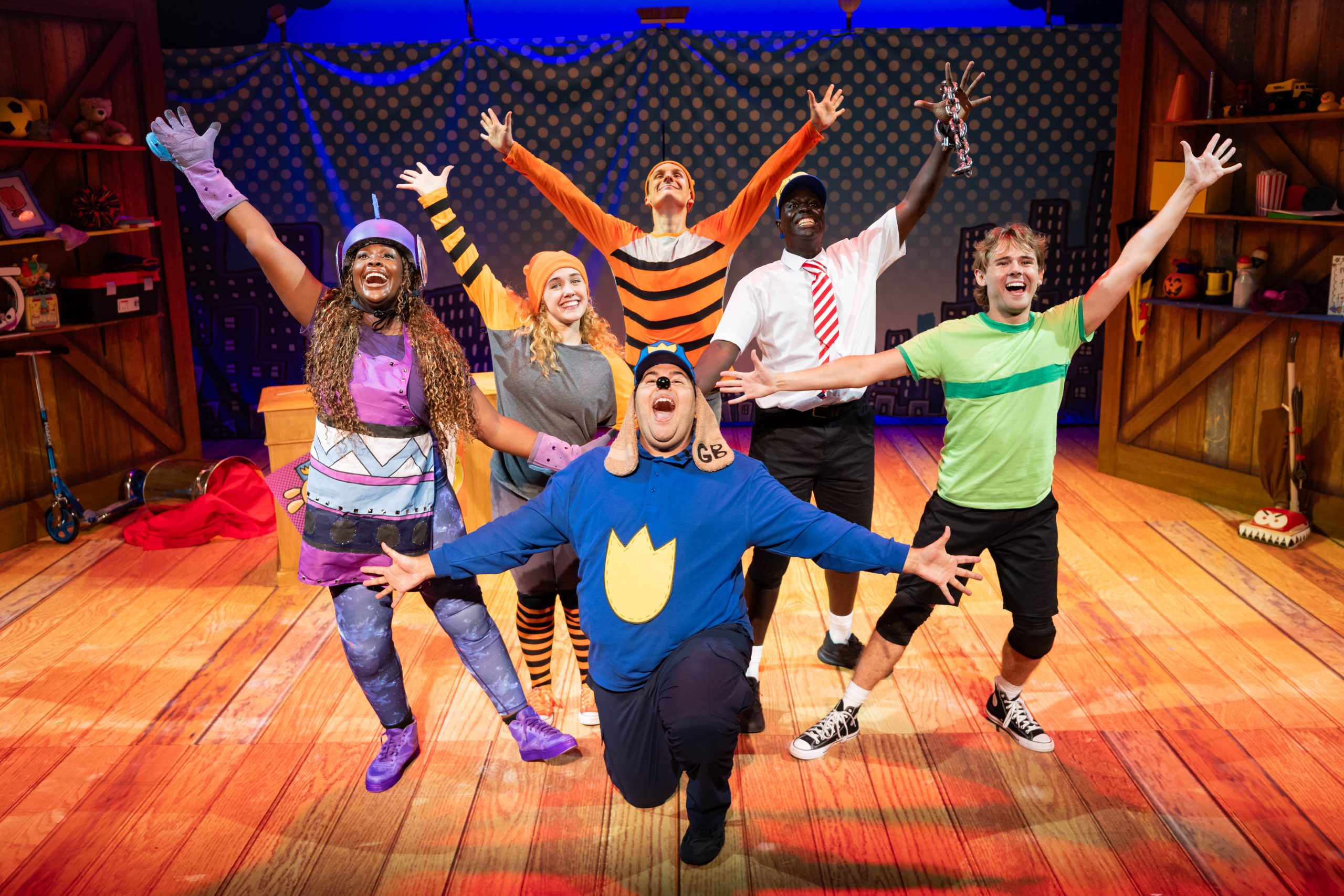
When Brad Alexander received the call asking him to compose Dog Man: The Musical, it was not simply another children’s adaptation landing on his desk. Of the thousands of titles TheatreWorks USA might have chosen, it had selected the one series his family already owned in its entirety.
‘We were obsessed,’ he remembers. ‘It wasn’t just one of the book series we had. It was the book series.’ His son was growing up with Dav Pilkey’s stories, and Brad’s immediate reaction had little to do with contracts or composing deadlines. ‘I almost dropped the phone. All I could think was, “I cannot wait to tell my kid.”’
Brad was already an experienced TheatreWorks USA composer, having created adaptations including Martha Speaks and Click, Clack, Moo with writer and lyricist Kevin Del Aguila. The pair knew how to transform familiar children’s books into live theatre, but this time they were starting with a world both of their families already loved.
That personal connection matters. Dog Man is not simply a hugely successful children’s property being transferred into another medium. For many families, Pilkey’s books are the stories that turn reluctant readers into avid readers. Brad saw it in his own home, while my own daughters found the same gateway through the series. Some adults remain dismissive of graphic novels, particularly books as anarchic and proudly silly as these, but Brad has little patience for the argument.
‘Some people think they aren’t real books,’ he says. ‘In this day and age, when you’re competing with social media, you take what you can get.’ More importantly, he argues, the books contain far more than toilet humour and comic-book chaos. They explore morality, loyalty, belonging, creativity, and whether even the most dedicated villain might be capable of change. ‘The themes are just so human and enlightening and funny. They explore all kinds of human psychology. They’re a beautiful gateway into reading for kids.’
Dav Pilkey’s books are frenetic, irreverent, and visually explosive, but the man Brad describes could hardly appear more different. ‘He is the most soft-spoken, kind, warm, gentle man you could possibly meet,’ he says. ‘He has a big, generous heart.’ Brad and Kevin had one initial phone conversation with Pilkey before starting work. Rather than surrounding his characters with restrictions, Pilkey told them about having allowed the creative team behind Captain Underpants the freedom to interpret his work and said he intended to offer them the same. His message was simple: ‘Spread your wings.’
There was only one condition: Dog Man could neither speak nor sing.
The challenge was preserving everything readers loved about Pilkey’s world while building a musical around a hero unable to use his own voice. It is an unusual limitation when the silent character is also the title character and the figure audiences have arrived to see, yet it helped reveal where the emotional story should ultimately lie.
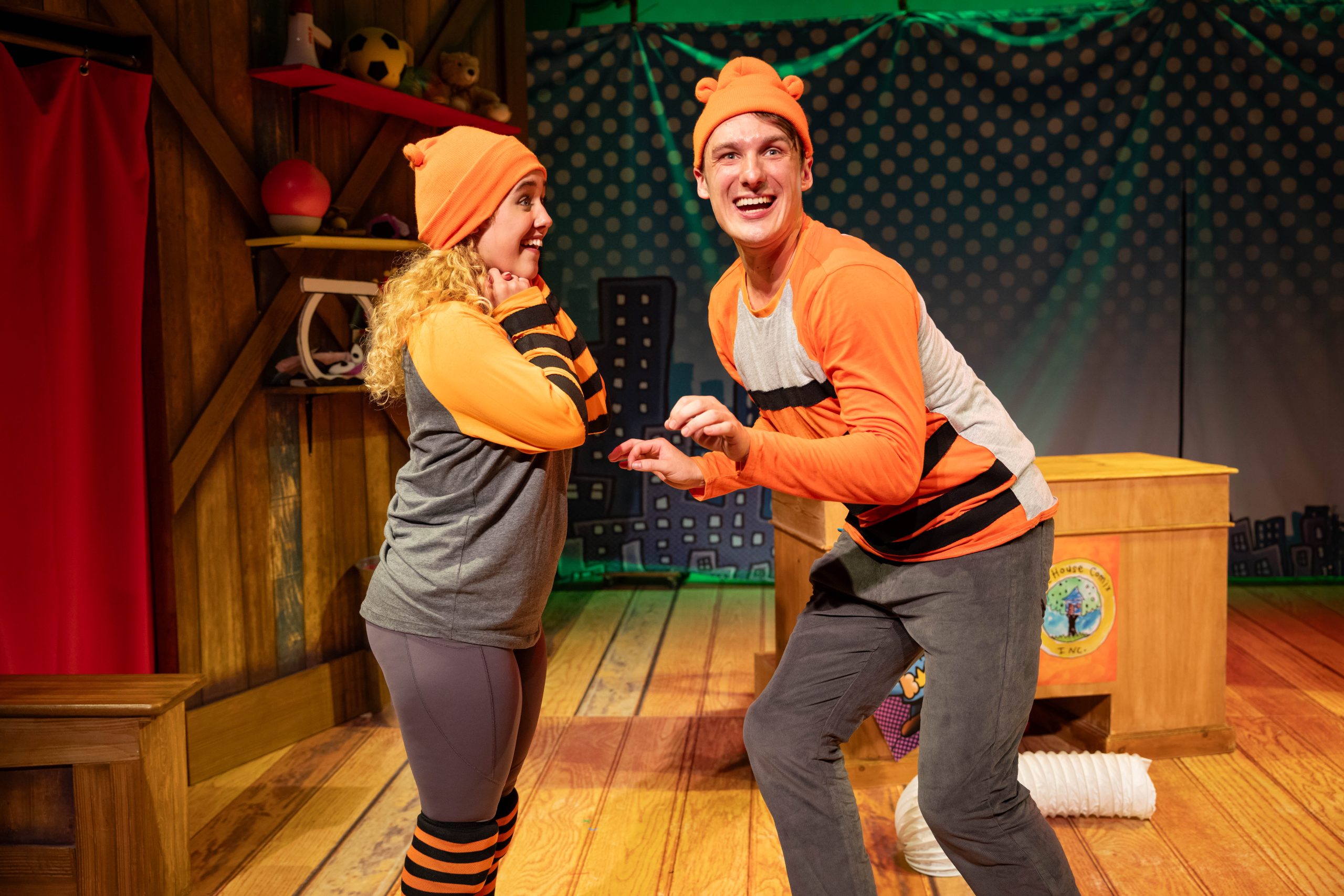
‘You could argue that it’s really the story of Li’l Petey and Petey,’ Brad says. ‘Dog Man is almost added colour.’ Dog Man still has his own journey, but after the musical establishes his famously ridiculous origin story, its emotional centre shifts towards Li’l Petey. Created in a laboratory as a clone of the villainous Petey, the kitten is rejected after proving kind, curious, and entirely uninterested in evil. He then meets Dog Man, another scientific misfit whose origins place him outside any conventional idea of family.
That shared difference creates their bond. Li’l Petey speaks and sings where Dog Man cannot, giving voice to their relationship while Dog Man gestures, reacts, and occasionally produces something approaching a musical howl. ‘It becomes about mentorship,’ Brad explains. ‘Li’l Petey was made in a lab. He’s an outcast, a scientific misfit. When he meets Dog Man, that’s their bond.’ The result is a musical carrying Dog Man’s name whose deepest journey belongs to the small orange kitten who eventually becomes Cat Kid.
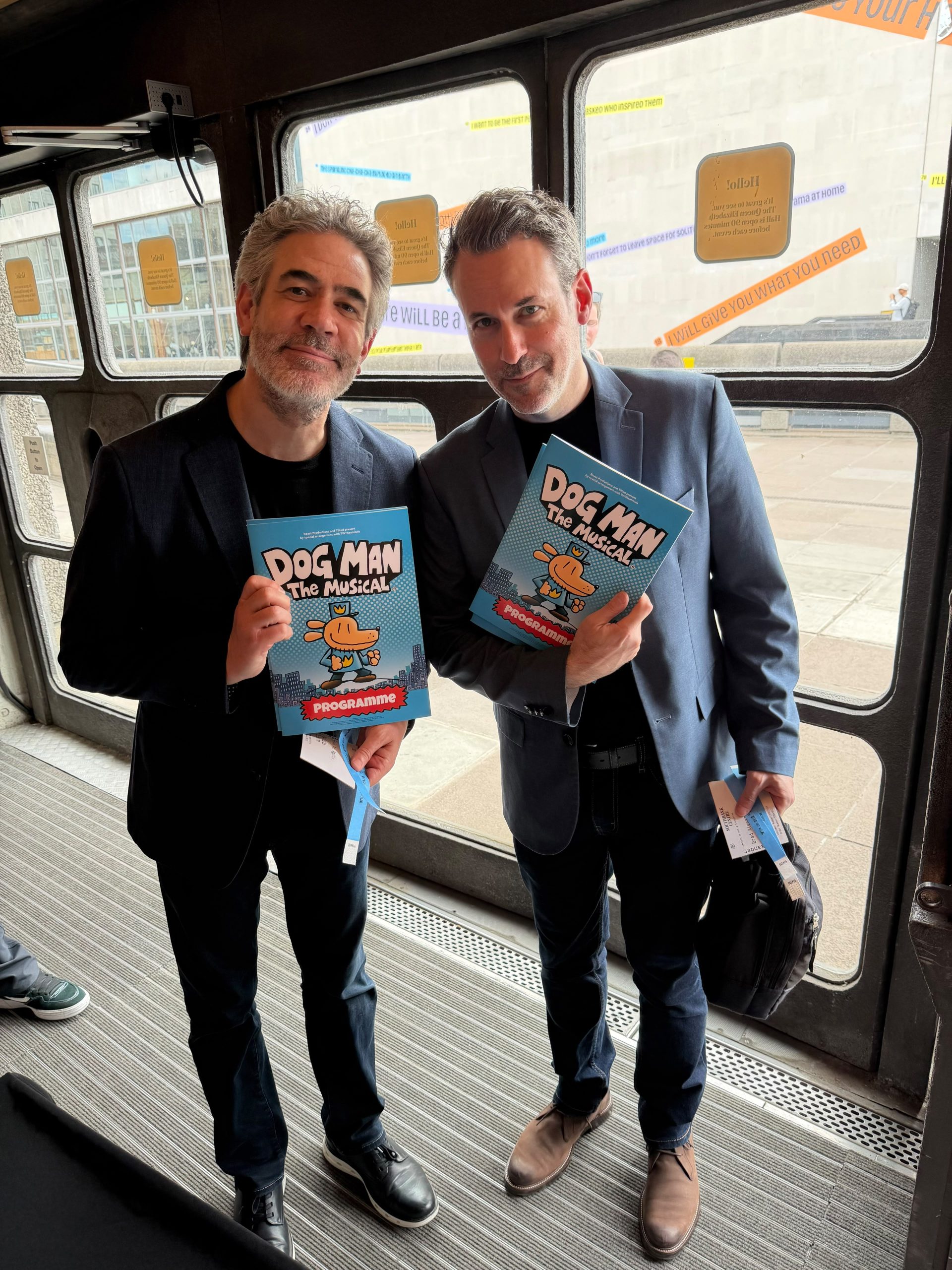
The creative solution was Brad and Kevin’s to find. True to his invitation to ‘spread your wings’, Pilkey did not hover over the process or attempt to steer it at all. After that initial conversation, he stepped away until attending a developmental workshop in New York, where the show was performed with minimal costumes, a piano, and little theatrical decoration.
His presence felt a little intimidating to the creative team, but his response quickly dissolved that tension. ‘He was laughing. He was crying. He was very moved because it was the first live theatrical adaptation of his work.’ Rather than witnessing an expensive spectacle, Pilkey saw what Brad describes as a ‘no-frills, very honest love letter’ to his books.
Brad also sees a natural connection between Pilkey and TheatreWorks USA, whose mission is to bring theatre to young people and communities who might otherwise struggle to access it. ‘Dav’s mission is to give children an opportunity to read and explore morality,’ he says. ‘What does it mean to be a good human being? Those two things lock together like puzzle pieces.’
Before Brad wrote a single song, he began trying to locate the internal rhythm of Pilkey’s world. ‘I start to channel it and vibe with it,’ he says. ‘I can get inside the psychology and the feel of it.’ The books provided plenty of clues. Pilkey’s stories are filled with references to the popular culture of the 1970s and 1980s, from buildings named after Hall & Oates to titles parodying classic novels. Adults recognise jokes that pass entirely over their children’s heads.
Brad wanted the score to reflect that combination of childhood chaos and grown-up cultural memory. The musical draws on pop, rock, cinematic scoring, and moments of heightened classical melodrama. ‘There needed to be a bit of classical, angst-ridden, melodramatic sound,’ he says. ‘Then rock and roll, pop, and cinematic film-score music.’
The relationship between comic books and musical theatre soon became obvious. Comic books exist in a heightened state. Anger is not expressed through a restrained glance; it fills the page. Characters shout, leap, crash, and transform. ‘Musicals also exist in a very heightened state,’ Brad says. ‘Characters bursting into song felt like a natural fit for these graphic novels.’
That does not mean matching every villainous action with sinister music. When Flippy, the evil fish villain, returns to life and prepares to wreak havoc across the city, the character launches into an upbeat, feel-good number. From Flippy’s perspective, everything is going brilliantly. ‘If we had made it sinister, it would have been a little on the nose,’ Brad says. ‘We were trying to play against the evil. If you’re in a musical comedy, a villain should have a good comedy number.’
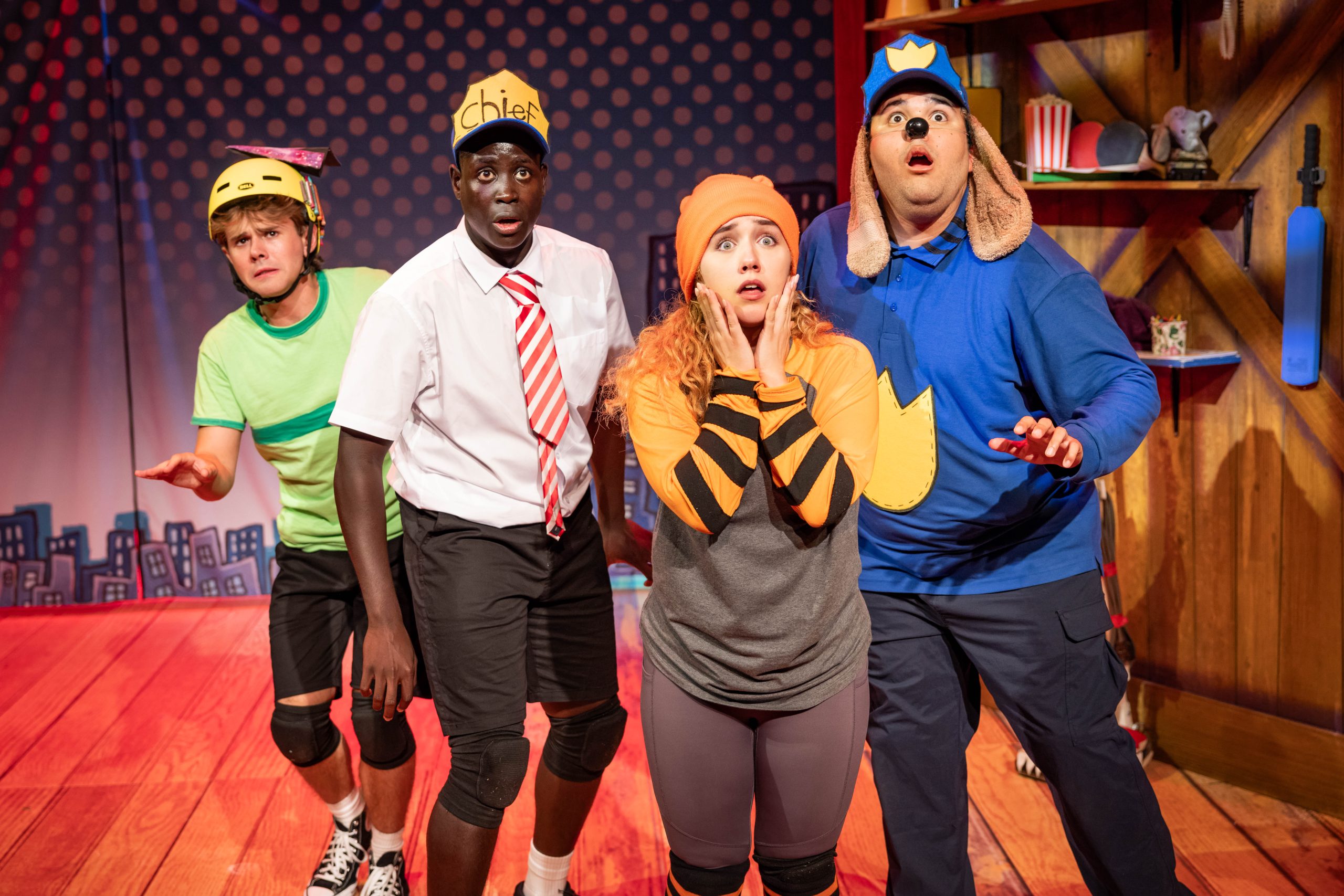
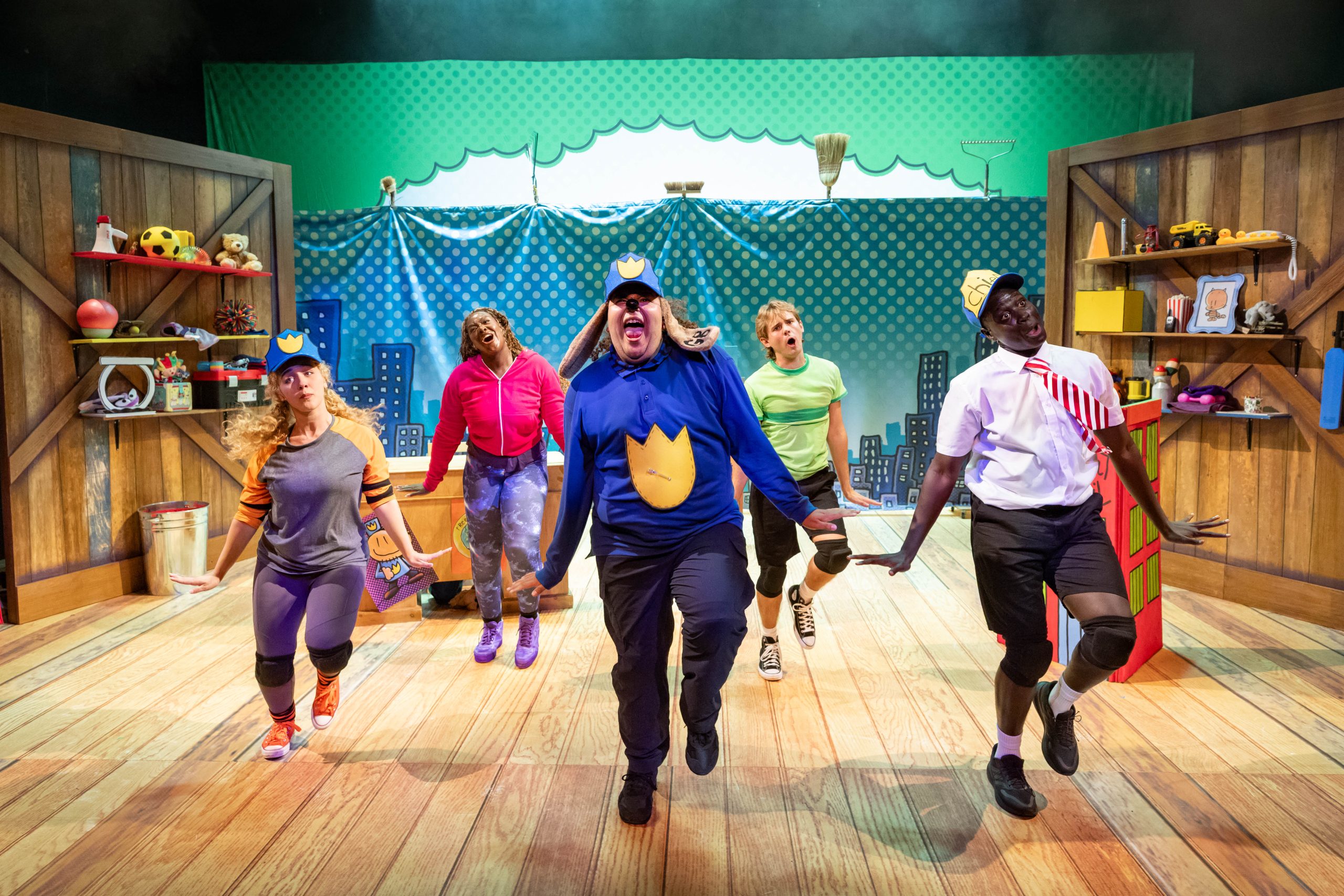
Dog Man may not sing, but he still has a musical identity. Brad first found the character’s theme while standing on a New York subway platform, before the score had properly taken shape. The motif now returns whenever Dog Man performs a heroic act. Flippy has a theme too, appearing in the underscoring when the character is introduced and returning within the song ‘I’m Back’.
Both can be heard in the short instrumental sequence that begins the show, which Brad named the ‘Underture’. An overture traditionally introduces melodies that will appear throughout a musical, but his version needed to perform a similar function while respecting the attention span of an audience filled with young children. ‘The lights go down and the kids would be sitting there for three minutes listening to instrumental music, wondering what the heck is going on,’ he says.
The piece was reduced to under a minute for the production, hence ‘Underture’. Only later did Brad discover that The Who had previously used the same title. He still hopes to release the original extended version as a bonus track, describing it as his own personal equivalent of the ‘Snyder Cut’ (IYKYK).
The anarchic surface of Dog Man works because it is grounded in sincere emotion. ‘If you can mine the humour and the story, great,’ Brad says. ‘If you can also find the heart and soul of the show, then you’ve got a real winner. Life isn’t just laughs. It’s all the feelings.’ That heart appears most clearly in ‘The Perfect Mashup’, where Dog Man and Li’l Petey meet and begin to form their friendship. The song contains jokes, but its final emotional beat is genuine.
‘It’s really happening,’ Brad says. ‘It’s a true friendship. It’s not an ironic friendship or a wink-wink friendship.’ Elsewhere, Flippy undergoes a transformation that is simultaneously ridiculous and moving. Brad praises Kevin and Pilkey for creating moments in which audiences find themselves ‘laughing through tears’ or ‘crying through a laugh’.
Comedy and emotion require different musical priorities. A comedy song needs a clear set-up and punchline, with the music supporting the lyrics rather than overwhelming them. ‘It has to be a platform for the lyric,’ Brad says. ‘That doesn’t mean it can’t be tuneful and catchy, but it can’t be about the music.’ A dramatic song may work in the opposite direction, with the music arriving first because the composer is searching for a feeling before the words have fully formed.
That balance creates an ongoing negotiation between Brad and Kevin. They did not write every part of Dog Man sitting together at a piano. Kevin developed the story’s architecture, identified song moments, and often handed Brad large sections of lyric. Brad might love a joke but need it to be eight syllables shorter, while Kevin might have imagined a rhythmic pattern that was not apparent on the page. Sometimes Brad’s music revealed an entirely different interpretation of the words.
‘Kevin has such musicality himself,’ Brad says. ‘Sometimes I’ll ask him to rhythmically tell me what he had in mind. Other times, I’ll set it in a way he hadn’t considered, and he’ll really like it.’
Children, of course, do not politely pretend to be engaged. TheatreWorks USA builds that honesty into its development process, inviting groups of children to watch early versions of new productions while the creative team sits at the back and studies their reactions. ‘When a ballad starts in a musical, kids start to tune out,’ Brad admits. ‘It’s just the reality of it.’
That may mean increasing the tempo, strengthening the rhythm, or altering the orchestration, but it does not mean removing emotional complexity. Brad and Kevin largely write material they themselves find funny, trusting that children and parents will respond on different levels. Pilkey’s books already function in much the same way. A child may laugh because Li’l Petey keeps asking ‘why?’; a parent laughs because they have survived that conversation hundreds of times.
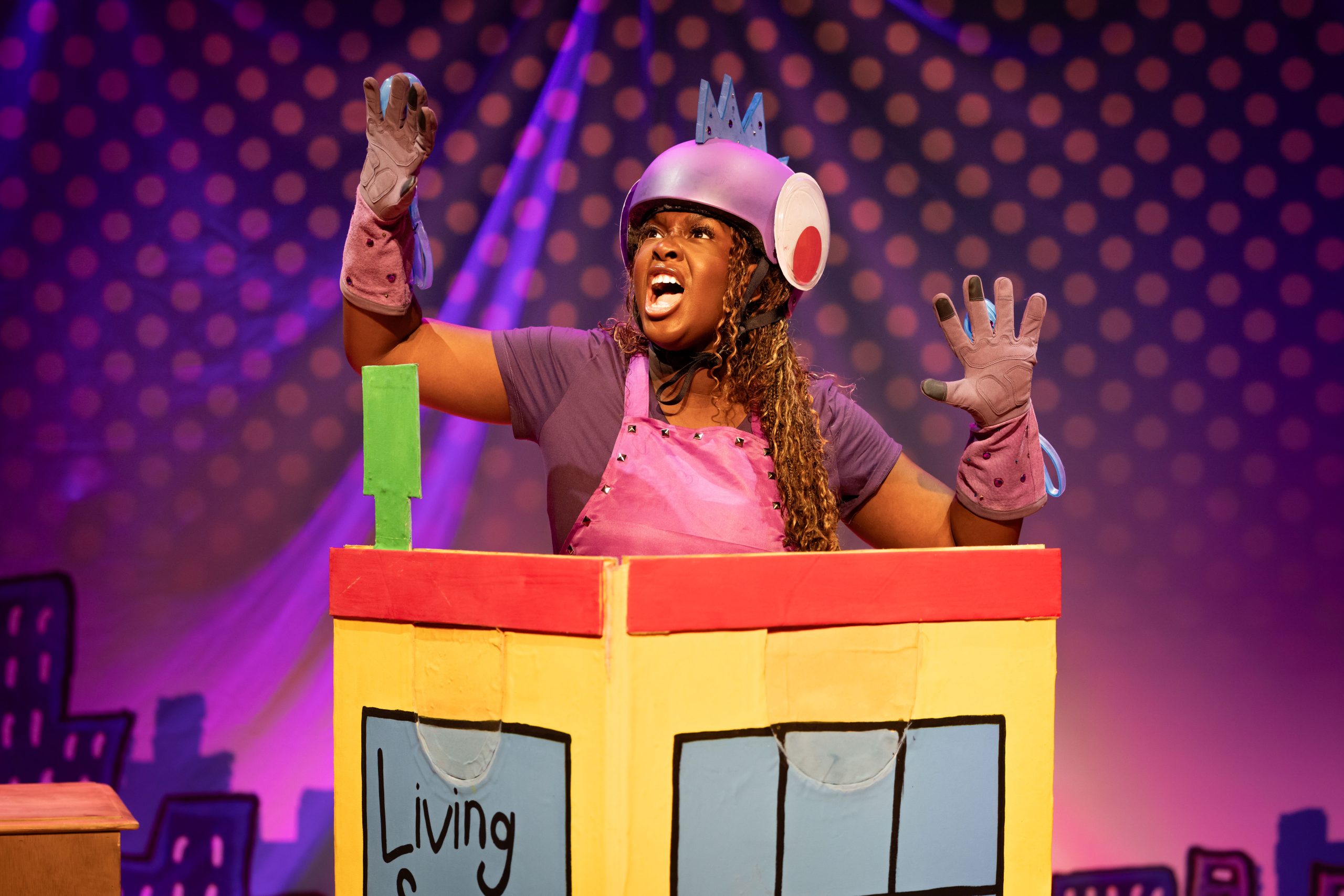
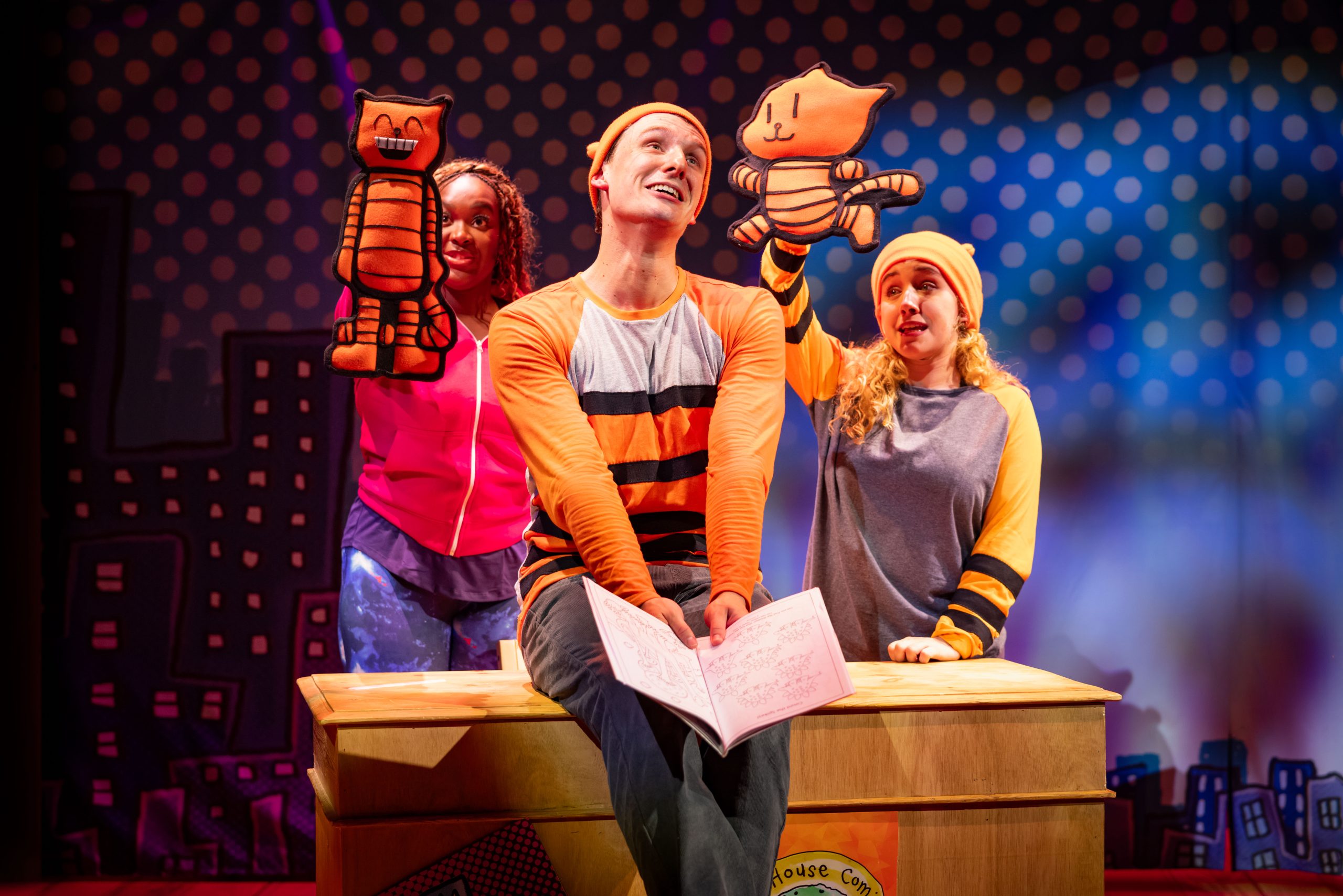
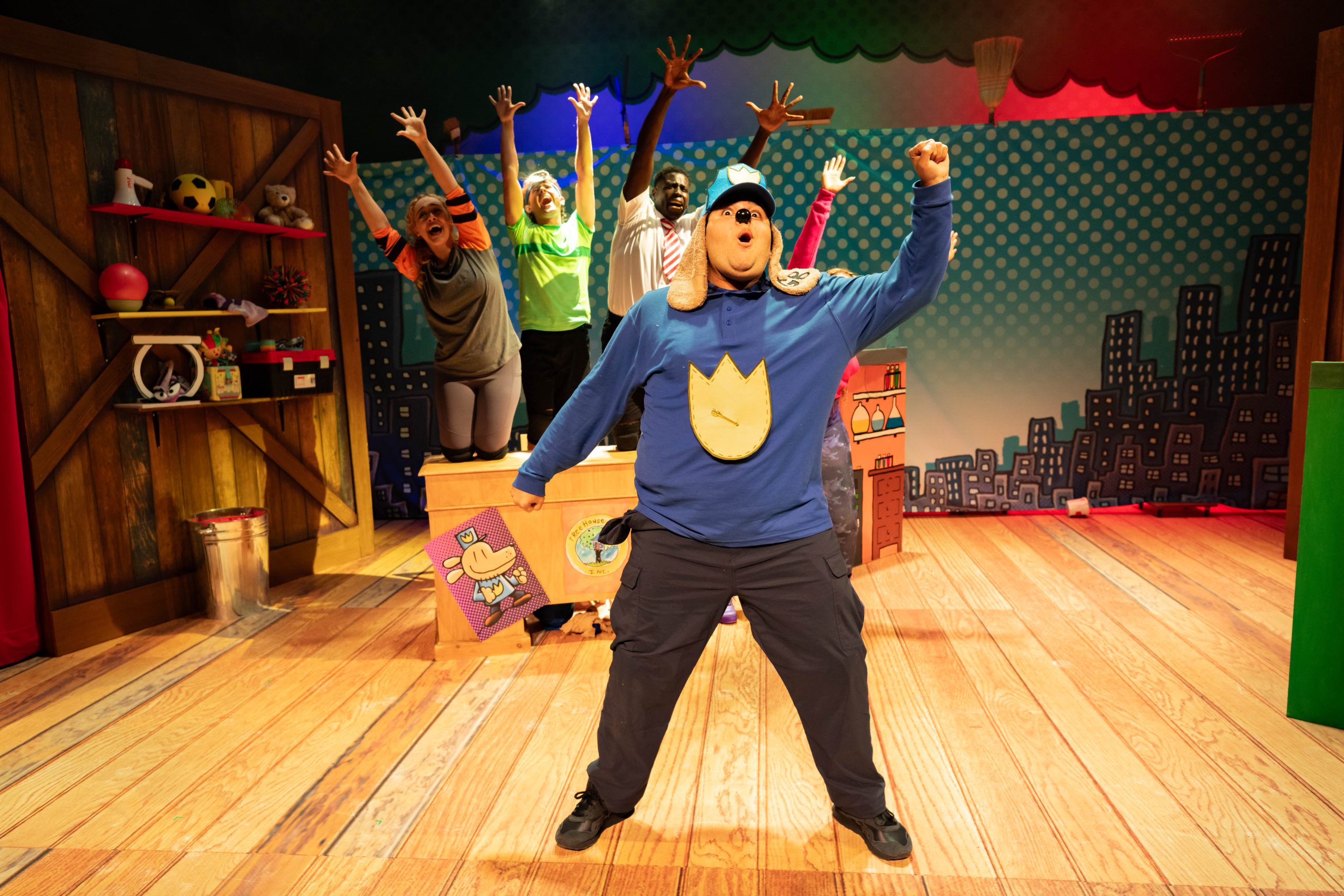
‘Now you have both the kid and the parent laughing,’ Brad says. ‘Then there’s humour that goes right over the kid’s head, but the parent is laughing. Everybody starts laughing together. That creates memories and connections.’ This is why TheatreWorks USA describes its work as theatre for young audiences rather than children’s theatre. There are no obligatory singalongs or attempts to talk down to the crowd. ‘We try to take the Broadway or West End style, and present it to children.’
Pilkey has spoken publicly about having ADHD, and Brad received his own diagnosis around the time work on Dog Man began. Asked whether that shared perspective shaped his understanding of Pilkey’s world, he initially rejects the idea. ‘Anything we create for the stage is based on what we believe is the best, most exciting, most dramatic adaptation of the source material.’
Yet as the conversation develops, the answer becomes more complicated. Brad recalls being a child with poor impulse control, regularly interrupting lessons with jokes. After being told to remain behind by one teacher, he would draw a caricature of the man, usually imagining some elaborate act of revenge. The teacher would sometimes study it, laugh, and dismiss him without punishment. ‘I sort of drew my way out of trouble.’
Reading about Pilkey creating characters while being punished at school felt familiar to him. Perhaps, Brad concedes, there is something in the frantic rhythm of Dog Man that simply feels natural to him. ‘First we were over here, then we’re over there, now we’re interrupting the scene, then we’re running over here,’ he says. ‘Maybe that’s a natural inner biorhythm that just feels right.’
He returns later to an idea running throughout Pilkey’s work: the traits children are taught to see as shortcomings may eventually prove to be strengths. ‘What we think growing up are liabilities are actually assets,’ he says. ‘We don’t always know that until we meet the right friend, the right teacher, or read the Dog Man books.’
As Dog Man: The Musical reaches a new audience, Brad is curious to discover whether British children laugh at the same moments as those in North America. What does he hope families will be discussing afterwards? ‘First of all, I hope they’re not talking,’ he says. ‘I hope they’re singing.’
If they are talking, he hopes children will recognise something of themselves in Li’l Petey’s optimism, Flippy’s grumpiness, Petey’s difficulty expressing love, or Dog Man’s unconventional place in the world. The musical gives those characters a new dimension. Figures who once existed through drawings and speech bubbles now have bodies, voices, rhythms, and recurring melodies.
The creative team knew young fans would challenge anything that felt false. During one workshop, children immediately objected to a line that Petey ‘would never say’, and the line was rewritten. ‘The idea was to enhance this property,’ Brad says, ‘not alter it to the point where kids couldn’t recognise it.’
That may be the secret of Dog Man: The Musical. It does not treat Pilkey’s world as something that needs elevating or making respectable. It meets the books at their own strange, noisy, emotionally generous level, then asks what music can add: a heroic motif created on a subway platform, an upbeat anthem for an evil fish, and a tiny kitten singing out the feelings that a silent dog-man cannot express.
It’s part comic book, part musical, and all hero!
Dog Man: The Musical plays at the Southbank Centre’s Queen Elizabeth Hall until 16 August, before continuing on a UK tour through 2026 and into 2027. For full UK tour dates and tickets, visit the official Dog Man: The Musical website at Dogman.live
Words Nick Barr
Production photography Mark Senior